The First Meeting of the Second Session of the 9th Parliament has concluded after nearly two months of legislative activity.
The session which commenced on February 3, 2026, was characterised by key policy debates and the passage of some important bills.
This article takes a look at main highlights of the session.
State of the Nation Address
The State of the Nation Address (SONA) was presented by President John Dramani Mahama on February 27, 2026.
The Minority Caucus were clad in black attire and wearing sashes bearing the inscription “Cocoa Akuafo Yɛyɛ Mɔbɔ Dodo” to register their displeasure over what they described as the worsening challenges facing Ghana’s cocoa sector.
The Caucus later presented the pods to President Mahama and the Vice President, Professor Jane Naana Opoku-Agyemang.
The SONA triggered extensive debate on the floor of the House and set the tone for the session’s legislative agenda.
Barari DV Ghana Lithium Mining agreement
Parliament ratified a mining lease agreement between the Ministry of Lands and Natural Resources and Barari DV Ghana Limited for the extraction of lithium and other minerals at Mankessim in the Central Region.
The agreement grants the company a 15-year mining lease, which is renewable in accordance with the Minerals and Mining Act, 2006.
Parliament passes Legal Education Bill 2025
Under the terms of the deal, the government will hold a 13 percent free carried interest in the rights and obligations of the mineral operations, also the royalty rate on lithium mining will be determined in line with the Minerals and Mining Royalty Regulations, 2025.
Education Regulatory Bodies Amendment Bill
Parliament also passed the Education Regulatory (Amendment) Bill, 2026, to provide a more flexible and optional pathway to chartering for private tertiary institutions in Ghana.
The bill seeks to amend the Education Regulatory Bodies Act, 2020 (Act 1023), to dispense with the requirement of affiliated institutions to meet the six-year requirement to obtain a charter.
Value for Money Office Bill
The Value for Money Office Bill 2026 makes way for the creation of a new independent body tasked with strengthening oversight of public spending and procurement.
It seeks to establish a specialised institution aimed at embedding efficiency, transparency, and accountability across government expenditure.
24 Hour Economy Bill
Additionally, the House passed the 24-Hour Economy Authority Bill, a flagship policy initiative of the government. The bill establishes a dedicated authority to oversee the implementation of the 24-Hour Economy Programme, aimed at boosting productivity, job creation, and economic growth.
The Bill has been assented to by President Mahama. In his remarks after the signing, the president said, “Cabinet colleagues, I just appended my signature to give assent to the 24-Hour Authority Bill. This Bill, which Ghanaians have been waiting for, was one of our flagship strategies for economic transformation.”
He explained that the process took a while because the government had to ensure due diligence to give legal effect to the policy initiative.
Parliament votes to reject Minority motion to probe GoldBod, BoG losses
“Now we must move from strategy to implementation. The business sector is waiting, Ghanaian investors are waiting, foreign investors are waiting”, President Mahama added.
Legal Education Bill
The Legal Education Reform Bill, 2025, has been passed by Parliament to expand access to professional legal education in the country.
It seeks to establish the Council for Legal Education and Training to regulate professional legal education in Ghana and provide the curriculum and standards for legal education.
The bill will also end the monopoly of the Ghana School of Law over professional legal education and entrance examination.
JKB/VPO
'I was sacked like a goat' Henry Quartey fumes after being chased away at Newtown
General News of Monday, 30 March 2026
Source: www.ghanaweb.com
9th Parliament: Key highlights of first meeting of the Second Session
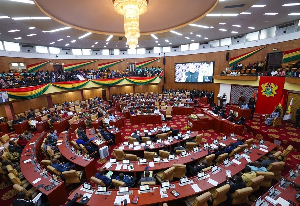 Parliament House of Ghana


Entertainment