Authors: Dr Nana Dadzie Ghansah (MOBA 84), Daniel Adu-Gyamfi (MOBA 90), Mawuena Agbenoto (MOBA 97), and Dr David Cornelius (MOBA 81)
(Historical Subcommittee of the Mfantsipim Sesquicentennial Anniversary Planning Committee)
“Our people in the Gold Coast (Ghana) no longer doubt our intention to establish better schools at our principal stations, Cape Coast and Lagos. For many years past, the cry of the people has been, ‘Give us better schools’…, “Rev. Thomas Picot to the Methodist Missionary Committee, 1874.
From its humble beginnings in the Cape Coast Mission House in 1876, Mfantsipim has weathered severe storms to become Ghana's premier secondary school. This synopsis traces that tumultuous 150-year journey.
Foundations: Wesleyan High School (1876–1888)
Mfantsipim began as Wesleyan High School on April 3, 1876, named after John Wesley.
Its establishment met demands from coastal elites and the Fante Confederacy for higher education beyond the elementary level, and the Methodist Mission's need for trained local agents.
Although early efforts by Rev Thomas Birch Freeman, Rev. Grimmer, and Rev. Henry Wharton faced setbacks from dysentery, sudden deaths, and the 1873 Anglo-Asante War, Rev Thomas Picot finally brought the project to fruition.
The school opened with James Picot, the superintendent’s 17-year-old brother as its first headmaster. On opening day, ten boys attended. They were:
•John Mensah Sarbah (future lawyer and Nationalist),
•William Fynn Penny (later Rev. Fynn Egyir Asaam; became the school’s first African headmaster).
• George Grant,
. Henry van Hien (became a wealthy merchant and Nationalist),
•William Fynn,
•Robert J. Hayfron,
•Benjamin Pine Wood,
•Samuel C. Crankson,
• Brodie Arthur, and
•John James Clement.
These foundation scholars were sons and wards of coastal merchants, clergy, and traditional rulers.
By 1880, a companion theological and teacher-training institution was underway, supported by pupil teachers trained in Sierra Leone. In 1884, headmaster Rev. Cannell extended secondary education by founding Wesley Girls’ High School.
Crisis and Resistance: Collegiate School (1889–1904)
In 1887, Rev Dennis Kemp assumed charge as head of the mission. Kemp openly opposed classical secondary education for Africans, advocating purely technical instruction and attempting to close the school.
When he transferred Egyir Asaam the school’s first African headmaster to Axim in 1889, local nationalists intervened. Led by J.W. DeGraft-Johnson, W.E. Pietersen, John Sarbah, and J.P. Brown, they formed a company, moved the students to Minnaux House, and reopened the institution as the "Collegiate School," initially headed by J.E. Casely Hayford and later by a returning Egyir Asaam.
Kemp resumed his offensive in March 1893 by gaining control of the school, exiling Egyir Asaam to Accra and attempting to merge it with his primary and technical schools.
The students walked out, and teachers resigned—Mfantsipim’s first recorded strike.
Though they were forced out of the Mission House to the old Colonial School on Saltpond Road, the school survived, and when Egyir Asaam returned in 1894, it thrived. However, after being suspended in 1896, he left the Church, and the teacher Albert M. Wright preserved the institution almost single-handedly through a revolving door of European principals.
In that time, a European Headmaster who did great work at the school was Rev. Barton. Present from 1900 - 02, he introduced the prefect system and the College of Preceptors examinations in 1901.
Its first honors graduates included Frederick Cann, future senior civil servant J.C. DeGraft Johnson (OBE), and Gaddiel Acquaah, who later became the first African Chairman of the Ghana Methodist Church.
The Nationalist Renaissance and Amalgamation (1905)
Exasperated by mission instability, John Mensah Sarbah and W.E. Sam established the "Mfantse National Educational Fund" in 1902 using funds from four Wassa chiefs who donated ten percent of their gold-mining concession royalties each.
In November 1903, they sailed to London and incorporated "The Fanti Public Schools Ltd" to raise money and to launch independent educational institutions in the Gold Coast.
On April 3, 1905, the company opened Mfantsipim at Coussey’s House. Old Boy J.B. Essuman-Gwira designed its iconic shield crest, incorporating a book (knowledge), stool and swords (authority and discipline) and industrial and farming tools (hard work and heritage). Mensah Sarbah coined the motto “Dwen Hwe Kan” ("Think and Look Ahead").
As former headmaster F.L. Bartels observed, the name symbolized a posuban a national sacred shrine where the masses would gather to spark an intellectual and cultural renaissance.
Seeing secular competition, the new Methodist chairman, Rev. A.T.R. Bartrop, negotiated a union.
Mensah Sarbah accepted on the condition that the merged school retain both the name Mfantsipim and its motto. In July 1905, Wright brought the Collegiate boys to join Mfantsipim, creating the unified institution we know today.
The "Faithful Eight" and Rev. Balmer (1907–1910)
The amalgamation soon faced financial obstacles. By late 1906, key patrons had died, shares lapsed, and teachers departed. By November 1907, enrollment had collapsed to just eight boys, with no master.
Arriving on November 11, 1907, missionary Rev. William T. Balmer met these boys and named them “The Faithful 8”:
* W.E.G. Sackey (Kobina Sekyi lawyer, nationalist, and playwright)
* W.E. Sacoom (entrepreneur)
* William Coleman
* Robert Smith Coleman
* John Intsiful (Harvard-trained dentist)
* John Doomson Odum (banker)
* Isaac W. Anaman
* Andrew Essien (surveyor)
Balmer revitalized the school. Preaching in Fante, relocating to Seaview House, restoring the teaching staff, and establishing the annual Speech and Prize-Giving Day in 1908, he increased enrollment to eighty by 1910.
His core vision guided generations: “I want to raise up a generation of men in the Mfantsipim School who will be brave enough to face the problems of their own continent, practically and unselfishly.”
Growth, "Richmond College," and Relocation to Kwabotwe (1911–1936)
Under Rev. Alec Andrews Sneath (1911–1919), the school relocated to Mount Hope and combined with ministerial training under the name "Richmond College" (modified after intense nationalist backlash to "Mfantsipim School at Richmond College").
Rev Reginald P. Dyer (1919–1924) reinforced rigorous discipline, expanded Ghanaian staff, and began eyeing Kwabotwe Hill, but the land was mired in litigation.
Rev R.A. Lockhart (1925–1936) proved to be one of the most transformative leaders in Gold Coast history. Lockhart firmly reverted the school's title to Mfantsipim School in 1927. When the colonial government slashed promised
building grants from £13,300 to £3,960, Lockhart rallied alumni, municipalities, and the Methodist Church to raise £40,000 for the project.
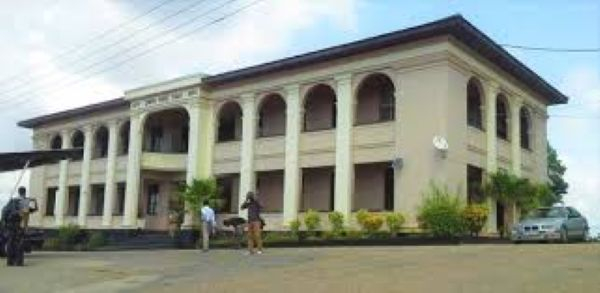
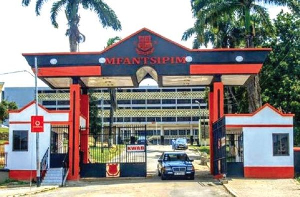
In January 1931, Mfantsipim took possession of its permanent home on Kwabotwe Hill, opening the Freeman, Sarbah, and Balmer dormitories, an assembly hall, and an administrative block.
Academically, Lockhart drove Mfantsipim to West African dominance in the Cambridge Local Examinations. He leveraged these top results to dismantle contemporary colonial racist theories regarding African intellect. He nurtured a stellar cohort of future leaders, including K.A. Busia, Joe Appiah, F.L. Bartels, and C.M.O. Mate.
Nationalist Stirrings (1936–1948)
The following decade brought acute disruption. The 1936 "Jam Strike" led by student Joe Appiah challenged domestic conditions.
World War II took a direct toll: headmaster Rev. Fenby was killed at sea by German bombing in 1941, and his successor Rev. Warren resigned due to physical disability.
The Gold Coast’s independence struggle reverberated across campus. Following the arrest of the "Big Six" in February 1948, Mfantsipim students sparked a strike that triggered early closures ("Monsoon Holidays") and the dismissal of dissident teachers and students. In Cape Coast, Kwame Nkrumah promptly established Ghana National College to absorb these expelled scholars.
The Golden Bartels Era (1949–1961)
In October 1949, Francis L. Bartels assumed the headmastership the first Ghanaian appointed substantive head in four decades. Bartels ended European administrative primacy and aligned the school with national self-determination.
Leveraging Kwame Nkrumah’s Accelerated Development Plan, Bartels erected modern science laboratories, dining complexes, and five new domestic dormitories: Balmer-Acquaah, Freeman-Aggrey, Lockhart-Schweitzer, Pickard-Parker, and Sarbah-Picot.
He pioneered the Sixth Form system (initially admitting Wesley Girls Sixth Formers), instituted high professional standards through CHASS, and cultivated an ethos of civic pride and moral courage.
Among the students shaped during his tenure was future UN Secretary-General Kofi Annan.
Bartels resigned in 1961 to join UNESCO amid increasing state intrusion in educational governance.
State Interference and Transition (1961–1976)
The post-Bartels period brought ideological friction. The Education Act of 1961 absorbed mission institutions into the civil service.
Headmaster Rev. W.G.M. Brandful resisted political indoctrination through the state-run Young Pioneer movement, leading to his dismissal in 1963.
His successor, noted author J.W. Abruquah, was abruptly dismissed in 1970 during the Busia government's civil service shakeup ("Apollo 568"). Acting headmaster O.K. Monney was similarly removed by the Acheampong regime shortly before the 1976 Centenary.
Despite state overreach, the school marked its 100th anniversary in 1976 under H.V.A. Acquaye-Baddoo by unveiling the monument to the Faithful Eight and building the Bartels-Sneath dormitory.
Modern Era: Resilience and Legacy (1977–Present)
Through severe national economic contractions and teacher departures in the 1980s, long-serving headmaster B.K. Dontwi (1980–1997) held the school steady. Subsequent administrators C.K. Ashun, K.M. Edjah, J.K.A. Simpson, M. Barton-Oduro, and current head Rev. Ebenezer K. Aidoo (appointed in 2020) guided the campus through major transitions from GCE O/A-Levels to the SSSCE and WASSCE systems.
As enrollment surpassed 3,000, the Mfantsipim Old Boys Association (MOBA) stepped in to fund ICT centers, sports arenas, classrooms, and newer residences (Abruquah-Monney and Brandful-Dontwi Houses).
Kwabotwe became a sporting powerhouse dominating national basketball championships.
The school also won the prestigious National Science & Math Quiz four times (1999, 2014, 2024, and 2025).
Beyond individual achievements, Mfantsipim served as the mother of Ghanaian secondary education.
It helped birth Wesley Girls' High School, Adisadel College, and Wesley College; its alumni became the pioneer headmasters of Prempeh College and Fijai; and its early sixth formers formed the foundational undergraduate nucleus of the University of Ghana at Achimota.
As the Sesquicentennial arrives, Lockhart's prophetic 1932 words remain fulfilled:
“In a few years the people of this country will be amazed at the number of its influential citizens who owe allegiance to this school.”
For 150 years, across eight campuses and through repeated existential trials, the school has raised men based on traditions it has never strayed from.
Traditions tested by time. These are foresight, thoughtfulness, altruism, community, courage, resilience, hard work, discipline, faith, and excellence.
And based on these traditions, we as Old Boys, together with the students, parents, and friends of the school, can only hope to keep the torch lit that April Day in 1876 burning bright, forever guided by John Mensah Sarbah’s timeless principle: “Dwen Hwe Kan.”
References
* Ayiku Jnr, M. & Cornelius, D. (Eds.). Memoirs of the Centenary Greenhorns. 2023.
* Bartels, F.L. Mfantsipim: A Headmaster Remembers. 2025; The Roots of Ghana Methodism. 1965; The Persistence of Paradox. 2006.
* Boahen, A. Adu. Mfantsipim and the Making of Ghana: 1876–1976. 1996.
* Doortmont, M. Pen-Pictures of Modern Africans. 1929.
* Kimble, D. A Political History of Ghana: 1850–1928. 1963.
* Tenkorang, S. "The Founding of Mfantsipim 1905–1908." THSG, 1974.
Samira Bawumia Stuns Audience with ‘Asaase Yaa’ Poem at Literary Night
Press Releases of Monday, 9 November 2026
Source: Mfantsipim School
150 Years of Mfantsipim: A short history
 Mfantsipim School, entrance