November 19 marks the anniversary of the death of Professor Kwesi Botchwey, one of Ghana’s most influential economic policymakers, whose 13-year stay at the Finance Ministry placed him at the centre of some of the country’s most difficult economic decisions.
The distinguished economist and former Minister of Finance and Economic Planning died on Saturday, November 19, 2022, at the Korle-Bu Teaching Hospital in Accra, where he was receiving treatment for a short illness.
His death brought an end to a remarkable career that stretched across academia, national economic management and international development policy. However, his contribution to Ghana's economic history remains closely associated with the administration of former President Jerry John Rawlings and the country's Economic Recovery Programme (ERP).
Appointed in 1982, Professor Botchwey inherited an economy facing severe difficulties. Ghana was grappling with high inflation, declining production, shortages of essential commodities, foreign exchange constraints and deteriorating public finances.
The country was also dealing with the consequences of years of economic mismanagement, political instability and declining export earnings.
It was against this background that Rawlings turned to the young legal scholar to help manage the country's economic affairs.
Botchwey became Secretary for Finance and Economic Planning under the Provisional National Defence Council (PNDC), a position he held during the military administration before continuing as Finance Minister when Ghana returned to constitutional rule in 1993.
He remained in office until 1995, making him Ghana's longest-serving Finance Minister.
His biggest assignment was helping formulate and implement the Economic Recovery Programme, introduced in 1983 with support from the International Monetary Fund (IMF) and the World Bank.
The programme sought to stabilise the economy, restore production, improve public finances, revive exports and rebuild Ghana's relationship with international financial institutions.
Under the reforms, the government pursued currency adjustments, trade liberalisation, public-sector restructuring and measures to control government expenditure. These policies helped restore economic stability and improve access to external financial support.
However, the programme was not without controversy. Although it helped reverse some of Ghana's economic difficulties, its implementation came with considerable social costs. Currency depreciation, rising living expenses, public-sector restructuring and pressure on household incomes became part of the difficult experience of economic adjustment.
This complicated legacy remains an important part of any assessment of Botchwey's time in office. His contribution cannot be separated from the difficult choices involved in attempting to revive an economy that was in serious distress.
Beyond his work under Rawlings, Botchwey established himself as an academic and internationally respected development policy expert.
He attended Presbyterian Boys' Senior High School before pursuing a Bachelor of Laws degree at the University of Ghana. He subsequently obtained a Master of Laws degree from Yale Law School and a doctorate from the University of Michigan Law School.
Before entering government, he taught at the University of Zambia, the University of Dar es Salaam in Tanzania and the University of Ghana.
His professional career also extended to some of the world's leading development institutions. He served as an adviser to the World Bank on its 1997 World Development Report and worked with the United Nations Development Programme (UNDP) on its Special Initiative on Africa.
He was also a member and chairman of the IMF's Group of Independent Experts, which conducted the first external evaluation of the Fund's Enhanced Structural Adjustment Facility.
After leaving the Finance Ministry, he continued contributing to discussions on African economic development, governance and policy reforms. He later served as Chairman of Ghana's National Development Planning Commission (NDPC) from 2009 to 2016.
Despite his international engagements, Botchwey maintained strong connections with Ghanaian politics. He remained associated with the National Democratic Congress (NDC), serving as a member of its Council of Elders.
His experience and standing within the party also led to his appointment to lead a committee tasked with examining the NDC's defeat in the 2016 general elections. The committee's findings subsequently became a subject of internal debate, with sections of the party calling for the report to be made public.
His death attracted tributes from political figures and institutions, reflecting the influence he had acquired beyond party politics.
President Nana Addo Dankwa Akufo-Addo, former President John Dramani Mahama and other prominent political figures attended his state-assisted burial service at the Forecourt of the State House in Accra on December 22, 2022. He was subsequently laid to rest at a private interment.
There was, however, some confusion over his age at the time of his death. Initial reports, including those from the Ghana News Agency, described him as 78, while a subsequent family notification to Parliament stated that he was 80.
Three years after his passing, Professor Kwesi Botchwey remains an important figure in Ghana's economic and political history.
His career represents a significant period in the country's transition from economic crisis to reform, as well as the complicated relationship between economic recovery policies and their social consequences.
For a man who spent 13 years managing Ghana's finances under two successive political administrations, his place in the country's economic history is difficult to overlook.
His legacy is ultimately one that invites both recognition and critical examination: the story of a policymaker who helped steer Ghana through an economic crisis, while overseeing reforms whose benefits and costs continue to inform debates about the country's development.
EA
General News of Thursday, 19 November 2026
Source: www.ghanaweb.com
Today in History: Remembering Kwesi Botchwey, Ghana’s longest-serving Finance Minister
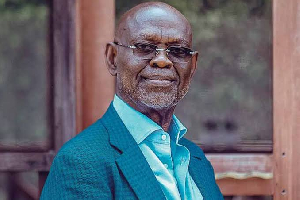 A photo of the Prof. Kwesi Botchwey