About 77 per cent of households surveyed in 10 communities in the Ada East District practiced open defecation, highlighting persistent sanitation challenges despite efforts to improve access to household toilet facilities.
The 2025 Population Mobility Mapping Survey conducted by the International Organization for Migration (IOM), involving 437 households across the communities, found that only 23 per cent of the households had pit toilets or latrines.
Benjamin Tetteh, the Environmental Health Officer at the Ada East District Assembly, said the findings showed that access to household sanitation facilities remained a major challenge in parts of the district.
Tetteh told the Ghana News Agency (GNA) ahead of the 2026 World Toilet Day celebration, although several communities had been declared Open Defecation Free (ODF), the practice persisted in some areas and required sustained attention.
He explained that inadequate household toilet facilities, financial constraints, socio-cultural practices, limited sanitation education, planning, and environmental conditions contributed to the problem.
Tetteh said the sanitation challenge was not limited to constructing toilets but required appropriate technology, household ownership, behaviour change, community participation, enforcement of sanitation by-laws and regular environmental health monitoring.
He identified the lack of proper building plans as a critical underlying cause of inadequate household sanitation, noting that the Assembly had an important role to play through its planning and development-control processes.
The environmental health officer noted that although several communities had achieved open defecation free status through collective action and community interventions, such gains could be reversed when household toilet facilities deteriorated, new households lacked toilets or monitoring and behaviour-change activities declined.
He called for intensified sanitation education in communities where open defecation remained prevalent and continuous monitoring of those that had attained ODF status and urged the assembly to strengthen enforcement of building-planning requirements and engage community leaders as sanitation champions.
He further called for women and girls to be actively involved in sanitation planning and decision-making while encouraging collaboration among the Environmental Health, Physical Planning, Works and Health departments.
The 2026 World Toilet Day, observed on November 19, is on the theme “Sanitation and Gender Equality”, with the campaign message, “Safe Toilets. Equal Futures.”
The occasion highlights the connection between access to safe sanitation, privacy, dignity and safety, particularly for women and girls.
Regional News of Friday, 20 November 2026
Source: GNA
Open defecation high in the Ada East – Survey
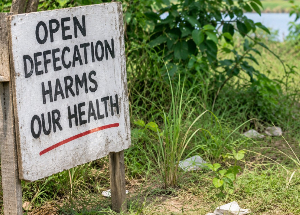 Open defecation is high in Ada due to inadequate toilet facilities