Chief Justice Paul Baffoe-Bonnie has announced plans to introduce a shift court system as part of broader measures to decongest Ghana’s courts and prisons, while cautioning judges against the routine imposition of excessively long custodial sentences.
To address these challenges, he announced that judges would soon begin sitting in morning and afternoon shifts under a new court system aimed at speeding up trials.
“We already have Sunday courts. We are not yet at night courts, but this is the beginning,” he noted.
The Chief Justice said the new system may require prison officers to present convicted and remand inmates earlier than usual to ensure the smooth running of proceedings.
According to him, prison congestion is being worsened by prolonged remand periods and sentencing practices that prioritise punishment over rehabilitation.
In a report by graphic.com.gh on February 5, 2026, the Chief Justice explained that prisons are primarily intended to reform offenders, but excessively lengthy sentences often defeat that goal.
Court congestion undermining justice delivery - Chief Justice
He stressed that although long sentences may be justified in some cases, they often undermine the reformative purpose of imprisonment.
“I have sentenced people to 70 years before. When I was a High Court judge, I gave Ataa Ayi 70 years, so I am not against long sentences. But long sentences really affect the prison population and, sometimes, they are counterproductive,” he said.
He observed that some judges had lost sight of established sentencing guidelines and disclosed that the Judicial Service would periodically engage officers of the Ghana Prisons Service to help orient newly-inducted judges on appropriate sentencing standards.
Justice Baffoe-Bonnie also attributed prison congestion to delays in the judicial process, particularly the lengthy time suspects spend on remand.
“It is not anybody’s wish that somebody stays on remand for so long, but because the courts are congested and other cases are prioritised, remand cases tend to suffer,” he said, adding that the growing number of remand prisoners continues to put pressure on correctional facilities.
He further revealed that special courts dedicated to cybercrime, human trafficking and cross-border offences would soon be established, citing concerns that some inmates continue to engage in cyber-related crimes while in custody due to the smuggling of mobile phones and electronic devices into prisons.
MRA/AE
Social media uproar as Ghanaians, Zambians clash over Mahama's fashion choices:
General News of Friday, 6 February 2026
Source: www.ghanaweb.com
Chief Justice announces shift courts to decongest prisons, courts
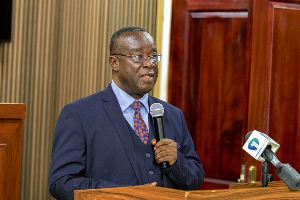 Paul Baffoe-Bonnie is the Chief Justice of Ghana