Watch as JJ Rawlings recounts how a 'sneaky' General made him add Afrifa to execution list
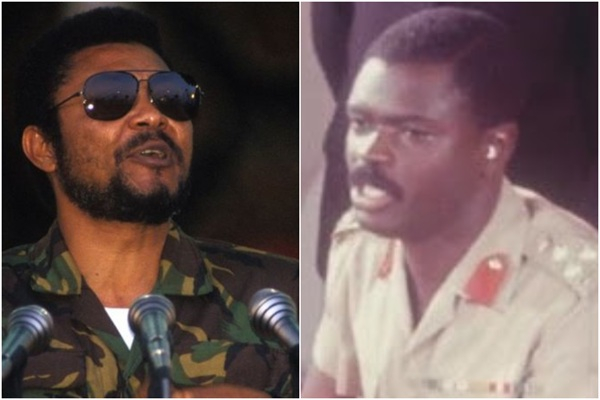
The late former President Jerry John Rawlings, before his demise, told the story of how an unnamed senior military officer influenced the decision to include former military head General Kutu Acheampong’s predecessor, General Akwasi Amankwaa Afrifa, on a list of military officers to be executed in 1979.
JJ Rawlings, speaking in an old interview with veteran journalist Kwaku Sakyi-Addo, said that Afrifa was initially not part of the list of officers earmarked for execution following the June 4, 1979 uprising.
According to him, Afrifa had earlier been detained after what he described as “provocative conduct” but was later taken to hospital after falling ill.
He said that after Afrifa recovered, he instructed that the former military leader be allowed to return home.
“I had him locked up, and he wasn't feeling too good. So I said they should send him to the hospital. And after he recovered, I remember very well... I said, let him go home,” Rawlings recounted.
However, Rawlings said the situation changed when he visited a senior general he held in high regard shortly before the executions were carried out.
He said that he had gone to show the general the list of officers who were to be executed and was in an emotional state because efforts to prevent the executions had failed.
Rawlings said that while sitting with his back to the general, he heard him ask: “And where's the rogue? Where's the rogue?”
The former president said he was initially confused by the remark until the general identified the person as General Afrifa.
“He said Afrifa had been advanced a good load of money to wage a campaign against Acheampong's government,” Rawlings said.
Rawlings said the general claimed the money had allegedly come from an establishment within a Western organisation and that, instead of using it against Acheampong, Afrifa had allegedly used it to remove another politician, whom Rawlings identified as Mr Power-Wili, from the leadership of the United National Convention (UNC).
Rawlings stressed that he could not independently confirm whether the allegations were true.
“Whether it happened or not, I don't know,” he said.
Despite his uncertainty, Rawlings said he accepted the general's account at the time because of the high regard in which he held the officer.
“I used to hold him in such high esteem,” he said.
‘I saw through what he did later’
Rawlings said he later came to believe that the general had a personal motive for wanting Afrifa removed.
According to him, the general may have felt “upstaged” by Afrifa's role in the 1966 coup that overthrew Ghana's first president, Kwame Nkrumah.
Rawlings said the unnamed general had previously considered himself a rising star and a key contact for Western intelligence organisations, but Afrifa's prominence after the 1966 coup may have altered that position.
“I was a little naive also around that time. It wasn't until later that I saw through what he did,” Rawlings said.
I would love to go to Rawlings’ grave and pay my respect - Pete Edochie
He added that the general may have wanted Afrifa out of the way because of the latter's prominence.
‘Afrifa was not on the list’
Rawlings was asked directly whether Afrifa's name would have appeared on the execution list if not for the general's intervention.
“No,” he replied.
He said that when the list was initially compiled, Afrifa was not among those selected for execution.
“When we combined the list, none of us had him in mind,” Rawlings said.
He explained that Afrifa had already been detained, sent to hospital and subsequently released, indicating that he had not been part of the original plan.
Rawlings said the senior general's intervention therefore changed the situation.
He also recalled another conversation with a junior military colleague while discussing plans surrounding the overthrow of General Fred Akuffo's government.
According to Rawlings, he had suggested that the unnamed general was one of the competent officers who could be brought back into government because he believed the officer could help restore discipline within the military.
But the colleague reportedly rejected the suggestion, describing the general and others like him as “holier than thou characters”.
Rawlings said the response surprised him because he considered the general a competent officer at the time.
‘The number of attempts he made on my life’
Asked whether the same general was still alive and whether he remained his friend, Rawlings responded in the negative.
He then made a further allegation against the unnamed officer, claiming that the general had subsequently made several attempts on his life.
“No, no, no, no, no! I've... You must, you know. In a way, I was a little naive also around that time,” Rawlings said.
He added: “He's a survivor. He's a survivor. The number of attempts he made on my life.”
Rawlings did not provide details of the alleged attempts during the interview, instead directing viewers to his forthcoming book for further information.
“Read my book when it comes out,” he said.
Asked whether he hoped the general would be alive to read the book, Rawlings replied: “Yeah, I hope he will be alive to read it.”
Watch the interview below:
BAI
Inside Ghana’s Abandoned Engineering Powerhouse: What Went Wrong?
Source: www.ghanaweb.com« Previous |
Next »