This blog is managed by the content creator and not GhanaWeb, its affiliates, or employees. Advertising on this blog requires a minimum of GH₵50 a week. Contact the blog owner with any queries.
Western Blog Blog of Tuesday, 26 August 2025
Source: Thomas Tetteh
Prof. Michael Affam Proposes Ore Sand as Sustainable Solution to Mining Waste and Sand Scarcity
- Share:


The Dean of the Office of Research, Innovation and Consultancy at the University of Mines and Technology (UMaT), Prof. Michael Affam, has called for the adoption of ore sand from mine waste as a viable solution to Ghana’s growing fine aggregate scarcity and environmental degradation caused by excessive sand mining.
Delivering his professorial inaugural lecture on the topic “Ore Sand: Critical Circular Solution to Address Huge Mine Waste Challenges and Fine Aggregate Scarcity” at the UMaT Auditorium on August 14, 2025, Prof. Affam warned that the rising global demand for sand, driven by infrastructure development, has placed severe pressure on natural deposits along beaches, riverbanks, and landmasses.
He cited United Nations Environment Programme (UNEP) reports that rank sand as the world’s second most exploited natural resource after water, and the World Bank’s findings of severe sand depletion along West African coasts due to illegal mining. Without intervention, he said, “natural renewal will not match the rate of extraction.”
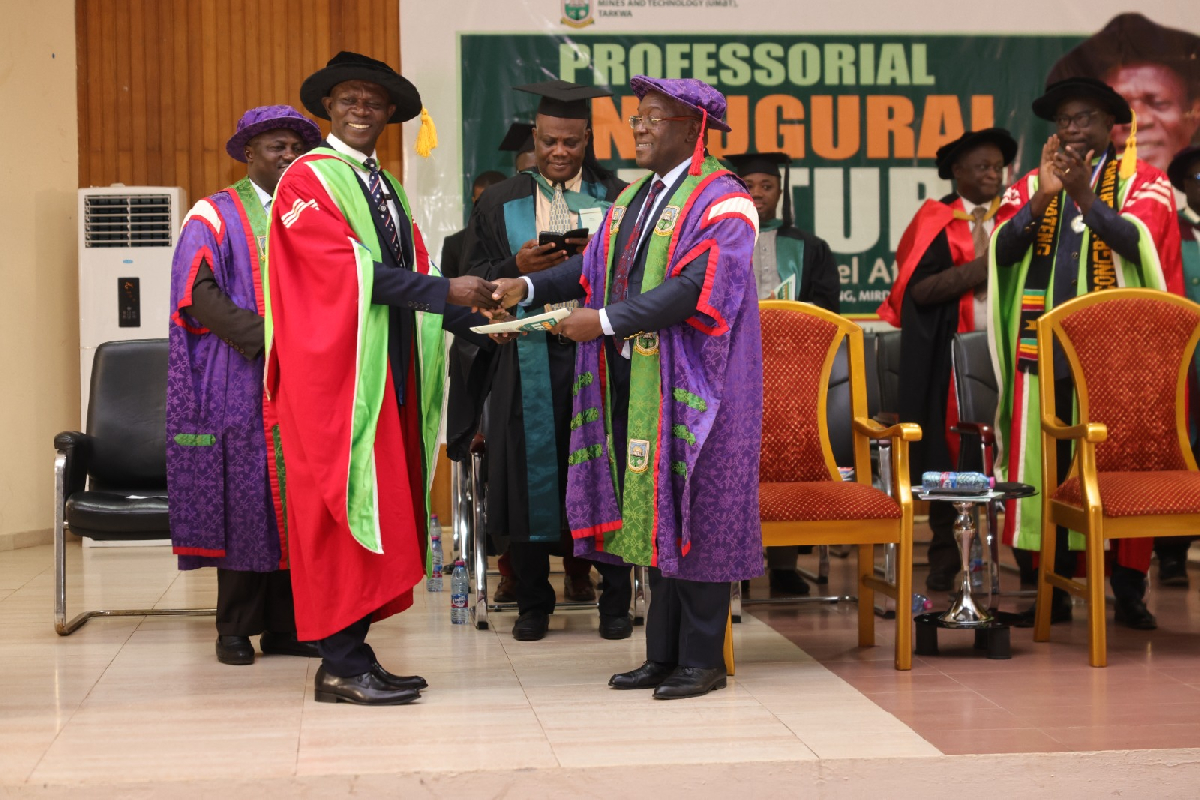
According to Prof. Affam, mining communities across the country are confronted with massive deposits of waste rock, often left idle and forming hills that displace communities. His research indicates that these rocks, particularly those of Tarkwaian origin, can be milled and processed into high-quality sand for construction. Preliminary estimates suggest Ghana’s mining corridors hold close to 100 billion tons of such material, enough to meet aggregate demand for hundreds of years.
“Processing these waste rocks into sand not only provides a long-term solution to the depletion of natural river sand but also frees up vast tracts of land currently occupied by waste dumps,” Prof. Affam explained.
He noted that scientific analyses have confirmed the suitability of ore sand for construction projects. While natural sand typically has a coarse content of around 90%, ore sand ranges between 66% and 85%, a level deemed sufficient for durability and safety. Tests on pH and other properties also confirmed that ore sand can stand the test of time, ensuring strong and safe infrastructure.
Prof. Affam further stressed the economic implications, citing that a 20-cubic meter load of river sand from Nzema can cost up to GH¢4,000, while processed waste rock of the same volume costs less than half that amount. With natural river sand supplies dwindling, he warned that over-reliance on this source poses long-term risks.
He called on entrepreneurs and industrialists to invest in the commercialisation of ore sand, revealing that several quarries have already begun milling the material. “As researchers, our role is to provide the technical basis. We now need industrial players to take an interest, adopt the findings, and scale up production. The business value is clear, and the environmental benefits are enormous,” he said.
The lecture underscored the dual opportunity presented by ore sand, tackling the pressing environmental issue of mine waste while providing a sustainable, affordable, and readily available alternative to natural sand for Ghana’s booming construction sector.









Opinions