This blog is managed by the content creator and not GhanaWeb, its affiliates, or employees. Advertising on this blog requires a minimum of GH₵50 a week. Contact the blog owner with any queries.
Northernblog Blog of Monday, 30 March 2026
Source: Yunus Mumuni
More Than a Meal: Feeding Hope in Northern Ghana
- Share:


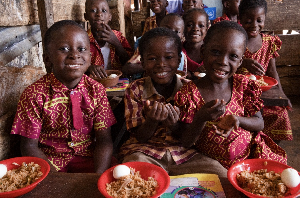
In many rural communities across northern Ghana, hunger has long been an invisible barrier between children and their dreams. For years, pupils often arrived at school with empty stomachs or left before the day ended in search of food.
In 2025, the World Food Programme, with support from the American People launched a School Feeding Activity in the Northern, Upper East, Upper West, and North East regions of Ghana. The programme guarantees nearly 60,000 children a nutritious meal every school day in more than 200 schools in underserved communities, turning schools into places not only for learning, but also for nourishment and hope.
When Hunger Used to Win
At Bright Masters Academy, headmaster Alhassan Musah remembers how difficult it was to keep children in class.
“Before the programme, food for the children during school hours was a serious challenge,” he recalls.
“Some children would ask to go home to look for food. Many never returned for the rest of the lessons.”
For teachers, it was heartbreaking to watch bright pupils lose learning opportunities simply because they were hungry.
Today, the story is different.
When the lunch bell rings, children gather eagerly with bowls in hand. A warm meal now awaits them every school day. With hunger no longer distracting them, classrooms are fuller, attendance has improved, and children are able to focus on learning.
“Before we started the feeding, we had 250 students but now it has increased to 305 in less than one year.”
“No child now uses food as an excuse to leave school,” Musah says with a smile. “They stay, they learn, and they are happier.”
For 13-year-old Feruza, one of the pupils benefiting from the programme, the meals make coming to school something to look forward to.
“Every day I get food to eat in school. Sometimes we get rice and egg, or rice and beans, banku or TZ. I am happy because, anytime I’m coming to school I know I will get food to eat.”
Cooking Hope for the Next Generation
For the women who prepare the meals, the programme is also changing lives.
Every morning before the sun rises, the school’s caterer begins preparing food for the children. The work is demanding, but the reward goes beyond the monthly income.
“I feel happy seeing the children eat the meals I cook,” she says. “It makes me proud.”
The job has also given her something she once struggled to find; financial stability.
“With the income I earn, I can take care of my five children: their feeding, their health, and their education.”
What began as a meal for schoolchildren has become a lifeline for families.
From Losses to Opportunity
The impact of the programme reaches far beyond the school compound.
In northern Ghana, members of the Bolga-Bawku-Navrongo Women Cooperative Network, many of them widowed farmers, work tirelessly to produce fortified rice.
For years, they struggled to find buyers.
“We used to produce rice, but people were not buying it,” says Stella, a widow and member of the cooperative. “Sometimes we run losses after all our hard work.”
Everything changed when the World Food Programme connected the cooperative to schools participating in the feeding programme.
Now, their rice has a guaranteed market.
“Anytime we finish producing, we send it to the schools and we are paid,” Stella says. “Since then, we have not run at a loss.”
A Mother’s Dream Revived
For Stella, the most meaningful change is not just the income; it is what that income has made possible.
Her daughter once had a dream of becoming a nurse. But when Stella could no longer afford the school fees, the dream seemed to fade.
“My daughter stayed at home because I could not pay her fees,” she says quietly.
Today, that dream is alive again.
With the profits from their rice sales, Stella was able to send her daughter to the Bolgatanga Nursing Training College.
“I feel proud,” she says, smiling. “Now she is studying to become a nurse.”
More Than a Meal
What started as a school meal programme has become something far greater.
It is keeping children in school.
It is providing the essential nutrition children need to grow.
It is creating jobs for women.
It is opening markets for farmers.
And it is turning small opportunities into life-changing possibilities.
Across northern Ghana, a simple plate of food is doing something extraordinary - it is feeding hope, one child, one family, and one community at a time.