This blog is managed by the content creator and not GhanaWeb, its affiliates, or employees. Advertising on this blog requires a minimum of GH₵50 a week. Contact the blog owner with any queries.
Neo Report Blog of Saturday, 15 August 2026
Source: Obeng Samuel
KNUST Moves To Tighten Procurement Compliance And Accountability
- Share:


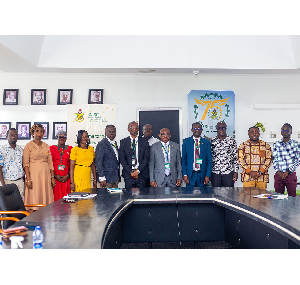
The Kwame Nkrumah University of Science and Technology (KNUST) is stepping up efforts to strengthen compliance, efficiency and accountability in institutional procurement, as the University moves towards greater decentralisation of procurement activities across its colleges and departments.
The move follows an engagement between KNUST Vice-Chancellor, Professor Christian Agyare, and the University's Procurement Office to discuss measures aimed at improving procurement management and strengthening institutional governance.
The engagement, reported by KNUST's University Relations Office on August 6, 2026, comes at a time when procurement accounts for a significant proportion of the University's expenditure, making strict adherence to Ghana's Public Procurement Act critical to safeguarding public resources and maintaining accountability.
COMPLIANCE AS A SHIELD FOR THE UNIVERSITY
The Director of Procurement, Mr Duke Agyeman Fredua, reaffirmed the Directorate's commitment to supporting the Vice-Chancellor's strategic vision.
He explained that the Procurement Directorate has already begun sensitisation and educational engagements with user departments to improve staff understanding of procurement procedures and statutory requirements.
The objective is clear: ensure that procurement decisions are made within the law and that staff understand the procedures they are required to follow.
For an institution managing significant public and institutional resources, procurement compliance is more than an administrative requirement. It is an important safeguard against waste, irregularities, audit concerns and potential legal consequences.
DECENTRALISATION DEMANDS STRONGER OVERSIGHT
Professor Christian Agyare welcomed the Procurement Directorate's proactive approach but challenged the Office to strengthen its monitoring and compliance systems as procurement responsibilities become more decentralised.
According to the Vice-Chancellor, decentralisation must go hand in hand with monitoring, evaluation and feedback.
The emphasis is not simply on checking whether procurement rules have been followed, but also on learning from procurement outcomes to continuously improve the University's systems and service delivery.
This approach could help ensure that decentralisation does not weaken institutional oversight but instead creates a procurement system that is more responsive, efficient and accountable.
DOCUMENTATION AT THE HEART OF ACCOUNTABILITY
Professor Agyare also stressed the importance of proper documentation and continuous professional development for procurement officers.
He encouraged the Procurement Directorate to strengthen staff capacity through standard operating procedures, documentation and continuous education.
Proper documentation, he noted, provides protection not only for the institution but also for individual officers who may have to explain or defend procurement decisions during audits or legal proceedings.
The message is particularly significant for public institutions: a procurement decision must not only be right—it must also be properly documented and capable of being defended.
AN ADVOCACY CALL FOR RESPONSIBLE PUBLIC RESOURCE MANAGEMENT
KNUST's renewed focus on procurement compliance offers a broader lesson for public institutions across Ghana.
Every cedi committed through public procurement represents resources that ultimately serve students, staff, communities and the wider public.
Strengthening procurement systems, therefore, is not merely about following procedures. It is about protecting public resources, promoting value for money, reducing institutional risk and building public confidence.
KNUST's decision to combine decentralisation with stronger monitoring, staff training, documentation and feedback could provide a useful model for other institutions seeking to balance operational efficiency with accountability.
Professor Agyare also pledged to maintain an open-door leadership approach, encouraging constructive ideas and collaboration as the University works towards achieving its strategic vision.
As KNUST continues to expand and decentralise its operations, the effectiveness of these measures will ultimately be judged by how well they translate into transparent decisions, efficient procurement and stronger protection of institutional resources.
Credit: This advocacy report is based on information published by the University Relations Office (URO), Kwame Nkrumah University of Science and Technology (KNUST). The original report was written by Abigail Ofori, with photographs by Isaac Kwaku Duah, and was published on August 6, 2026.
Read the original KNUST publication