This blog is managed by the content creator and not GhanaWeb, its affiliates, or employees. Advertising on this blog requires a minimum of GH₵50 a week. Contact the blog owner with any queries.
Neo Report Blog of Saturday, 15 August 2026
Source: Obeng Samuel
KNUST Challenged To Turn Government Policies Into Practical Solutions For Ghana
- Share:


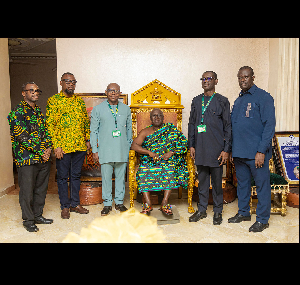
The Kwame Nkrumah University of Science and Technology (KNUST) has been challenged to move beyond academic research and position itself as a strategic engine for solving Ghana’s socio-economic challenges.
Chairman of the KNUST Governing Council, Akyamfour Asafo Boakye Agyemang-Bonsu, wants the University to use its intellectual, scientific and technical capacity to translate government policies into practical, evidence-based solutions that can improve the lives of Ghanaians.
He made the call when KNUST Vice-Chancellor, Professor Christian Agyare, and members of the University Management paid a courtesy call on him at the Asafo Palace on Friday, August 7, 2026.
The visit was to thank the Council Chairman for his participation in Professor Agyare’s investiture ceremony and acknowledge his continued support for the governance and development of the University.
FROM POLICY TO IMPACT
The Council Chairman believes KNUST has the expertise and human resources required to make a measurable contribution to Ghana’s development.
He therefore urged the Vice-Chancellor to harness the University's scientific and technical capabilities to respond directly to national priorities.
His message is particularly significant at a time when Ghana continues to face challenges that require more than policy statements—they require research, innovation, technology and workable implementation models.
He called on KNUST to develop policy papers that demonstrate exactly how the University can contribute to major government initiatives, including the 24-hour economy policy.
For the Council Chairman, a university of science and technology must not stop at analysing national policies. It should be able to ask the difficult question: How can this policy actually work on the ground?
KNUST AND THE 24-HOUR ECONOMY
The call for KNUST to contribute to the 24-hour economy creates an opportunity for the institution to bring together its expertise in science, technology, engineering, business, logistics and other disciplines.
Rather than leaving policy implementation entirely to government, the University could provide research-based models that examine issues such as technology, productivity, energy, transportation, industrial operations, worker safety and skills development required to sustain extended economic activity.
Such research could help bridge one of the persistent gaps in national development—the gap between policy formulation and practical implementation.
PROTECTING KNUST'S INSTITUTIONAL MEMORY
Beyond policy and innovation, Akyamfour Asafo Boakye Agyemang-Bonsu also raised concerns about the preservation of KNUST's institutional memory.
He urged the University to systematically document and archive its activities, research outputs, major achievements and experiences.
According to him, records generated today can become valuable knowledge resources for future generations.
The Council Chairman particularly highlighted the importance of converting audiovisual records into accessible knowledge resources, noting that proper documentation strengthens research, supports evidence-based decision-making and protects the University's legacy.
He also commended Professor Agyare for promoting improved documentation and transcription of University activities.
A CHALLENGE TO GHANA'S UNIVERSITIES
The KNUST Council Chairman's call raises a broader question about the role of universities in national development.
Should universities simply produce graduates and academic publications, or should they become active laboratories for solving the country's most pressing problems?
For KNUST, the challenge is now to demonstrate how its research and technical expertise can move from laboratories, lecture halls and academic papers into communities, industries and public policy.
If successfully implemented, stronger collaboration between KNUST and government could provide an evidence-based pathway for turning national policies into practical interventions—while giving researchers and students opportunities to work on real Ghanaian problems.
COLLECTIVE RESPONSIBILITY
Professor Agyare, who is serving as KNUST's 13th Vice-Chancellor, thanked the Council Chairman for his support and sought his continued guidance as he begins his tenure.
The Council Chairman, in turn, assured the Vice-Chancellor of the Governing Council's full support, emphasising that advancing KNUST requires collective effort and shared responsibility.
The message is clear: Ghana does not only need policies; it needs institutions capable of turning those policies into results.
And with its strong foundation in science, technology, research and innovation, KNUST is being challenged to show that universities can become powerful partners in delivering those results.
visit: neoreportgh.com
Credit: This advocacy report is based on information published by the University Relations Office (URO), Kwame Nkrumah University of Science and Technology (KNUST) on August 7, 2026.




Entertainment