This blog is managed by the content creator and not GhanaWeb, its affiliates, or employees. Advertising on this blog requires a minimum of GH₵50 a week. Contact the blog owner with any queries.
Neo Report Blog of Friday, 6 March 2026
Source: Obeng Samuel
Ghana’s Green Industrial Revolution: President Commissions $150M Projects to Slash Imports and Create Jobs
- Share:


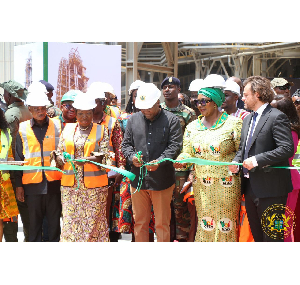
In a landmark day for Ghana’s industrial transformation, President John Dramani Mahama has commissioned two major manufacturing facilities in the Tema enclave, signaling a bold shift toward sustainability and self-reliance. The $150 million combined investment in green cement and food processing is set to transform the nation’s manufacturing landscape while addressing global climate concerns.
Building a Sustainable Future: The World’s Largest LC3 Cement Plant
A centerpiece of the government's industrial agenda is the new $110 million calcined clay cement plant developed by CBI Ghana Ltd within the Tema Free Zones Enclave. This facility is not just a local milestone; it is described as the largest of its kind globally.
Innovative Technology: The plant utilizes Limestone Calcined Clay (LC3) technology to produce environmentally friendly cement.
Climate Action: This method significantly reduces the carbon footprint compared to traditional cement production.
Economic Impact: With a capacity of 1.5 million tonnes annually, the plant will reduce Ghana’s dependence on imported clinker and provide sustainable materials for the local construction sector.
Trade Minister Elizabeth Ofosu-Adjare hailed the project as a "major milestone," noting that it proves Ghana’s industrial sector can remain competitive while responding to global climate change.
Strengthening Food Security: The $40M Pasta Powerhouse
Advancing the nation's agribusiness agenda, President Mahama also commissioned a $40 million state-of-the-art pasta processing plant by Olam Agri in Kpone.
Integrated Supply Chain: The facility uses flour from a neighboring $55 million mill, creating a robust local value chain.
Reduced Imports: The project reflects a direct effort to reduce Ghana’s reliance on imported food products.
Job Creation: These investments are designed to stimulate local supply chains and create sustainable employment for Ghanaians.
The Vision: A Manufacturing and Export Hub
President Mahama emphasized that these projects represent the strategic private sector investments needed to drive economic transformation. By focusing on local raw materials and innovative technology, the government aims to:
Save Foreign Exchange by cutting down on raw material imports.
Transfer Technology to the local workforce.
Position Ghana as the premier manufacturing and export hub for the West African sub-region.
"Government remains committed to creating an enabling environment for businesses to thrive," the President stated, reiterating a determination to support policies that encourage local production over importation.










Opinions