This blog is managed by the content creator and not GhanaWeb, its affiliates, or employees. Advertising on this blog requires a minimum of GH₵50 a week. Contact the blog owner with any queries.
Neo Report Blog of Monday, 16 November 2026
Source: Obeng Samuel
Ghana’s Forests Need More Than Protection Policies; Journalists Must Help Demand Accountability
- Share:


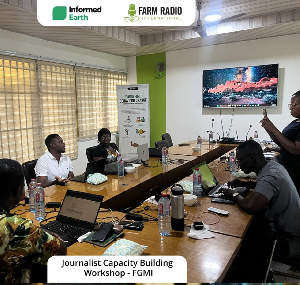
As illegal mining, illegal logging and agricultural expansion continue to threaten Ghana’s forests, a new capacity-building initiative is seeking to strengthen the media’s role in exposing forest governance challenges and demanding greater accountability.
Farm Radio International (FRI) has organised a three-day workshop in Accra to equip selected journalists with investigative reporting, data research and gender-inclusive storytelling skills under the Forest Governance Media Initiative (FGMI), a programme by Informed Earth.
The workshop, held from November 10 to 12, 2026, brought together journalists and freelance media professionals to deepen their understanding of forest governance and improve the quality of environmental reporting in Ghana.
The training comes at a time when concerns over illegal mining, unsustainable logging, cocoa-driven deforestation and weak enforcement continue to raise questions about how effectively the country’s forest resources are being managed.
Participants examined Ghana’s forest governance framework, the responsibilities of institutions and other stakeholders, and the impact of forest degradation on biodiversity, water bodies, livelihoods, food security and the cultural heritage of communities.
A major focus was on strengthening investigative journalism beyond routine reporting. Led by FRI’s Radio Craft Officer, Isaac Mintah, the sessions covered how to develop story ideas, formulate investigative questions, gather and verify evidence, interview sources and give subjects a fair opportunity to respond.
Journalists were also introduced to digital research tools, including Global Nature Watch and Google Earth, to help track changes in forest cover and investigate environmental concerns. The training emphasised the need to verify digital findings against credible sources and the experiences of affected communities.
Beyond the environmental evidence, the workshop challenged journalists to examine whose interests are represented in forest governance decisions and whose experiences are being overlooked.
Facilitated by FRI’s Project Lead, Rosetta Atiso, alongside Isaac Mintah, the gender inclusion session highlighted the need to give meaningful attention to women, young people, persons with disabilities and other marginalised groups whose livelihoods and participation may be affected by decisions on forest resources.
This is an important dimension of environmental reporting. Forest governance is not only about trees, land and regulations; it is also about the people who depend on these resources and whether they have a voice in decisions affecting their lives.
As participants prepare for field assignments, they have also been introduced to the Forest Governance Media Initiative’s High-Quality Story Criteria, which emphasise credible sources, balance, clear story focus, human interest, gender inclusion and the representation of marginalised groups.
The wider project aims to support the production of twelve in-depth stories on forest governance challenges, including illegal mining, illegal logging, cocoa-driven deforestation and the implementation of Ghana’s Forest Law Enforcement, Governance and Trade (FLEGT) licensing system.
It also seeks to establish the Ghana Forest Governance Media Network to encourage collaboration and knowledge exchange among journalists and relevant stakeholders.
However, the real value of this training will not be measured by the number of journalists who attended or the tools they have been introduced to. It will be seen in the quality of investigations that follow, the evidence brought into the public domain and whether the reporting helps citizens understand who is responsible for protecting Ghana’s forests.
Institutions responsible for forest management and enforcement must be prepared to answer difficult questions, while journalists must remain committed to accuracy, fairness and sustained public-interest reporting.
Ghana’s forests cannot be protected by policies on paper alone. They require effective enforcement, meaningful community participation and a media that is prepared to investigate beyond official statements and keep public attention on the decisions, failures and actions shaping the country’s forest future.