This blog is managed by the content creator and not GhanaWeb, its affiliates, or employees. Advertising on this blog requires a minimum of GH₵50 a week. Contact the blog owner with any queries.
Neo Report Blog of Monday, 24 August 2026
Source: Obeng Samuel
Ghana’s Coastal Regions Unite to Tackle Challenges Facing Small-Scale Fisheries
- Share:


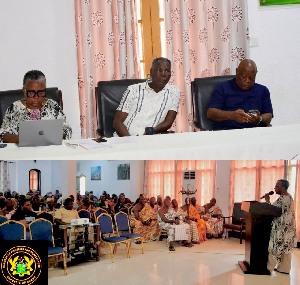
Stakeholders in Ghana’s small-scale fisheries sector have called for stronger collaboration and practical measures to protect the country’s marine resources while improving the livelihoods of fishing communities.
The call was made during a stakeholder engagement organised by the Ministry of Fisheries and Aquaculture, with support from Blue Ventures, in Cape Coast, bringing together key actors from Ghana’s four coastal regions.
Representatives from the Central, Western, Greater Accra and Volta Regions, alongside officials from the Fisheries Commission, Regional Coordinating Councils, artisanal fishing communities and other stakeholders, met to discuss the current state of small-scale fisheries, emerging challenges and possible ways to make the sector more sustainable.
The discussions come at a time when the future of many coastal communities remains closely tied to the health of Ghana’s marine resources.
A presentation on the State of Small-Scale Fisheries and Emerging Issues in the Central Region, delivered by the Central Regional Director of the Fisheries Commission, Mr. Emmanuel Dolvo, highlighted developments and concerns affecting the artisanal fisheries sector.
The presentation gave participants the opportunity to look at the situation on the ground and discuss practical measures that could help address the challenges facing fishers while protecting fisheries resources for the future.
Another important issue discussed was the licensing and registration of artisanal canoes.
The Fisheries Commission took participants through the importance of canoe licensing, registration and compliance with fisheries laws and regulations, stressing their role in effective fisheries management.
But the engagement was not only about regulations and compliance.
The social and economic wellbeing of artisanal fishers also came into focus, with Mr. Eric Baah, Director of Policy, Planning, Budget, Monitoring and Evaluation (PPBME), speaking on insurance and pension schemes for fishers.
The discussion highlighted the importance of social protection in helping fishers and their families deal with unforeseen circumstances while also providing some security for their future.
Bringing the four coastal regions together also created an opportunity for stakeholders to share their experiences, identify challenges that cut across the regions and consider solutions that respond to specific local realities.
For many fishing communities, the conversation goes beyond fish catches.
It is also about livelihoods, family income and the future of communities that have depended on fishing for generations. This makes cooperation between government institutions, fishing communities, traditional authorities, development partners and other stakeholders particularly important.
The engagement therefore emphasised the need for stronger collaboration to ensure that Ghana’s fisheries resources are managed sustainably while creating an environment in which fishing communities can continue to thrive.
Addressing the gathering, the Minister for Fisheries and Aquaculture, Hon. Emelia Arthur (MP), reaffirmed the Government’s commitment to protecting Ghana’s fisheries resources while improving the livelihoods and resilience of people who depend on the sector.
She stressed that sustainable fisheries management cannot be achieved without the active participation and cooperation of stakeholders, especially fishing communities whose livelihoods are directly connected to the health of Ghana’s marine resources.
The Minister encouraged stakeholders to take advantage of initiatives aimed at improving compliance, strengthening social protection and promoting responsible fishing practices.
She noted that the future of the fisheries sector depends on collective responsibility and sustained engagement among all actors.
Hon. Emelia Arthur also expressed appreciation to Blue Ventures for supporting the engagement and commended stakeholders from the four coastal regions for their participation and contributions.
The meeting forms part of the Ministry’s wider efforts to deepen stakeholder consultation, improve awareness of fisheries policies and regulations, strengthen social protection for artisanal fishers and promote the sustainable management of Ghana’s fisheries resources.
For Ghana’s coastal communities, the message is an important one: protecting the sea and protecting livelihoods cannot be treated as separate issues.
The challenge now is to turn the conversations into practical action—because the future of Ghana’s fisheries depends not only on how much fish is caught today, but also on whether there will be enough fish and healthy marine resources for the generations that come after us.