This blog is managed by the content creator and not GhanaWeb, its affiliates, or employees. Advertising on this blog requires a minimum of GH₵50 a week. Contact the blog owner with any queries.
Neo Report Blog of Tuesday, 1 September 2026
Source: Obeng Samuel
Ghana Marks 2026 Children’s Day With Call To Put Children At The Table
- Share:


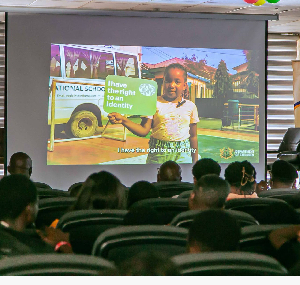
Ghana has marked the 2026 Children’s Day with a strong call for society to stop speaking for children without listening to them and instead create safe spaces where children can speak freely, report abuse and influence decisions that affect their lives.
The call was made by the Ministry of Gender, Children and Social Protection, through the Department of Children, during this year's celebration held at the premises of the Greater Accra Regional Coordinating Council.
neoreportgh.com
The event was held under the theme: “Amplifying Children’s Voices on Abuse in Ghana: Promoting Child Protection, Participation, and Advocacy.”
The Sector Minister, Dr Agnes Naa Momo Lartey, in a speech read on her behalf by the Acting Director of the Department of Children, Mr Sefah Alexander Boadu, said children must be given environments where they can speak without fear and, importantly, where adults are prepared to listen and act.
CHILDREN MUST MOVE FROM THE CONSULTATION ROOM TO THE POLICY ROOM
The Minister said children's participation must go beyond simply asking for their opinions.
She called for children's voices to move “from the consultation room into the policy room,” so that their experiences and recommendations can influence programmes, services and decisions.
According to her, the Children's Voices Sessions held across the regions have provided safe platforms for children to discuss their experiences and make recommendations.
But the challenge now, she said, is ensuring that these voices do not end with consultations.
The message is straightforward: listening to a child has little meaning if nothing changes after the child has spoken.
“WHERE ARE THE CHILDREN AT THE TABLE?”
Dr Lartey challenged adults to rethink the way decisions concerning children are made.
For years, parents, institutions and policymakers have largely made decisions for children, designed programmes for children and spoken about children.
She asked a critical question:
“Where are the children at the table?”
The Minister stressed that child participation is not a favour granted by adults but a right.
Meaningful participation, she explained, requires creating opportunities for children to express their views and ensuring those views have an influence on decisions.
EVERY CHILD DESERVES PROTECTION
The Minister also reaffirmed Government's position that every Ghanaian child deserves protection, regardless of age, background or circumstances.
She stressed that:
“Every child is entitled to safety, dignity and protection.”
This puts child protection squarely beyond the responsibility of government agencies alone.
Parents, teachers, community and religious leaders, the media and other child protection actors all have roles to play in creating environments where children can speak about abuse and seek help without fear of being ignored, blamed or punished.
CHILD PROTECTION MUST BECOME A NATIONAL CULTURE
Dr Lartey called for child protection to become part of Ghana's national culture, with institutions and communities treating the safety and wellbeing of children as a shared responsibility.
She argued that the value of a child cannot be measured in financial terms and warned that protecting children today is an investment in the country's future.
“Every child protected today is a future strengthened tomorrow,” she said, describing child protection not merely as a policy issue but as a moral responsibility and national priority.
She also encouraged children who experience abuse or situations that make them feel unsafe to speak to a trusted adult.
Her message to children was direct:
“We see you, we hear you, and your voice matters.”
She encouraged them not to give up even when they are not heard the first time.
GREATER ACCRA URGED TO LEAD
The Greater Accra Regional Minister, Madam Linda Obenewaa Ocloo, in a speech read on her behalf by the Chief Director of the Greater Accra Regional Coordinating Council, Rev. Harry Nii Kwatei Owoo, said the region must take the lead in creating communities where children can learn, play, grow and express themselves without fear.
She called on traditional and religious leaders to use their influence to promote child protection and urged law enforcement agencies, social workers, health professionals, civil society organisations and other child protection actors to strengthen collaboration in supporting children in need.
According to her, protecting a child protects the country's future because today's children will become tomorrow's teachers, doctors, lawyers, engineers, farmers, entrepreneurs, leaders, parents and nation-builders.
SILENCING CHILDREN HAS A NATIONAL COST
Madam Ocloo warned that the consequences of failing to listen to children go beyond individual families.
She said:
“When we silence a child, we silence a part of our future; when we allow a child to suffer, we weaken the very foundation upon which our nation stands.”
It is a message that places child protection firmly within the broader national development conversation.
A child who is afraid to report abuse may continue to suffer in silence. A child whose concerns are ignored may lose confidence in the very systems designed to protect them.
This makes safe reporting channels, trusted adults, responsive institutions and genuine child participation critical—not only for individual protection but also for building communities where children can thrive.
FROM WORDS TO ACTION
The 2026 National Children's Day celebration therefore presents a challenge that goes beyond speeches and annual commemorations.
The real test begins after the celebration.
Are children being heard in schools?
Are communities creating safe spaces for them?
Are reports of abuse taken seriously?
Are children's views reflected in programmes and policies?
And when a child speaks, does somebody actually act?
These are the questions stakeholders must confront if Ghana is to turn the principle of child participation into everyday practice.
As the Ministry of Gender, Children and Social Protection and the Greater Accra Regional Coordinating Council renew their commitment to child protection, the wider society is being called upon to make the same commitment—not only with words, but through action.
Because protecting children is not simply about protecting the vulnerable.
It is about protecting Ghana's future.
neoreportgh.com
Credit: This report is based on information from the Ministry of Gender, Children and Social Protection, Department of Children, and the Greater Accra Regional Coordinating Council in connection with Ghana's 2026 National Children's Day celebration.