This blog is managed by the content creator and not GhanaWeb, its affiliates, or employees. Advertising on this blog requires a minimum of GH₵50 a week. Contact the blog owner with any queries.
Nanisto News Blog of Sunday, 5 April 2026
Source: Manteaw Amos
Kwahu Business Forum 2026: Sustaining African businesses take centre stage with KGL as the case study
- Share:



The 2026 Kwahu Business Forum, held at the Kwahu Convention Centre, entered its second day with a strong emphasis on finance, market access, growth, and innovation.
The high-level gathering brought together industry leaders, entrepreneurs, policymakers, and members of the public to explore pathways for investment and economic expansion.
Among the notable attendees were John Dramani Mahama, Chief of Staff Julius Debrah, ministers of state, traditional leaders, and key figures from the business community.
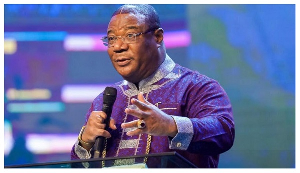
Delivering a keynote presentation, Alex Dadey, Group Executive Chairman of KGL, spoke on the theme “Good Corporate Citizenship in Building Sustainable African Business Champions – The KGL Case Study.”
He stressed that corporate citizenship must be embedded as a core business strategy rather than treated as an afterthought.
Drawing on the experience of the KGL Group, Dadey highlighted trust as a vital currency in Africa’s evolving markets. He noted that long-term success depends on strong governance, regulatory compliance, strategic partnerships and measurable social impact.
According to him, businesses must go beyond profit-making to actively contribute to education, healthcare, youth empowerment, and community development.
“Corporate citizenship is not something you do after success; it is often the reason success becomes sustainable,” he stated, citing KGL’s investments in sports development, education, and healthcare as practical examples of responsible corporate engagement.
Dadey also raised concerns about the structural fragility of many African businesses, which are often built around individuals rather than enduring systems.
He warned that such models risk collapse in the absence of their founders and called for a shift toward institution-building, stronger governance frameworks, and long-term sustainability.
Responding to these concerns, President Mahama underscored the importance of succession planning, describing it as a significant gap in both the formal and informal sectors.
He urged business owners to intentionally plan for continuity to ensure enterprises outlive their founders.
Addressing the challenge of businesses remaining at the startup level, the President pointed to limited managerial capacity among founders as a major constraint to growth.
He encouraged established companies to support emerging enterprises through equity partnerships and acquisitions to help scale promising ventures.
President Mahama also reflected on the origins of the forum, revealing that he and Chief of Staff Julius Debrah conceived it as a platform to harness Kwahu’s entrepreneurial spirit for national development.
He noted that despite being in opposition at the time, they initiated the first forum in 2024 to promote networking, enhance business management and expand market opportunities.
The forum, he explained, was designed not only to celebrate Kwahu’s rich entrepreneurial culture but also to address structural challenges facing businesses while fostering partnerships that drive productivity and innovation.
As deliberations continue, the 2026 Kwahu Business Forum is reinforcing its role as a key platform for shaping Ghana’s business landscape, placing corporate responsibility, sustainability and strategic growth at the center of Africa’s economic future.