This blog is managed by the content creator and not GhanaWeb, its affiliates, or employees. Advertising on this blog requires a minimum of GH₵50 a week. Contact the blog owner with any queries.
Nanisto News Blog of Thursday, 10 July 2025
Source: Manteaw Amos
Beyond Diplomacy: Ukraine’s chance for humanity in freeing Joshua Nkrumah
- Share:


Ghana’s ties with Ukraine have recently entered a new phase of goodwill and cooperation.
Ghana has been a staunch supporter of Ukraine on the world stage – it joined UN votes condemning Russia’s invasion and even hosted a Crimea Platform Summit – and Ukraine, for its part, has thanked Ghana as “one of Ukraine’s most important and promising partners in West Africa”.
The two governments have boosted trade and diplomatic engagement: Ukrainian officials now talk of working together on agriculture, digital technology, education and other areas, and Kyiv highlights its role in global food security through initiatives like “Grain from Ukraine”.
In short, Ghana and Ukraine are drawing closer. But on this path of rapprochement, complex challenges remain – one being the fate of a Ghanaian civilian caught up in the war, now held by Ukrainian forces.
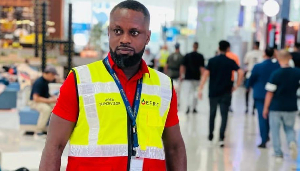
Joshua Nkrumah’s personal story has become a cause for concern in Ghana. A Ghanaian by birth, he somehow found himself in Ukraine’s conflict zone and was taken captive by Ukrainian authorities.
According to his family, for eight agonizing months they heard nothing and feared him dead – until finally his wife received the shock call that he was alive in a Ukrainian detention center.
Since then relatives in Accra have pleaded for his release, insisting he is innocent of any wrongdoing and was simply in the wrong place at the wrong time.
They emphasize that Joshua never volunteered to fight – he was never a soldier – and yet his continued detention is tearing a family apart.
His young son goes to school without a father, and his mother and wife live in daily agony. Ghanaian media report that human rights advocates in Accra have appealed to both governments: Joshua is not a combatant, and his disappearance and suffering should not be brushed aside.
The question of Joshua’s fate also shines a light on how prisoners can be treated in this war. International observers have noted cases of abuse by Ukrainian captors.
For example, UN-facilitated study (reported by The Kyiv Independent) found that roughly half of prisoners taken by Ukraine had endured torture or beatings during capture.
Common abuses included repeated beatings, kicks and even electric shocks during transit to camps.
(These interviews were conducted with soldiers who had been released from Ukrainian captivity, but they drew a stark picture of what can happen when guards lose all restraint.)
Such accounts – of Ukrainian soldiers using violence that violates the Geneva Conventions – are deeply disturbing. They remind us that any detainee, even a foreign civilian like Joshua, could face severe mistreatment at the moment of arrest if discipline breaks down.
In a war this brutal, watching international law closely often becomes the last priority, and reports of cruelty by some Ukrainian fighters underscore how raw emotions can override rules of war.
The problem is compounded for African captives.
Media and social networks have circulated footage of Ukrainian forces taunting prisoners of African descent with openly racist slurs.
In one widely seen video, a black prisoner is mocked as a “monkey” and taunted by guards offering him a banana – an act many commentators decried as blatant racism. We must stress that this is not official policy (most Ukrainian soldiers are professional), but it does show that Africans in captivity can face added humiliation and hostility.
In practical terms, it means Joshua Nkrumah’s situation is more precarious: as a Ghanaian he could suffer not only the normal deprivations of being locked up, but also racist abuse that other prisoners avoid.
Such incidents remind us that even among allies, racist behavior exists and leaves far-away families terrified for their loved one’s safety.
Amid these grim realities, there is a practical solution that could win international praise: free Joshua Nkrumah.
Ghana has made its support for Ukraine’s independence and peace very clear, and Ukraine has an interest in honoring that friendship.
Indeed, prisoner exchanges continue regularly in this war – a public way to show goodwill.
By mid-2025, Ukraine reported exchanging thousands of POWs with Russia: for example, Russia alone freed over 3,300 Ukrainian captives in one round of swaps, with Ukrainians returning Russian soldiers in exchange.
These high-profile releases are meant as gestures of goodwill and compliance with human rights.
Ghanaian commentators argue that Joshua’s case – a young civilian held far from home – deserves similar consideration.
Releasing him would be a powerful act of kindness.
It would demonstrate the “benevolence” of Ukraine’s military and political leadership, showing that even amid a brutal conflict Ukraine protects innocents, not just its own fighters.
In the end, Joshua Nkrumah’s freedom should not be a divisive issue. Ghana and Ukraine now share common goals, and they each care about innocent lives.
Ghanaian officials and families ask simply that Joshua’s case not be forgotten: he should be included in any humanitarian considerations or special releases.
A swift release would relieve a Ghanaian family’s suffering and reinforce the growing bond between Accra and Kyiv.
That would be a fitting act of compassion one that cements Ghana’s solidarity and Ukraine’s honor in the eyes of friends and allies alike.