This blog is managed by the content creator and not GhanaWeb, its affiliates, or employees. Advertising on this blog requires a minimum of GH₵50 a week. Contact the blog owner with any queries.
Mind of the Writer Blog of Friday, 13 November 2026
Source: Etsey Atisu
How KIWIX4SCHOOLS is breaking barriers and transforming access to education across Africa
- Share:


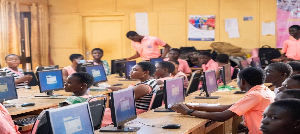
For a student sitting in a classroom without reliable internet, the world of knowledge can feel much further away than it actually is. Beyond that classroom are millions of books, articles, educational resources and reference materials, yet unreliable connectivity, expensive data, limited ICT infrastructure and unequal access to devices can determine whether a learner ever reaches them.
This is where the story of Kiwix4Schools begins.
The idea was simple but powerful: what if students did not have to wait for the internet to learn? What if educational knowledge could be brought directly into schools and made available on computers and other devices, even when connectivity was unavailable?
Through Kiwix, educational resources can be stored and accessed offline, allowing students and teachers to search, read and explore digital learning materials without requiring a continuous internet connection.
For Open Foundation West Africa (OFWA), Kiwix4Schools has become more than a technology project. It is an approach to educational inclusion—one that responds to the realities of schools and communities where access to the internet cannot be taken for granted.
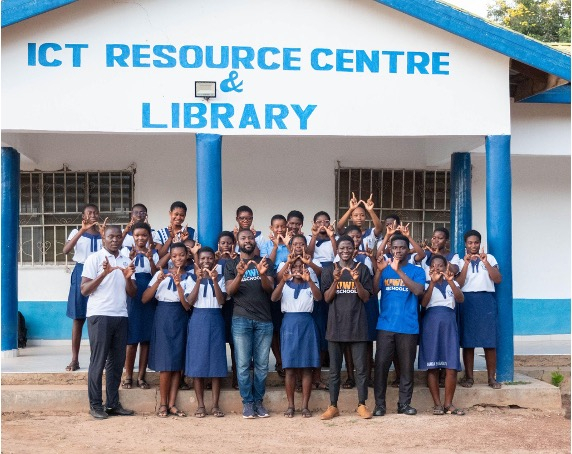
From a Ghanaian pilot to a growing African Model
The journey began in Ghana, where the first pilots exposed a significant gap in both digital access and awareness. During the 2019 pilot, more than 95% of students and 70% of teachers had neither heard nor used Wikipedia or the educational resources available through Kiwix, while almost 98% had not heard of Kiwix before the intervention. The resources existed, but many learners and teachers did not know they could access them.
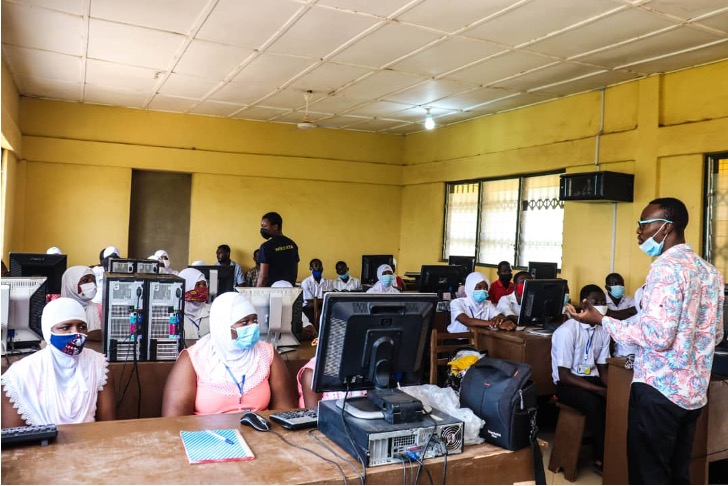
The programme subsequently expanded across Ghana. Between 2021 and 2022, Kiwix4Schools was implemented across seven regions, reaching 22 schools and training 777 students, with females representing 49.8% of participants. Volunteers installed Kiwix on 395 devices, bringing offline educational resources directly into school environments.
The figures continued to highlight the importance of the intervention: although 75.5% of participating students had previously used the internet and 52% had heard of Wikipedia, only about 2% had heard of Kiwix.
The experience in Ghana created a foundation for wider experimentation. In 2023, Kiwix4Schools pilots expanded to Tanzania, Nigeria, the Democratic Republic of Congo, South Sudan and Burundi.
At Kisutu Girls High School in Tanzania, Kiwix was installed on 20 ICT laboratory computers, and 40 students were trained. Before the intervention, 99% of students and 95% of teachers were unfamiliar with Kiwix.
In Nigeria, 49 students received training in digital citizenship, internet use and Kiwix, while educational content was downloaded for continued offline access. In the Democratic Republic of Congo, 15 students and 10 teachers were trained in Kiwix installation, ZIM files and content creation. Similar demand for longer and additional training emerged across the participating countries.
From Installing technology to building a community
The most important lesson from Kiwix4Schools is that the impact goes beyond the installation of software on computers. Technology creates the opportunity; people make the opportunity useful.
A student who discovers Kiwix can introduce classmates to resources they had never encountered. A teacher can use offline materials as an additional reference in the classroom. A trained participant can support another user, help with basic installation and troubleshooting, or identify content that responds to the needs of the school.
This is why the programme is increasingly moving towards a Kiwix Ambassador model, where trained students and teachers become knowledge-access champions within their schools and communities. Rather than treating each intervention as a one-time installation, the ambition is to create a network of people who can encourage continued use, support peers and help schools sustain offline access to knowledge.
In this way, Kiwix4Schools is evolving from a technology deployment programme into a distributed community of practice for offline knowledge access. The long-term value is not simply how many computers have Kiwix installed, but how many people have the confidence and skills to keep using, supporting and expanding access to the resources available through it.
Building the next chapter: partnerships scale and educational equity
The journey has also shown that sustainable digital education requires more than technology. Schools, teachers, volunteers, Wikimedia communities, civil society organisations, technology partners and policymakers all have a role to play in ensuring that offline learning can grow and remain relevant.
Challenges such as limited ICT infrastructure, insufficient computers, storage requirements, copyright considerations and gaps in curriculum-relevant content point to the next areas of work. The future of Kiwix4Schools will therefore depend on stronger partnerships, better curation of locally and curriculum-relevant educational resources, continued teacher training, improved technical support and the expansion of the Kiwix Ambassador network.
The principle behind the programme remains straightforward: a lack of internet should not mean a lack of access to knowledge.
From a Ghanaian pilot to implementation across several African countries, Kiwix4Schools has demonstrated that digital inclusion can take different forms. Sometimes, expanding access does not mean connecting another school to the internet. It means bringing the knowledge to the school, equipping people to use it, and building a community capable of sustaining that access.
One school. One device. One learner at a time, Kiwix4Schools is helping make knowledge available where connectivity cannot always reach.