This blog is managed by the content creator and not GhanaWeb, its affiliates, or employees. Advertising on this blog requires a minimum of GH₵50 a week. Contact the blog owner with any queries.
Michael Oberteye Blog of Tuesday, 9 September 2025
Source: Oberteye Michael
Founder of Legacy Crop Improvement Centre petitions IGP, Bank of Ghana over alleged fraudulent accounts at Stanbic Bank
- Share:


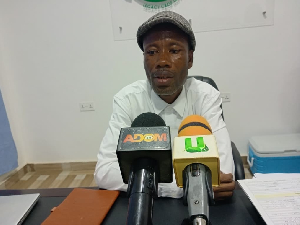
Dr. Amos Rutherford Azinu, founder of the Legacy Crop Improvement Centre Limited (LCIC), has filed formal petitions with the Inspector-General of Police (IGP), the Bank of Ghana, and other state authorities over what he describes as the fraudulent creation and operation of bank accounts in his name at Stanbic Bank Ghana — without his knowledge or consent.
The Bank of Ghana has since confirmed fraudulent activity in the case and has ordered the immediate closure of the disputed accounts.
Fraud Discovered at Stanbic Achimota Branch
The controversy began on August 19, 2023, when Dr. Azinu visited Stanbic Bank’s Achimota branch in Accra after receiving alarming information about accounts linked to his identity. Initially informed that he was not a signatory to any account, a follow-up visit the next day — accompanied by his association's treasurer — revealed otherwise. Bank officials produced documentation listing him as a signatory to three accounts: two cedi-denominated and one in U.S. dollars.
Stanbic Bank issued a letter that same day confirming his signatory status on all three accounts. Curiously, a second letter — signed by the same officials and issued on August 20, 2023 — claimed he was signatory to only one account.
“These contradictory letters, both official and signed by the same officers, remain unexplained,” Dr. Azinu stated.
Police Treated Victim as Suspect
After weeks of silence from the bank, Dr. Azinu petitioned the Commercial Crime Unit of the Ghana Police Service on October 18, 2023. However, he says he was initially treated as a suspect because his name appeared in the account documentation. Police reportedly requested specimen signatures from him for forensic analysis — a request he declined, insisting that the core issue was unauthorized use of his Ghana Card and biometric data.
Internal Audit Confirms Irregularities
In March 2024, Stanbic Bank Ghana completed an internal forensic audit. The report, signed by the bank’s Head of Forensic Audit, Stephen Tepe, revealed disturbing lapses: A request to open the accounts was submitted on February 27, 2024, by a “Mr. Mills”, accompanied by a scanned copy of Dr. Azinu’s Ghana Card and a passport photo. a bank staff member admitted to not physically sighting Dr. Azinu, yet stamped the ID card as “sighted” and approved biometric verification, Stanbic Bank failed to produce the original Know Your Customer (KYC) forms and signature card, even after branch and archive searches.
Bank of Ghana Orders Closure of Accounts
Following escalating complaints between September 2024 and March 2025, the Bank of Ghana intervened. In a directive dated August 7, 2025, the central bank confirmed fraudulent activity and ordered Stanbic Bank Ghana to immediately close the disputed accounts.
“Our findings have established fraudulent activity associated with the said accounts,” the Bank of Ghana stated. “The Bank of Ghana has taken supervisory action in line with its mandate under the Banks and Specialised Deposit-Taking Institutions Act, 2016 (Act 930).”
While Dr. Azinu welcomed the directive, he said the matter remains unresolved.
“Closing the accounts is important, but there has been no accountability, no apology, and no sanctions. Crime has no expiry date,” he said.
Systemic Issues in Banking Sector
Beyond his personal ordeal, Dr. Azinu is calling attention to broader issues within Ghana’s banking sector, citing systemic weaknesses in customer verification processes. He referenced a recent case involving a national service personnel allegedly withdrawing GH¢30,000 under questionable circumstances, also involving Stanbic Bank Ghana.
A 2022 study published in the Journal of Financial Crime (Owusu et al., Emerald Insight) supports these concerns, noting that many Ghanaian banks suffer from poor enforcement of KYC protocols, leaving them vulnerable to fraud and identity theft.
Calls for Accountability
As of September 2025, the fraudulent accounts have been closed, but Dr. Azinu is still seeking formal responses from the IGP, the Interior Ministry, and the Office of the Chief of Staff.
“We cannot build a society where international banks treat citizens with such disregard,” he said. “This case is not just about me — it is about protecting every Ghanaian from identity theft and financial crime.”
Stanbic Responds — With a Deflection
When contacted for comment on the matter, Mawuko Afadzinu, Head of Marketing and Corporate Affairs at Stanbic Bank Ghana, declined to directly address the allegations or the Bank of Ghana’s directive.
“I want you to do a bit of digging about the guy [the petitioner],” Mr. Afadzinu said, without offering any specific rebuttal or clarification on the alleged fraudulent accounts.
Legacy Crop Improvement Centre Limited (LCIC), founded by Dr. Azinu, is a prominent institution in Ghana’s agricultural sector focused on research, seed production, and capacity building for local farmers.