This blog is managed by the content creator and not GhanaWeb, its affiliates, or employees. Advertising on this blog requires a minimum of GH₵50 a week. Contact the blog owner with any queries.
Kwame Adzaho Amenortor Blog of Tuesday, 17 November 2026
Source: Kwame Adzaho-Amenortor
Acheampong: The Man We Were Told to Forget - Ras Mubarak
- Share:


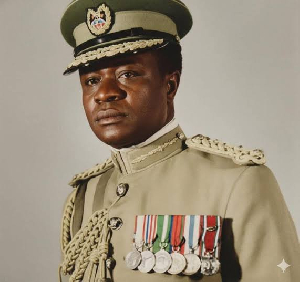
At the second General I.K. Acheampong Memorial Lecture held at the Marriott Hotel in Accra on 13 November 2026, veteran businessman Sir Sam Jonah delivered a powerful address that reignited a national conversation about one of Ghana's most controversial and consequential leaders, General Ignatius Kutu Acheampong.
The lecture, themed "Breaking the Silence: The Human and Political Complexities Behind the Leadership of General Kutu Acheampong," challenged decades of political silence surrounding the former Head of State and called for a more balanced assessment of his legacy.
According to Sir Sam Jonah, Acheampong became what he described as an "orphan of Ghana's politics", largely because neither of Ghana's two dominant political traditions fully embraced his legacy.
"He became an orphan of Ghana's politics," Sir Sam Jonah observed, noting that Acheampong overthrew the Progress Party government, widely regarded as the political ancestor of today's New Patriotic Party (NPP), and was later executed by the Armed Forces Revolutionary Council (AFRC), often associated with the roots of the National Democratic Congress (NDC).
For nearly five decades, discussions about Acheampong have often focused on the circumstances of his overthrow and execution.
Yet, Sir Sam Jonah argued that such a narrow focus has prevented generations of Ghanaians from examining the larger ideas and philosophies that shaped his leadership.
Patriotism Beyond Slogans
One of the central themes of the lecture was Acheampong's belief that patriotism was not merely ceremonial but a practical commitment to national development and discipline.
"No nation can thrive without patriotism and discipline," Sir Sam Jonah stressed.
Like Ghana's first President, Dr Kwame Nkrumah, Acheampong believed that patriotism required more than public displays of nationalism.
"Patriotism is not singing and dancing, Patriotism is character."
Perhaps one of Acheampong's most enduring contributions was the introduction of Ghana's National Pledge in 1973.
Through daily recitations in schools, the National Redemption Council sought to cultivate a generation committed to national service and civic responsibility.
For many Ghanaians who grew up during that period, the pledge represented more than a routine exercise.
"We were taught that Ghana had a good name, and it was our duty to uphold and defend it," Ras Mubarak reflected.
Today, he argues, many Ghanaians still recite the pledge but have drifted away from the values it represents.
"We still recite it in most schools, but we no longer live it."
He cited growing indiscipline in public life, from poor sanitation and reckless driving to corruption and disregard for public property.
Fearless Honesty and National Values
The lecture also revisited Acheampong's role during a significant period of national identity-building.
Sir Sam Jonah noted that today's national anthem, God Bless Our Homeland Ghana, emerged during Acheampong's era after a national competition.
Its powerful words continue to challenge Ghanaians to live by the values of honesty, humility and courage.
"Fill our hearts with true humility; make us cherish fearless honesty."
For Jonah, these are not merely poetic words.
"Fearless honesty. When was the last time we demanded that of ourselves?"
He lamented what he sees as a growing intolerance for truth-tellers in contemporary politics.
"Those who speak honestly are often excluded because they will not condone sycophancy and corruption."
A Philosophy Against Corruption
One of the recurring themes of Acheampong's political philosophy was that genuine patriotism is incompatible with corruption.
Sir Sam Jonah referenced a statement long associated with Acheampong's beliefs:
"If you love your country, you will not steal the country's money."
"If you love your country, you will not take goods meant for the people and smuggle them outside."
"If you love your country, you will not sell the country to outsiders."
While acknowledging that the exact wording could not be historically verified, Jonah insisted that the sentiment accurately reflected Acheampong's worldview.
"It is true to his philosophy."
The Spirit of "Yentua"
Jonah also defended Acheampong's controversial economic nationalism, particularly the celebrated "Yentua" policy.
In 1972, the government refused to honour approximately US$90 million in supplier credits that it considered tainted by corruption and overpricing.
"Yentua was negotiation, not recklessness," Jonah argued.
"He was prepared to accept short-term difficulty for long-term national dignity."
Similarly, Acheampong's famous Operation Feed Yourself programme was praised as one of the boldest attempts to achieve food self-sufficiency.
"A nation that cannot feed itself will struggle to realise the full promise of independence," Sir Sam Jonah said.
He noted that Ghana dramatically reduced rice imports during the programme's peak years, demonstrating what national mobilisation could achieve.
Discipline as a National Project
The lecture linked Acheampong's emphasis on patriotism and discipline to contemporary efforts by the government to strengthen civic responsibility among young people.
Ras Mubarak welcomed the National Service Authority's Basic Military Training Programme, describing it as a step in the right direction.
"It is a positive step."
However, he argued that such training should be extended beyond university graduates to include all senior high school leavers.
"To leave them out is to say discipline is only for the privileged. That cannot be right."
He warned that limiting such programmes to a small segment of society could create unequal citizenship experiences.
"A nation cannot be disciplined in half."
According to him, the formative years immediately after senior high school present the best opportunity to cultivate discipline, patriotism and national consciousness.
"That is when a young man or woman must learn to put Ghana first."
A Complex Legacy
Neither Sir Sam Jonah nor Ras Mubarak attempted to portray Acheampong as flawless.
Both acknowledged the difficulties and controversies associated with his administration, including economic challenges, the rise of Kalabule, and divisions created by the Union Government proposal.
"He was not a saint," Mubarak admitted.
Yet both argued that history must evaluate him in his entirety.
"Judge the man whole, the vision and the blindness, the triumph and the disappointment."
That, they insist, is the true meaning of Sankofa.
"Se wo were fi na wosankofa a yenkyi" it literally means, "It is not wrong to go back for what you have forgotten."
Finishing the Work
For Mubarak, the real significance of revisiting Acheampong's legacy is not nostalgia but national renewal.
He believes Ghana has drifted away from many of the values that Acheampong sought to instill: patriotism, self-reliance, discipline, honesty and national pride.
"We have forgotten how to love Ghana enough not to steal from her."
"We have forgotten how to feed ourselves."
"We have forgotten how to recite a pledge and mean it."
In closing, Mubarak argued that Acheampong's greatest ambition was to build a generation of Ghanaians who would place the national interest above personal gain.
"Acheampong was ahead of his time because he tried to build a Ghanaian who would not sell his country for a pittance."
And with that, he offered one final challenge:
"It is time to finish that work."
Ras Mubarak | Pan-Africanist | Politician | Former Legislator