This blog is managed by the content creator and not GhanaWeb, its affiliates, or employees. Advertising on this blog requires a minimum of GH₵50 a week. Contact the blog owner with any queries.
Harry Graphic Blog of Thursday, 24 September 2026
Source: Harry Graphic
You Can Suspend a Man But Can You Suspend a Stool?
- Share:


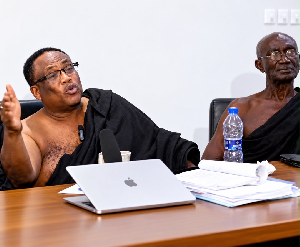
Wenchi's Twafohene was ready to tell the Bono Regional House of Chiefs how a Wenchihene is properly enstooled. Now he faces what two royal families call a purported destoolment, and the Twafo Stool itself is reported to have been suspended. The families are asking a question that should trouble anyone who cares about custom: by whose authority, and by what process?
In the old Akan order of battle, the Twafo marched in front. They were the advance guard, the company that moved ahead of the main body to find the path and meet whatever waited on it before anyone else had to. It was never the comfortable place in the column. It belonged to those whose duty was to go first.
The wars ended long ago, but the office outlived them, as so much of Akan statecraft has. It survives in the stools of the traditional areas, in the order of seating at a durbar, in who speaks when, in whose consent is needed before a thing is done. In Wenchi, in the Bono Region, the Twafo Stool is held, as far as the Twafo Family and two of Wenchi's royal families are concerned, by Nana Akora Tua Adutwum Kyereme Konfour IV.
Lately the vanguard has found itself out in front again, and badly exposed.
A witness, then a storm
On Saturday, 5 September 2026, the family heads and senior members of the Sofoase and Nkwaduano Yefri Royal Families of Wenchi held a press conference on recent developments affecting chieftaincy, customary lands and peace in Wenchiman. Of the six matters their statement raises, this is the first. That ordering is not accidental. When people sit down to write a document of that kind, what they put at the top is what frightens them most.
They strongly condemn what they describe as the intimidation, harassment and purported destoolment of the Twafohene, and they make clear that the Twafo Family and the two royal families continue to recognise him as the lawful Twafohene of the Wenchi Traditional Area.
What troubles them most is the sequence. According to the statement, these developments arose against the background of the Twafohene's preparedness to give evidence before the Judicial Committee of the Bono Regional House of Chiefs concerning the customary processes for the enstoolment of a Wenchihene. In Wenchi, that is not an academic subject. Whether Mr Kwaku Damoah was validly nominated and enstooled as Wenchihene is precisely the question that has been waiting before the Regional House since 2019.
The families choose their words with unusual care. They do not claim to know anyone's motives. They say they are "concerned about the apparent connection" between his willingness to give that evidence and the actions subsequently taken against him. It is a restrained sentence. It is also, if the concern proves well founded, a grave one, because a judicial process can only ever be as honest as the witnesses who are free to walk into it.
“A judicial process can only ever be as honest as the witnesses who are free to walk into it.”
What the Council has said
The other side has spoken in public too, and it deserves to be heard.
When the suspension was announced at a meeting of the Wenchi Traditional Council, it was reported that the Twafo Stool had been "overturned" so that allegations against the Twafohene, including matters relating to land, could be investigated. The public and the media were told not to deal with him as a sub-chief in the meantime, and he was warned against presenting himself as one or using the title, on pain of further sanctions.
Read that account slowly and it makes the families' point for them. An investigation, by definition, has not finished. Allegations under investigation are, by definition, unproven. Yet the penalty has arrived ahead of the finding: a chief suspended, a stool overturned, and a public instruction that nobody should treat him as the chief his own family still says he is.
The families answer this in a single line that any elder would recognise. Whatever allegations may have been made against him, "accusation cannot by itself amount to guilt." He must be informed of the case against him, given a fair opportunity to respond, and dealt with through the applicable customary and lawful processes.
Anyone who has sat through a family meeting in Ghana knows that rule, even without the Latin for it: audi alteram partem, hear the other side. You do not pronounce on a nephew's conduct before he has opened his mouth. You do not settle a boundary quarrel with only one farmer in the room. You do not let the loudest voice in the courtyard stand in for the evidence. The principle is older than any court in Sunyani, and it does not lapse because the accused happens to be a chief.
"Not in our name"
One sentence in the statement deserves to be read twice. The Twafo Family, it says, maintains that it has not destooled the Twafohene.
Consider the weight of that. In much of Akan custom, the power to remove a chief travels with the power to install one. Destoolment is not an announcement; it is a process, and it belongs to the stool's own people. There are charges to be laid, elders to be convened, a case to be answered, and finally acts whose symbolism every Akan community understands without explanation. It is deliberately difficult, because a people who could unmake a chief casually would be a people whose chiefs answered to nobody but the powerful.
Here, the family to which the Twafo Stool belongs is saying, in effect: not in our name.
That leaves a wide gap between what has been announced and what custom is said to recognise, and the families decline to paper over it. In their view, a unilateral pronouncement cannot, by itself, finally determine the status of the Twafohene or the Twafo Stool. Any legitimate determination, they argue, must follow the appropriate customary and judicial processes.
A stool is not a chair
Then there is the stool itself.
The families say they are concerned by reports that it is the Twafo Stool, rather than merely its occupant, that has purportedly been suspended. They single this out, and it is worth understanding why.
To an outsider a stool is furniture. To the Akan it is closer to a living archive. The stools of revered ancestors are blackened and kept, remembered and honoured long after the men and women who sat on them are gone. A stool carries a lineage, a history and the accumulated obligations of every occupant before the present one. Whoever sits on it is its custodian for a season. It was there before him, and it is meant to be there long after him.
So when the families insist that the customary basis, authority and process for any such suspension must be clearly established, they are not splitting hairs. A stool, in the words of their statement, "is an institution with its own history, lineage and customary significance, and its status cannot be treated as indistinguishable from that of its present occupant."
You can suspend a man, where custom and due process allow it. Suspending a stool is a far larger act, and the burden of justifying it is heavier to match.
“You can suspend a man. Suspending a stool is a far larger act.”
Why the land keeps coming up
One thread runs through nearly everything now unsettling Wenchi, and it runs through this story too.
The Twafohene, the statement records, has publicly objected to what he considers an unlawful and unfair allocation of approximately 14,000 acres of land belonging to different families and lineages to an individual by Mr Kwaku Damoah. The families add their own view: any such serious dispute over customary lands must be handled transparently and through the proper customary and lawful processes.
The Traditional Council, on the published account of its announcement, named land among the matters it says it is investigating in relation to the Twafohene. So on one point, remarkably, every side appears to agree: land sits near the centre of this quarrel.
Where they part company is on how such quarrels are to be settled. A dispute over thousands of acres is not resolved by announcement. It is resolved by records, by consents, by witnesses and by reasons given in a forum with jurisdiction to give them. That is slower. It is also the only kind of resolution that still stands ten years later.
What the vanguard is owed
None of this asks anyone to decide today whether the Twafohene is right about the land, or whether the allegations against him have substance. Those are exactly the questions that fair processes exist to answer, and a fair process cannot be run in a newspaper.
It asks something narrower, and harder to argue with: that the processes be allowed to work, and that the man at the centre of them be free to walk into them unafraid.
The two royal families have demanded the immediate cessation of harassment, intimidation and unilateral actions directed at the Twafohene. They have said they will not sit idly by while legitimate chiefs and customary authorities are subjected to actions contrary to the customs and traditions of Wenchi. And in the same breath, more than once, they have said that their objective is not to create conflict but to prevent it.
Those two positions sit comfortably together. They are the voice of people who want this settled in a hearing room rather than on a street.
The Twafo once went ahead so that the whole column could follow in safety. If Wenchi genuinely wants to establish how its paramount stool ought to be filled, it should want to hear from the man whose office once cleared the road. Let him speak. Let any charges against him be put to him plainly, with a real opportunity to answer. Let the forum seized of the Wenchihene matter decide it, on evidence, in the open.
Anything less is power borrowing custom's cloth.
SOURCING NOTE
This article draws on the statement issued by the Sofoase and Nkwaduano Yefri Royal Families of Wenchi on 5 September 2026, and on published reports of the Wenchi Traditional Council's announcement. None of the allegations referred to has been determined by a court or a customary tribunal.
Watch