This blog is managed by the content creator and not GhanaWeb, its affiliates, or employees. Advertising on this blog requires a minimum of GH₵50 a week. Contact the blog owner with any queries.
GH Blinks Blog of Friday, 13 February 2026
Source: Gh Blinks Atule Joseph Atanga
Why Soybean Must Be Treated as a “Political Crop” in Ghana – Much Like Cocoa
- Share:


By: George Agana Awuni PhD
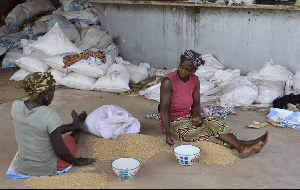
Last week, I shared my views on why Ghana needs a Soybean Promotion Board. This piece builds on that argument by exploring why soybeans must be treated as a “political crop” through a Soybean Promotion Board. For more than a century, cocoa has occupied a privileged place in Ghana’s political economy. Today, cocoa is not merely an agricultural commodity but a national institution. It enjoys guaranteed pricing, dedicated research, strong extension, export coordination, and high-level political attention. Soybean, by contrast, is treated as a “minor food crop,” despite its strategic importance for food security, livestock, industry, and regional equity.
This imbalance is costly, and Ghana must look soybeans as a source of industrialization, import substitution, nutrition, and northern development rather than just another crop. This might sound like wishful thinking or a policy daydream. But cocoa was not born “political.” It was made political because the nation decided it mattered.
Soybeans by contrast, is considered a “minor” food/industrial crop, grown mostly by northern smallholders, and largely ignored by macroeconomic policy. Elevating soybeans to the status of a political crop, just like cocoa must be a deliberate decision and effort.
Soybean is strategic to national food and nutrition security
Soybeans are one of the most affordable sources of high-quality protein. In a country facing rising food prices and malnutrition, especially among children and women, soybean directly supports nutrition through soy-based foods, fortified staples, and complementary feeding. Treating soybean as a political crop would justify sustained public investment to stabilize supply, improve quality, and make protein accessible nationwide.
Soybean underpins livestock, poultry, and aquaculture growth
Ghana’s poultry and livestock sectors are crippled by dependence on imported soybean meal. This drains foreign exchange and exposes farmers to global price shocks. Elevating soybeans to political-crop status would align agricultural policy with industrial needs, ensuring reliable domestic supply for feed mills and reducing imports. Cocoa once played this role for export earnings; soybean can play it for import substitution and industrial resilience.
Soybean is a tool for inclusive regional development
Cocoa transformed southern Ghana’s rural economy because it received political backing, roads, research stations, marketing boards, and price guarantees. Soybean has the same potential for northern Ghana, where poverty rates are higher and climate risks are greater. A political-crop approach would mean targeted infrastructure, irrigation, mechanization, and credit in the savanna zones, turning soybean into a vehicle for spatial equity and political stability
Soybeans are a climate-smart crop and fit well with climate smart agriculture
Unlike cocoa, soybean fixes nitrogen, improves soil fertility, and fits well into cereal-based systems. In an era of climate stress and expensive fertilizer, this ecological value is not optional, it is strategic. Political recognition would support breeding programs for drought tolerance, promote rotations with cereal crop with is a dominate cropping system of northern Ghana and scale agroecological practices that reduce input dependence. It will also reduce the impact of Striga, an endemic parasitic weed in cereal crop yield reduction.
Markets don’t self-organize, politics does
Cocoa’s success was never the result of “free markets.” It was built through deliberate state action: guaranteed minimum prices, quality control, coordinated exports, and farmer support. Soybean suffers from price volatility, weak aggregation, and poor bargaining power for smallholders. Treating it as a political crop would legitimize instruments that support floor price or price-stabilization mechanism, public–private aggregation and storage systems, and coordinated linkages between farmers, processors, and feed mills.
Suffice to use Malaysia’s example. Oil palm (Elaeis guineensis) is indigenous to West Africa, including Ghana. Yet it was Malaysia that transformed the crop into a global economic powerhouse. Malaysia deliberately imported improved planting materials from West Africa and embedded it within a coordinated national development strategy. The government invested in state-backed plantation expansion, established strong research and regulatory institutions such as the Malaysian Palm Oil Board (MPOB), implemented the Federal Land Development Authority (FELDA) smallholder integration schemes, developed large-scale processing infrastructure, and pursued an export-oriented industrial policy.
Through this integrated and politically prioritized approach, Malaysia converted a tropical crop into a strategic economic pillar. Today, it ranks second among the world’s largest palm oil exporters.
Soybean aligns with Ghana’s industrial and trade ambitions
From edible oil and animal feed to soy-based foods and pharmaceuticals, soybean is a platform crop for agro-industrialization. Countries like the United States, Brazil realized the importance soybeans long before hand. Elevating it politically would signal seriousness to investors and regional partners, positioning Ghana as a soybean hub in West Africa, much as cocoa positioned Ghana globally.
The bottom line
Crops become “political” when governments recognize that their benefits extend beyond farms—to nutrition, industry, foreign exchange, regional balance, and national stability. Cocoa earned that status decades ago and soybeans in all aspects meet every criterion to join it. Treating soybeans as a political crop is not favoritism but foresight. Ghana cannot industrialize on cocoa alone. The next chapter of agricultural transformation, especially for the north, runs through soybeans.





Entertainment