This blog is managed by the content creator and not GhanaWeb, its affiliates, or employees. Advertising on this blog requires a minimum of GH₵50 a week. Contact the blog owner with any queries.
EnewsGhana Blog of Thursday, 22 January 2026
Source: EveryWhere DerrickManny
I Never Knew the Commercial Value or Revenue my Picture Generated after It was Commercialized - The Lady Behind Ghana’s Iconic Akwaaba Photo Recounts
- Share:


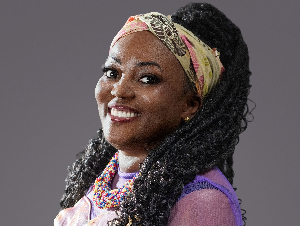
For years, it has smiled silently from the walls of homes, hotels, offices, and public institutions across Ghana and beyond. The image is instantly recognisable: a graceful Ghanaian woman holding a calabash and a clay pot, pouring water in a gesture of warmth and welcome. It is widely known as the Akwaaba picture, a visual symbol of Ghanaian hospitality and cultural pride.
Yet behind this iconic photograph is a woman whose story has largely remained untold.
Her name is Angelina Nana Akua Oduro, the woman in the photograph, and until today, she insists she never knew the commercial Value or Revenue her Picture Generated after it was commercialised.
A Childhood Dream in North Kaneshie
Angelina Nana Akua Oduro's story begins in North Kaneshie, Accra, where she grew up as a child in the late 1980s and early 1990s. Her mother was passionate about Ga kenkey, often sending her on errands to buy vegetables and kenkey. One of the routes Angelina Nana Akua Oduro frequently walked through was an area known as Dance Bar, a popular club and restaurant at the time.
Along that path was a painting that always caught her attention.
It was an image of a smiling woman holding a calabash and a clay pot, gently pouring water. Every time she passed, Angelina stopped to admire it. At just nine years old, she felt an immediate connection to the image.
“I saw myself in that picture,” she recalls. “I used to say to myself, one day I will grow up to be this beautiful. One day, I will take a picture like this and hang it in my hall.”
What began as a quiet childhood admiration slowly became a personal dream, one that stayed with her for years.
Turning a Dream into a Photograph
As Angelina Nana Akua Oduro grew older, the image never left her mind. Between the ages of 16 and 18, she met Mr Joseph Osae, a photographer. During their interaction, she shared the childhood dream she had carried for nearly a decade, the image of a woman welcoming the world with a calabash.
The photographer agreed to help her recreate it.
Angelina Nana Akua Oduro paid for the photo session herself. The concept, pose, and symbolism were all inspired by the painting she had admired as a child. Her intention was never commercial. The photograph, she says, was meant for one purpose only: to be framed and displayed in her living room as a personal fulfilment of a promise she made to herself.
“I did not take the picture for sale. I took it for myself,” she emphasises.
An Image That Took on a Life of Its Own
Sometime after the photographs were taken, the photographer returned with unexpected feedback. He told Angelina Nana Akua Oduro that the image was exceptionally beautiful and well-received.
What she did not know then or for many years afterwards was that the photograph had entered commercial circulation.
“I did not know that the photographer had commercialised my picture to date,” Angelina Nana Akua Oduro.
Unbeknownst to her, the image was reproduced, framed, and distributed widely. Over time, it found its way into countless spaces and gradually evolved into what many now recognise as the Akwaaba image, a cultural visual shorthand for welcome, warmth, and Ghanaian identity.
The photograph crossed borders, appearing in diaspora homes and tourism spaces, further cementing its status as a national cultural symbol.
Recognition Without Consent.
Despite the photograph’s widespread use and cultural significance, Angelina Nana Akua Oduro says she was never formally informed, credited, or consulted about its commercial distribution.
Her revelation raises broader questions about image rights, consent, authorship, and recognition, particularly within Ghana’s creative and cultural ecosystem, where many contributors to iconic works remain invisible or uncompensated.
While Angelina Nana Akua Oduro’s story is not framed as a legal battle, it is a powerful reminder of how easily personal stories can be absorbed into national culture without acknowledgement of the individuals behind them.
“It is strange to see yourself everywhere and yet be unknown,” she reflects.
More Than a Photograph
Today, the Akwaaba image is more than just a picture. It is a cultural artefact used to communicate welcome, identity, and tradition. But for Angelina Nana Akua Oduro, it remains deeply personal.
It is the fulfilment of a childhood dream, shaped by memory, imagination, and innocence. That it became a household image was never planned.
Her story highlights the unseen human narratives behind Ghana’s most familiar cultural symbols and underscores the need for stronger conversations around creative ownership, ethical practice, and historical documentation.
Reclaiming the Story
As Angelina Nana Akua Oduro steps forward to tell her story publicly, she hopes not only to be recognised but to ensure that future generations of creatives, especially young girls with dreams, are protected, acknowledged, and respected.
Behind the Akwaaba smile is not just an image.
Behind it is a child who dreamed.
A young woman who trusted.
And a story that Ghana is only now beginning to hear.
And her name is Angelina Nana Akua Oduro.