This blog is managed by the content creator and not GhanaWeb, its affiliates, or employees. Advertising on this blog requires a minimum of GH₵50 a week. Contact the blog owner with any queries.
DjQwequ Blog of Monday, 3 March 2025
Source: Emmanuel Jacob Amissah
Mahama petitioned to grant Ato Essien presidential pardon
- Share:


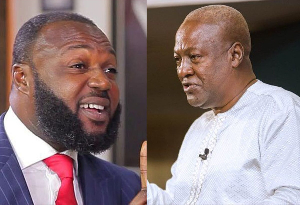
William Ato Essien, an entrepreneur and the creator of First Capital Plus, which subsequently changed its name to Capital Bank, is being petitioned to receive a presidential pardon from President John Dramani Mahama.
An Accra High Court sentenced Essien to 15 years in prison after he was accused of embezzling more than GH¢90 million in liquidity support that Capital Bank received from the Bank of Ghana.
He was first offered the chance to avoid a jail sentence by agreeing to reimburse the state GH¢90 million, but he did not fulfill the requirements of the payment that were agreed upon with the Attorney General and the court.
Essien was unable to pay the remaining GH¢60 million in the agreed-upon installments after paying GH¢30 million in full in December 2022. The court imposed a prison sentence since he did not meet the payment obligations.
However, the lawyer Andrew Appiah-Danquah's appeal, which was filed on Thursday, February 27, raised grave questions regarding the justice and integrity of Essien's conviction and incarceration.
As the founder of Capital Bank, Essien's leadership and inventiveness created thousands of jobs, bolstered local companies, and empowered Ghanaian entrepreneurs, among other noteworthy achievements to Ghana's financial industry, were emphasized in the petition.
The petition argued that his conviction undermined the achievements of a visionary entrepreneur who proved that local enterprises could thrive in a competitive financial sector.
Other facts of the petition were that “Capital Bank’s collapse in 2017 was not due to fraud but a politically orchestrated move to consolidate financial power. Mr. Essien refused to bow to political pressure to cede control of his bank to powerful interests, which ultimately led to its targeted demise. The GH₵ 620 Million Liquidity Support Was a Commercial Loan, Not a Fraud…Capital Bank was repaying this loan and had already paid GH₵ 336 million in interest over two years—clear evidence that it was a legitimate banking transaction.
“The GH₵ 480 million described as a “shareholder loan” was not stolen but rather a strategic restructuring of non-performing loans accumulated over 14 years. Such restructuring is a common financial practice aimed at strengthening a bank’s financial position and was not an act of fraud. The Court’s Acquittal of Others Contradicts Ato Essien’s Conviction
“Three other accused persons—Dr. Tetteh Nettey, Rev. Fitzgerald Odonkor,and Kate Quartey-Papafio—were acquitted on the same charges for which Mr. Essien was convicted. The court held that: The GH₵ 70 million transaction involving Kate Quartey-Papafio was fully accounted for. The GH₵ 130 million transaction involving Dr. Tetteh Nettey was fully accounted for. The GH₵ 27.5 million transaction involving Rev. Fitzgerald Odonkor was legal and authorized.
It went on to say that the state has a duty to examine Mr. Essien's conviction and make sure justice was done after the court ruled that the payments that formed the foundation of the allegations were legal.
“To avoid a prolonged trial, Mr. Essien was pressured into a plea bargain, agreeing to pay GH₵ 90 million—an amount significantly higher than the alleged loss which he has already paid GH₵ 43.75 million.
For this reason, it petitioned the president to pardon Mr. William Ato Essien.
The petition further stated that "granting Ato Essien a Presidential Pardon will not only restore justice but also affirm your commitment to a truly new Ghana—one where freedom and justice are not just words but lived realities."