This blog is managed by the content creator and not GhanaWeb, its affiliates, or employees. Advertising on this blog requires a minimum of GH₵50 a week. Contact the blog owner with any queries.
DC Kwame Kwakye Blog of Thursday, 11 December 2025
Source: KWAME KWAKYE
From Plates to Health: The Case for Warning Labels on Packaged Foods in Ghana
- Share:


Every day, Ghanaian families make decisions at the market: what snack to buy for the children, which drink goes into the fridge, what to pack for lunch. For decades, decisions were simple. Roots, tubers, fresh vegetables, fruits, legumes - largely unprocessed.
But today, the shelves are glutted with brightly packaged foods: chips, sugary drinks, instant noodles, biscuits, many of which are laden with sugar, salt, saturated fat (trans fat). What may seem like an innocent snack can contribute, over time, to life-changing diseases: obesity, diabetes, and heart conditions.
The result? A rising tide of non-communicable diseases. According to the 2023 nationwide Ghana STEPS Report 2023, conducted under the supervision of World Health Organization (WHO) and Ghana’s Ministry of Health, risk factors for NCDs are widespread across the country. Moreover, medical records and health facility surveys confirm that a substantial proportion of patients live with NCDs like hypertension and diabetes.
We must face a harsh truth: for many Ghanaians, what you don’t know about what you eat may be killing you slowly, silently, but surely. And the statistics are alarming. Chronic non-communicable diseases (NCDs) now contribute significantly to Ghana’s mortality and morbidity, especially with rapid urbanisation and lifestyle changes. A 2024 scoping review recently reinforced that diabetes remains a major burden in Ghana, with economic, social, and health consequences for individuals, families, and the health system.

So what’s the answer? Empowered consumers: Front-of-Pack Warning Labels.
Imagine standing in a supermarket. On one shelf, cornflakes labelled “high fibre” but loaded with sugar. On another, biscuits boasting “less fat” while still high in calories. The current system leaves too much room for marketing tricks and misleading packaging.
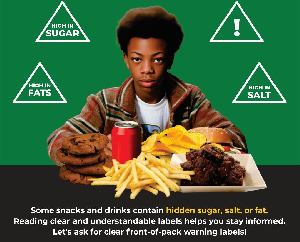
FOPWL changes that. Bold, front-facing warning labels, visible at a glance on any food “high in sugar”, “high in salt/fat”, or “high in calories.” No fine print. No confusion. Just clarity.
That’s why advocacy groups are mobilizing. SEND GHANA and GAND have joined forces, along with academic partners like KNUST, to demand that Ghana adopt national standards for food labelling.
In recent public forums and symposia, experts have argued that FOPWL is not only feasible but necessary, especially given Ghana’s heavy reliance on imported and processed foods and the limited capacity of the health system to manage rising NCDs.
You cannot eat what you can’t identify. That’s why mandatory Front-of-Pack Warning Food Labels (FOPWL) must become part of Ghana’s public health strategy.
Under a strong FOPWL policy:
• Every packaged product high in nutrients of concern including sugar, salt, and saturated fat would carry a front-pack warning.
• Labels help all consumers - even people with limited reading skills can make informed choices at a glance.
The impact is not theoretical. In Latin America, countries like Mexico, Chile, Peru and Uruguay have adopted mandatory warning-label schemes. In Chile, the labelling law contributed to a measurable drop in purchases of sugary drinks and unhealthy snacks.
Experimental research supports the claim. A 2023 study in Guatemala showed that warning labels reduced purchase intention of unhealthy foods and improved people’s ability to correctly assess nutrient content versus guideline-based labelling. Another 2025 global experimental study found warning labels influenced healthier product choices across countries.
The evidence is clear: FOPWL works.
Prevention is better than cure and cheaper too.
For Ghana, the economic and social burden of diabetes and other NCDs is enormous. According to the latest estimates, treating and managing diabetes places heavy demand on the health system and households alike. Hence, when all Ghanaians, especially the most vulnerable, know what they’re eating, it becomes an inexpensive, equitable, and effective public health intervention.
Investing in labelling is investing in our nation’s future: healthier children, fewer sick adults, lower healthcare costs, and stronger communities.
That’s why I call on our policymakers, regulators, and food industries: please support and enact a mandatory Front-of-Pack Warning Label policy for Ghana. Let us choose health. If Ghana cares about the health and future of its people, we must act now. Demand. Advocate. Protect. Because when we know what we eat, we can choose life.
By: Helena Amoah (Nana Aba Appiatewaa)






Entertainment