This blog is managed by the content creator and not GhanaWeb, its affiliates, or employees. Advertising on this blog requires a minimum of GH₵50 a week. Contact the blog owner with any queries.
Attractive News Blog of Saturday, 24 January 2026
Source: Andre Mustapha NII okai Inusah
PRINPAG President David Tamakloe Opens National Economic Reporting Workshop with Bank of Ghana
- Share:


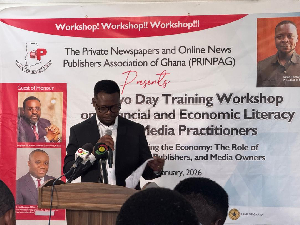
The President of the Private Newspapers and Online Publishers Association of Ghana (PRINPAG), David Sitsopé Tamakloe, has officially opened a national capacity building workshop on economic and financial reporting, organised in partnership with the Bank of Ghana.
The two-day workshop, which commenced on February 24, 2026, brings together 45 participants, made up of 44 media professionals and one media consultant, drawn from PRINPAG member institutions across the country.
Speaking at the opening ceremony, Mr. Tamakloe expressed appreciation to the Bank of Ghana for its foresight, partnership, and sponsorship, describing the initiative as a major step toward strengthening collaboration between the media and the nation’s central bank.
“This workshop is not a routine gathering. It is a direct response to the conversations we began with the Bank’s leadership during the New Year Media Engagement,” he stated.
He noted that the programme reflects the commitment of the Governor of the Bank of Ghana, Dr. Johnson Pandit Asiama, to deepen engagement with the media and expand training opportunities for journalists covering economic and financial issues.
Mr. Tamakloe underscored the growing influence of the media in shaping public confidence and market expectations, recalling the First Deputy Governor’s observation that “communication is policy.”
According to him, inaccurate or poorly contextualised reporting could have far-reaching consequences for economic stability, making capacity building for journalists more essential than ever.
The workshop is being held under the theme “Resetting the Economy: The Role of Journalists, News Publishers, and Media Owners.” Sessions are focused on improving understanding of monetary policy tools, inflation dynamics, foreign exchange mechanisms, banking sector resilience, and digital finance innovations.
Reflecting on Ghana’s recent economic journey, the PRINPAG President described 2025 as a year of difficult but necessary adjustments that led to the restoration of stability.
“As we move into 2026, a year dedicated to consolidation and discipline, the role of the media becomes even more critical,” he said, adding that economic stability must be clearly explained, protected, and nurtured through responsible journalism.
Mr. Tamakloe urged participants to actively engage resource persons from the Bank of Ghana and other disciplines, ask probing questions, and seek clarity on complex economic data to enhance public understanding.
He reaffirmed PRINPAG’s commitment to strengthening professionalism within the media industry and deepening partnerships that promote national development.
The workshop features presentations by senior officials of the Bank of Ghana and other experts and is expected to equip journalists with the skills needed to report Ghana’s economic story with greater accuracy, balance, and depth.
Mr. Tamakloe concluded by formally declaring the workshop open and expressing confidence that the deliberations would contribute meaningfully to informed public discourse and sustained economic stability.