This blog is managed by the content creator and not GhanaWeb, its affiliates, or employees. Advertising on this blog requires a minimum of GH₵50 a week. Contact the blog owner with any queries.
Attractive News Blog of Wednesday, 25 March 2026
Source: Andre Mustapha NII okai Inusah
Ghana Becomes First African Nation to Seal Defence Pact with European Union
- Share:


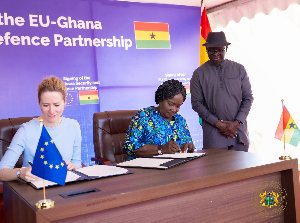
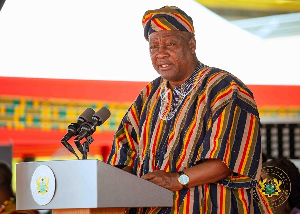
Kaja Kallas and Jane Naana Opoku-Agyemang have formalised a landmark Security and Defence Partnership between the European Union and Ghana, marking the first such agreement between the EU and an African country.
The agreement, signed in Accra on Wednesday, signals a major shift in Afro-European relations—from traditional aid frameworks to a strategic alliance anchored on mutual security and shared geopolitical interests.
A new chapter in Afro-European relations
Speaking at the ceremony, Kallas described the pact as a necessary response to evolving global threats, noting that the partnership elevates EU-Ghana relations beyond trade and development.
“Today, we are taking it to a new level, further signing a new Security and Defence Partnership. This is the first of its kind in an African country,” she stated.
Vice President Opoku-Agyemang underscored the urgency of collaboration, stressing that modern security challenges require collective action.
“No country can secure itself in isolation,” she said. “The threats facing our sub-region today—from violent extremism to organised crime—are transnational and demand integrated responses.”
Strengthening Ghana’s security capacity
The signing ceremony was followed by the handover of specialised military equipment to the Ghana Armed Forces, including surveillance drones, anti-drone systems, and motorcycles.
The equipment forms part of a €50 million support package delivered in 2023, bringing total EU assistance to Ghana’s peace and security efforts to over €100 million. Additional support is expected in 2026.
Opoku-Agyemang emphasised the importance of proactive security measures, particularly within the Gulf of Guinea.
“Acting together and proactively helps us identify risks earlier and maintain stability at a lower cost than responding after problems occur,” she noted.
Addressing global and regional threats
Discussions during the visit extended to conflicts in Ukraine, Sudan, and the Sahel. Kallas warned against the recruitment of African nationals into foreign conflicts, particularly Russia’s war in Ukraine.
“Your citizens should not be lured into a war that is not theirs,” she cautioned.
The Vice President, however, highlighted underlying socio-economic vulnerabilities that often drive such recruitment, including poverty, exclusion, and environmental pressures. She called for sustained investment in community-based peacebuilding initiatives.
Economic cooperation remains central
Beyond defence, both parties reaffirmed their commitment to economic development under the EU’s Global Gateway initiative, which has already supported the establishment of a vaccine centre and pharmaceutical hub in Ghana.
Opoku-Agyemang stressed that economic empowerment remains the foundation of long-term security.
“Our greatest asset remains our people,” she said, urging that investments target youth and women to unlock Africa’s full potential.
Ghana’s rising continental influence
The agreement comes at a time when Ghana is strengthening its diplomatic standing across Africa. Following endorsement by ECOWAS, John Dramani Mahama is expected to assume the Chairmanship of the African Union in 2027.
Opoku-Agyemang described the period ahead as an opportunity to redefine Pan-Africanism as both a security and economic necessity, anchored in cooperation rather than isolation.
Respecting sovereignty
Officials from both sides were clear that the partnership does not involve the deployment of European troops or the establishment of permanent military bases in Ghana.
Instead, the agreement focuses on strengthening Ghana’s own defence capabilities, particularly along its northern borders and within the Gulf of Guinea, while maintaining full national sovereignty.
A model for future cooperation
The EU-Ghana Security and Defence Partnership is being positioned as a blueprint for future collaboration between Europe and Africa—one rooted in equality, shared responsibility, and mutual respect.
As global uncertainties intensify, both Accra and Brussels are betting that deeper cooperation in security, trade, and governance will serve as a stabilising force, not only for the region but for the wider international community.
Writer’s Name: Andre Mustapha Nii Okai Inusah
Popularly Known As: Attractive Mustapha
Email: attractivemustapha@gmail.com
Contact Number: 0244 259 564