A federal appeals court has ruled that President Donald Trump’s attempt to suspend asylum access at the U.S. southern border is unlawful, blocking the policy because it conflicts with immigration law.
In a decision issued Friday, a three-judge panel of the U.S. Court of Appeals for the District of Columbia Circuit said migrants retain the legal right to seek asylum at the border, rejecting the administration’s effort to bypass that process through executive action.
The case traces back to Trump’s move on Inauguration Day 2025, when he declared the situation at the southern border an invasion and announced he was “suspending the physical entry” of migrants along with their ability to request asylum until further notice.
Judges found that the Immigration and Nationality Act does not give the president authority to create alternative removal procedures or suspend asylum protections laid out by Congress. The panel said the law requires a defined process for handling asylum and anti-torture claims, one that cannot be replaced by unilateral executive measures.
“The power by proclamation to temporarily suspend the entry of specified foreign individuals into the United States does not contain implicit authority to override the INA’s mandatory process to summarily remove foreign individuals,” wrote Judge J. Michelle Childs, an appointee of Joe Biden.
“We conclude that the INA’s text, structure, and history make clear that in supplying power to suspend entry by Presidential proclamation, Congress did not intend to grant the Executive the expansive removal authority it asserts,” the opinion said.
The administration still has options. It can seek review from the full appeals court or take the fight to the U.S. Supreme Court. For now, the ruling is not immediately in force while the court considers whether to revisit the case.
At the White House, officials pushed back quickly. Press secretary Karoline Leavitt, speaking on Fox News, dismissed the outcome as expected and accused the judiciary of bias.
“They are not acting as true litigators of the law. They are looking at these cases from a political lens,” she said.
Leavitt maintained that Trump’s actions fall squarely within presidential authority, describing them as “completely within his powers as commander in chief.” Separately, spokeswoman Abigail Jackson confirmed that the Department of Justice would pursue further review, adding, “We are sure we will be vindicated.”
Immigrant advocates reportedly tagged the decision as a crucial reaffirmation of legal protections. Lee Gelernt of the American Civil Liberties Union said the ruling restores a basic safeguard for those seeking refuge.
“essential for those fleeing danger who have been denied even a hearing to present asylum claims under the Trump administration’s unlawful and inhumane executive order.”
One of the plaintiffs, Las Americas Immigrant Advocacy Center, also welcomed the outcome. Its advocacy director, Nicolas Palazzo, said the judgment reinforces legal limits on presidential power.
“Today’s DC Circuit ruling affirms that capricious actions by the President cannot supplant the rule of law in the United States,” he said.
Not all members of the panel fully agreed. Judge Justin Walker, appointed by Trump, issued a partial dissent. He said the government retains authority to broadly deny asylum applications, though he concurred that migrants cannot be sent to countries where they face persecution or be stripped of mandatory procedural protections.
Judge Cornelia Pillard, an appointee of Barack Obama, also sat on the panel.
Trump’s order leaned on a provision of the INA allowing presidents to block the entry of groups deemed harmful to U.S. interests. It went further by halting asylum requests outright, a step the court has now rejected.
The policy was part of a broader tightening of asylum access that has unfolded across administrations. While restrictions deepened under Donald Trump, limitations also expanded during the Biden era, though some narrow legal pathways remained open for certain migrants at the southern border.
Beyond the courtroom, the human impact continues to unfold. In southern Mexico, where many migrants have been stranded, the ruling offered a measure of cautious optimism.
For Josue Martinez, a psychologist working in a small shelter, the decision hinted at possible relief after months of uncertainty.
“I hope there’s something more concrete, because we’ve heard this kind of news before: A district judge files an appeal, there’s a temporary hold, but it’s only temporary and then it’s over,” he said.
Many migrants, including those from Haiti, Cuba and Venezuela, remain in precarious conditions in Mexico, struggling within an overstretched asylum system weakened by funding cuts. Earlier this week, hundreds left the city of Tapachula on foot, searching for better prospects elsewhere in the country.
World News of Sunday, 26 April 2026
Source: face2faceafrica.com
Appeals court strikes down Trump border asylum ban as unlawful
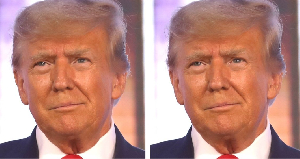 President Donald Trump of the USA






Entertainment