The UK stock market opened slightly higher on Wednesday despite continuing energy price volatility over fears that the US-Israel war with Iran may drag on.
In London, the FTSE 100 index edged ahead alongside positive trading in Germany and France, contrasting with Asian share which fell for a third day.
South Korea and Thailand stock markets were forced to temporarily halt trading on indexes after plunging by more than 8% and triggering so-called circuit breakers, which aim to avoid panic selling.
Brent crude rose 2.5% to $83.96 a barrel. It has jumped by 15% since Israel and the US began bombing Iran on Saturday, and Tehran responded by attacking neighbouring Arab countries.
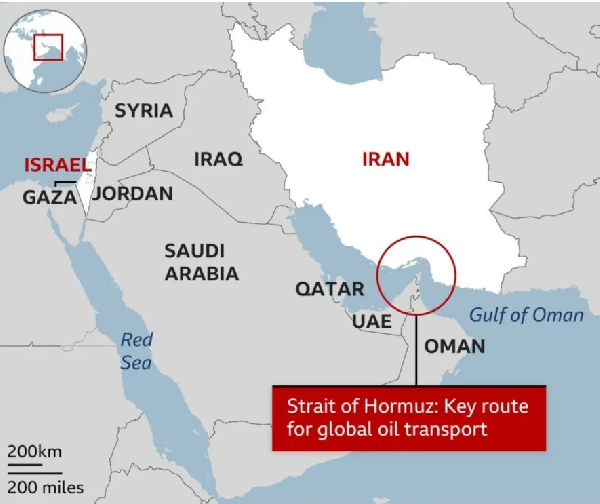
Both oil and gas prices have soared this week after vessels near the crucial Strait of Hormuz shipping lane have come under attack.
Around a fifth of the world's oil and gas usually flows through the narrow waterway between Iran and the United Arab Emirates (UAE).
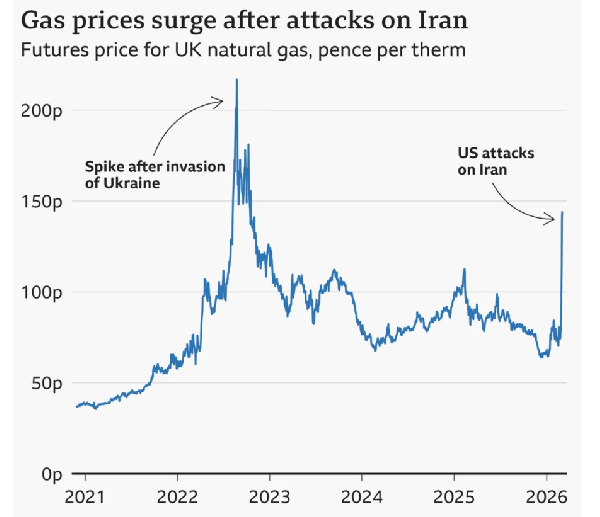
Gas prices continued to be volatile on Wednesday, hovering around 143p per therm in early trading below Tuesday's high of 170p.
Lindsay James, investment strategist at wealth management firm Quilter, told the BBC's Today programme that investors are looking at "a growing probability of this conflict just taking longer to resolve".
But she added it was important to keep in perspective that the current gas price levels were "not anywhere near as significant as we have previously seen" when Russia first invaded Ukraine four years ago.
South Korea's benchmark Kospi index closed 12% lower, while the Nikkei 225 in Japan lost 3.6%. Hong Kong's Hang Seng index dropped 2.5%.
Meanwhile, the price of gold, which is considered a safe-haven asset during economic uncertainty, ticked up to $5,169 in early trading.
Many Asian stock markets have been hit particularly hard as the region imports large amounts of energy from the Middle East, which has to pass through the Strait of Hormuz.
Export-reliant countries like South Korea and Japan are vulnerable to geopolitical shocks that put shipments at risk.
Traffic through the strait has almost entirely halted following Iran's threats to "set fire" to ships. On Wednesday, the UK Maritime Trade Operations Centre reported that a vessel had been struck "by an unknown projectile" close to the UAE.
There was no fire and the crew is safe, it said, but authorities are investigating.
On Tuesday, President Donald Trump said the US Navy will protect ships in the region "if necessary" in a bid to stop the energy supply crunch sparked by the war.
He said Washington will provide risk insurance "at a very reasonable price" to all shipping firms in the region to "ensure the FREE FLOW of ENERGY to the WORLD".
But experts warned his assurances might not be enough to ease companies' concerns.
Stock markets have fallen sharply since the US and Israel attacked Iran over the weekend.
South Korea's Kospi had one of its worst days in decades. Trading was automatically halted for 20 minutes during the morning, as part of an emergency mechanism that is triggered by major falls and is designed to curb panic selling.
It was the first time the circuit breaker had been activated since August 2024.
The Kospi's slide reflects how "fragile" market sentiment has been affected by the conflict, said Jack Lee from the research organisation China Macro Group.
Compared to most other Asian countries China has so far seen relatively little impact.
China's financial market has been "buffered", in part because Beijing has alternative sources of energy, including oil from Russia, said Lee.
But, with the war now in its fifth day, investors are concerned about the potential of it turning into a protracted conflict, he added.
In the UK, Chancellor Rachel Reeves is set to meet with North Sea energy bosses on Wednesday afternoon to discuss the implications of the Middle East conflict "and work with them to manage this uncertain period".
The meeting comes after the chancellor announced her Spring Statement on Tuesday including new economic forecasts by the Office for Budget Responsibility (OBR), estimating that the government's headroom against its fiscal rules had grown from £21.7bn to £23.6bn.
However, the OBR's forecasts were conducted before the conflict and it said the war could have a "very significant" impact on the global and UK economies.
James told the BBC that investors are forecasting higher inflation in the UK "and that could take one of the interest cuts that was pencilled in off the table".
Markets had projected that the Bank of England could cut interest rates twice this year as inflation eased - although it remains above the central bank's 2% target.
The Bank of England will announce the latest interest rate decision on 19 March.
James added that the size of the government's headroom was vulnerable to narrowing.
"The higher fiscal headrooms that [Reeves] was able to announce were built on lower gilt yields, which are now reversing," she said.
"When you actually look at the wider market backdrop to financial markets, it underlines just how weak UK finances still are."
World News of Wednesday, 4 March 2026
Source: bbc.com
UK stock market calms but oil prices rise over fears Iran war may drag on
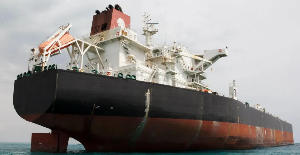 Brent crude rose 2.5% to $83.96 a barrel