PART TWO IN THE QUEEN MOTHER SERIES
By Nana Konadu Yiadom I
Nkosuohemaa of Kwabre Abirem
Barbara Acheampong, MBA, EA, NTPI-F
Nananom, my sisters.
I write this letter not as someone standing outside our institution looking in, but as one of us. I write as a woman freshly enstooled and still learning what this office asks of me. I write with humility to my senior sisters, whose service across decades has shaped what I am now inheriting and whose example forms the ground on which every younger queen mother stands. I write because I believe we owe each other a conversation that our public appearances rarely permit, and because the moment we are living in will not wait for us to have it later.
The clothes are beautiful. The ceremonies are meaningful. The appellations carry history. The respect our communities give us is an inheritance generations before us preserved at great cost. None of this is small, and none of it should be treated as small. But none of it, by itself, is the work. And the work is what I want to write to you about.
I want to ask a question, and I want us to sit with it honestly. What is a Queen Mother for?
Not what she should wear. Not where she should sit at a durbar. Not who should rise when she enters a room. What is she for? What becomes better because there is an Ohemaa in the community? Which girl remains in school because her queen mother intervened? Which struggling mother finds help because her queen mother organized the women around her? Which widow is protected? Which young person finds direction? Which injustice becomes impossible to ignore because an Ohemaa stood up and said, enough?
These are uncomfortable questions. I believe we must ask them anyway. The stool was not entrusted to us merely to give us status. It was entrusted to us so that we could give service.
What We Actually Inherited
Long before development agencies began speaking the language of “women’s empowerment,” African women were already exercising authority within sophisticated systems of family, lineage, commerce, diplomacy, community organization, and traditional governance. Our foremothers advised. They negotiated. They organized. They protected women and children. They traded. They resolved disputes. They preserved lineage and identity. They served as diplomats and, when history demanded it, defenders of their nations.
Our inheritance, therefore, is not one of silence. It is one of responsibility.
Our elders have long said that a wise child honours the mind of her forebears. To honour our foremothers is not only to remember what they did. It is to carry the same seriousness into the work that is now ours.
Within Asante tradition, the developmental role of traditional leadership has taken on renewed importance in the modern era. Under the reign of His Majesty Otumfuo Osei Tutu II, Asantehene, development-oriented traditional leadership has become an increasingly visible part of the work of stools and communities throughout Asanteman. For those of us who serve as Nkosuohemaa, the title itself carries the language of development. It tells us something. It tells us that leadership in this century cannot rest only on ceremony. It must also address the social and economic advancement of our people. The stool I now occupy has therefore caused me to think deeply about what traditional authority must mean in a modern community.
We remember Nana Yaa Asantewaa because when history placed a demand on her leadership in 1900, she did not retreat into ceremony. But Nana Yaa Asantewaa should not become so monumental in our memory that we miss the ordinary lesson her life leaves for leadership. The lesson is not that every queen mother must lead a war. The lesson is that the stool must mean something when the community needs us.
There is a danger in remembering powerful women only as historical figures. We praise them at anniversaries. We print their faces on banners. We tell their stories to schoolchildren. But history becomes comfortable when we admire courage without allowing it to make demands on our own lives. It is easy to celebrate Nana Yaa Asantewaa. The harder question is what courage looks like on my stool today, and on yours.
It is worth remembering that the tradition we inherit is not only historical. It is still being written. In our own time, a Cape Coast woman named Naana Jane Opoku-Agyemang has become the first female Vice President in the history of our republic — the first woman to lead a state university in Ghana as Vice-Chancellor before that, a former Minister for Education who spent her portfolio fighting for the girl child, an advocate whose voice on child marriage, domestic violence, and sexual abuse has shaped a generation of policy in this country. She stands at Golden Jubilee House because Ghanaian women have never accepted that leadership is not their inheritance. If she can carry that authority into the second-highest office of the republic, none of us on our respective stools has any excuse for accepting a smaller version of the leadership our own communities are asking of us.
For one queen mother, courage may mean confronting parents who intend to remove a gifted girl from school. For another, it may mean challenging a practice that continues to harm women simply because it has existed for generations. For another, it may mean demanding accountability for community resources. For another, it may mean gathering unemployed young people and refusing to accept that idleness is their destiny. And for another, it may mean walking into a government office, a university, a bank, a foundation, or a business and asking plainly for the partnership her community needs.
Courage does not always arrive with a war drum. Sometimes it arrives with a school register, a meeting agenda, a funding proposal, a hospital referral, a scholarship list, or a difficult conversation that everyone else has been avoiding.
The Comfort of Ceremony
I want to ask this next question with respect, because I include myself in it. Have some of us become too comfortable with the ceremonial version of our office?
We attend funerals. We attend durbars. We receive invitations. We sit in places of honour. We wear the cloth. We are introduced by our titles. Each of these has its proper place. Ceremony carries culture. Protocol preserves order. Tradition gives a people continuity. But ceremony cannot become the destination of leadership. Our people cannot eat protocol. A brilliant girl cannot pay her school fees with our title. A young man without work cannot build a future from our photograph at a durbar. A pregnant woman frightened to attend a clinic does not need only our blessing. She may need our intervention.
At some point, leadership must become visible in people’s lives. That is why I believe our generation of queen mothers faces a choice. We can inherit the stool as an ornament of history. Or we can inherit it as an instrument of change. I know which inheritance I want.
Why Trust Is Our Economic Power
There is a specific reason the queen mother’s stool matters to development, and I do not think we have fully appreciated it. That reason is trust.
An economy is not made only of markets, banks, and money. It is also built on relationships between people who believe that others will honour their word. Where trust is weak, everything becomes harder. People hesitate to cooperate. Credit becomes more difficult. Projects collapse after disagreements. Communities struggle to mobilize around shared priorities. Trust, therefore, is not a sentimental thing. It has economic value.
And the queen mother’s stool often carries something that governments, businesses, and development organizations spend years trying to build community trust. When an Ohemaa convenes women and they come, that is an asset. When families listen because they know she understands their lives, that is an asset. When market women, farmers, professionals, and diaspora members respond because they trust the institution she represents, that is an asset. When a respected woman can encourage parents to allow their daughters to attend training, can organize women around savings, can bring professionals into a community, or can persuade people to contribute toward a shared project, something economically significant is happening.
This is what I have come to think of as development capital. A queen mother may possess several forms of it at once. She may have legitimacy capital because the stool carries cultural authority. She may have trust capital because the community believes in the institution. She may have network capital through professionals, institutions, businesses, and the diaspora. And she may have mobilization capital because she can bring people together around a purpose. These are not decorative assets. Properly organized, they can become development power.
This is why the developmental question is not simply whether queen mothers should participate in economic and social development. The deeper question is whether we are prepared to use — deliberately, responsibly, and at scale — the trust our communities have already placed in us.
The Stool Is a Public Trust
Since becoming Nkosuohemaa of Kwabre Abirem in April 2026, one conviction has settled heavily on me. I did not sit on the stool to be admired. I sat on the stool to work. And I suspect many of my sisters feel the same calling, whether or not they have found the words for it yet.
Across Ghana, queen mothers are already doing important work, often quietly and with limited support. They help children remain in school. They settle family disputes. They organize women. They support the sick and vulnerable. They advocate for girls. They raise funds. They mentor young people. They connect communities with professionals at home and abroad. Much of this never reaches a newspaper. That is precisely why this letter is not a condemnation of queen mothers. It is an invitation to recognize the scale of what becomes possible when we become more intentional about the authority we already hold.
The strength of a queen mother, however, should never depend only on her personal energy. Strong leaders build structures. Our women’s councils must become working councils — with women of experience in education, health, finance, business, and community mobilization, with professionals from our towns who live elsewhere in Ghana and abroad given meaningful ways to serve, with basic records, annual priorities, assigned responsibility, and honest follow-up. This does not require expensive bureaucracy. It requires seriousness. The difference between an institution and a personality is whether the work continues when the person is absent. If a queen mother’s entire development agenda exists only in her head, the stool has not yet built an institution. Our goal must be to leave behind structures stronger than the ones we inherited.
The Work Is Shared
None of what I am describing is work a queen mother can or should do alone. And none of it should be undertaken outside the wider traditional order. Our chiefs, elders, and traditional councils are partners in whose company this work must proceed. The queen mother’s stool has always existed in relationship with the chief’s stool. When I speak of queen mothers stepping more fully into development leadership, I do not speak of competition with our chiefs. I speak of partnership. Traditional governance is strongest when authority is exercised with mutual respect, consultation, and clarity of purpose. Any Nkosuohemaa who mistakes development leadership for a contest with the male traditional order will accomplish less, not more. The goal is not to weaken traditional authority. The goal is to make the whole institution more responsive to the needs of the people it serves.
Our Girls Are Watching
There is another reason this conversation matters. The girls are watching.
Somewhere in every community is a girl who is learning what female leadership looks like by studying the women who already possess authority. She may never become a queen mother. That is not the point. She is watching whether a woman with authority is expected to speak. Whether she is expected to think. Whether she can lead. Whether she can disagree respectfully. Whether she can manage resources. Whether she can sit with chiefs, ministers, businesspeople, and professionals without shrinking. Whether she can challenge injustice. Whether she can organize. Whether she can dream beyond herself.
Every time a queen mother uses her authority wisely, a girl learns something about the possibilities of womanhood. Every time we reduce ourselves to ornament, she learns something too. Our communities are not only listening to what we say. They are studying what we normalize.
Three Questions from Every Stool
I am not calling for every queen mother in Ghana to follow the same programme. That would misunderstand the beauty of our communities. Every stool has its own needs. One town may need sanitation. Another may need maternal-health support. Another may need youth employment. Another may need help for market women. Another may need to mobilize its diaspora. The priorities will differ, as they should. But I believe every queen mother should be able to answer three questions about her stool.
What does my community need most? What authority, relationships, and resources does my stool possess? What am I going to do with them?
That is where development begins. Not with a title. With a decision.
If you have not already done so, convene your women’s council before the next festival and put three measurable priorities on paper. Not twenty. Three. Name who is responsible for each. Set a date by which the first visible result must be achieved. Begin there. The movement I am describing in this letter does not begin with a conference. It begins with a meeting.
A Word to Our Sisters Across the Water
Much of what I have written applies also to those reading from London, Toronto, New York, Washington, Amsterdam, and the many other places where Ghanaian women have built lives and careers. Distance does not erase responsibility. Our professional training, networks, experience, and capacity to organize can become powerful assets to our hometowns. Diaspora women can mentor girls. They can help schools. They can connect entrepreneurs to markets. They can support scholarship funds. They can introduce hospitals, universities, and nonprofit organizations to communities that would otherwise never reach them. They can bring expertise as well as money.
If you are a professional woman with roots in a Ghanaian town, your queen mother may be one of the most important calls you make this year. Introduce yourself. Ask what is needed. Offer what you genuinely can.
And if you are a queen mother with people from your town living abroad, do not wait for them to guess what the community needs. Organize them. Give them something credible to support. Give them accountability. Give them a reason to believe that their contribution will become visible work. The distance between Chelmsford and Kwabre Abirem is smaller than it looks when there is real work to be done.
A Quiet Movement Is Possible
I have found myself imagining, more than once, what might happen if queen mothers across Ghana decided collectively, but without waiting for anyone’s permission, to redefine what active traditional female leadership looks like in this century.
Imagine thousands of queen mothers each choosing three measurable priorities and holding themselves accountable to them. Education registers in traditional areas. Women’s savings groups linked to credible financial institutions. Health campaigns organized through palaces. Mentorship networks connecting girls to professionals. Scholarship funds. Enterprise training. Diaspora committees with real work to do. Imagine queen mothers exchanging practical ideas across regions — an Asante Ohemaa learning from a Ga Manye, a Dagomba women’s leader sharing a maternal-health model with sisters elsewhere, an Ewe Mamaga exchanging community-enterprise ideas with queen mothers in Fante or Nzema. Imagine the knowledge already sitting inside our traditional systems moving horizontally across Ghana, community to community, woman to woman.
Not every solution needs to begin in a ministry. Some solutions already exist in our communities. They simply need to travel.
This does not require a revolution against tradition. It would be a movement through tradition. Quiet. Practical. Local. Woman-led. And difficult to stop once communities begin seeing results.
Conclusion
There comes a moment in every generation when an inherited institution must decide whether it will live only through memory or live again through action. I believe that moment has come for us.
Our foremothers have already demonstrated that African women can lead. We do not need to prove that again. The question before us is what we will do with the authority now resting in our hands.
Years from now, our stools will pass to other women. They will wear the cloth. They will hear our names. They will inherit whatever institutions we leave behind, or whatever silence we leave in place of them. What will they say about us? Will they say we preserved the ceremonies? I hope so. Will they say we respected our elders and protected the dignity of our traditions? I hope so. But I hope they will be able to say more. I hope they will say that these were the queen mothers who kept girls in school, who organized women economically, who brought professionals and the diaspora home to build, who protected vulnerable children, who strengthened families, who formed partnerships, who understood that a stool without service is only decoration. I hope they will say that these were the queen mothers who worked.
Nananom, the stool already gives us a platform. Our communities give us trust. Our histories give us legitimacy. Our relationships give us reach. What remains is what we choose to do with them.
So, I return to the question with which I began. What is a queen mother for?
Each of us must answer it from her own stool, in her own community, in her own generation. But I know this much. We were not enstooled merely to sit. We were enstooled to stand when our people need us. To speak when something must be said. To organize when something must be built. To protect when someone is vulnerable. To challenge when complacency has settled in. To serve. And to leave the stool stronger than we found it.
Nana Yaa Asantewaa stood at Ejisu in 1900 and fought the war. What she preserved was something the empire could not carry away: the demonstration that when the political order breaks, the women can hold. One hundred and twenty-six years later, a daughter of Cape Coast stands at Golden Jubilee House as Vice President of the republic, proof that what Nana Yaa Asantewaa preserved has never left us. The line runs unbroken from her stool to ours. The question is whether, in our own time, we too will hold.
My sisters, let us stand.
Nana Konadu Yiadom I is the Nkosuohemaa of Kwabre Abirem in the Ashanti Region. Professionally known as Barbara Acheampong, MBA, EA, NTPI-F, she is a Tax Resolution Strategist, PhD candidate, and Board Chair of the Otumfuo Foundation USA.
This is the second piece in her series on the queen mother’s stool as an instrument of transformation.
Opinions of Wednesday, 25 November 2026
Columnist: Nana Konadu Yiadom I
A Letter to My Fellow Queen Mothers: The stool was never meant to be decorative
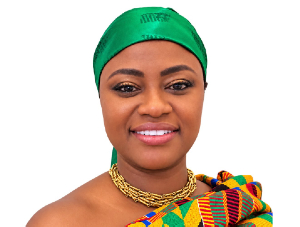 Nana Konadu Yiadom I is the Nkosuohemaa of Kwabre Abirem