Protecting the Volta River while safeguarding sustainable livelihoods in North, Central and South Tongu, Ada, Ningo and neighbouring communities
Abstract
An independent scholarly opinion and public-policy analysis.
The issue of river sand mining, locally called sand winning in Ghana, has generated increasing debate over environmental protection, employment and sustainable natural-resource management in the Lower Volta River Basin and adjoining areas of Greater Accra, especially North, Central and South Tongu, Ada and Ningo.
This article critically reviews the scientific, socioeconomic and legal aspects of sand extraction based on peer-reviewed hydrological and public-health research, official district development plans, Ghanaian water-resource legislation and international environmental guidance.
It considers claims that sand extraction may increase river-channel capacity, reduce flooding, restrict aquatic vegetation associated with schistosomiasis (bilharzia) transmission and provide essential employment and construction materials. Although scientific research confirms that targeted sediment removal and aquatic habitat management can be beneficial in some circumstances, there is still insufficient site-specific evidence that existing commercial sand-mining operations in the affected communities have reduced flood levels, controlled schistosomiasis, or achieved lasting environmental sustainability.
The article also discusses Ghana’s regulatory framework, especially the Water Resources Commission Act, 1996 (Act 522) and the Water Use Regulations, 2001 (L.I. 1692), which provide mechanisms for environmental assessment, public participation and conditional authorisation. It argues that a differentiated, science-based regulatory framework should be considered as an alternative to blanket prohibition, without automatically creating legal entitlements for existing operators.
The article recommends independent environmental and hydrological assessments, coordinated institutional oversight, transparent licensing procedures, community participation, and monitored pilot programs. It concludes that environmental protection and sustainable livelihoods should be sought as complementary national goals through evidence-based policy, lawful regulation and responsible governance.
Introduction
Introduction The debate on river sand mining popularly known as sand winning in Ghana poses a formidable challenge for environmental governance, sustainable development and local economic security. Sand extraction is associated with construction, transportation, jobs and local economic activity in North Tongu, Central Tongu and South Tongu in the Volta Region and adjoining parts of Greater Accra, including the Ada and Ningo areas. At the same time, the environmental impacts of unregulated extraction are worthy of serious consideration.
These include riverbank erosion, disturbance to aquatic habitats, changes in sediment movement, degradation of agricultural land and possible threats to infrastructure and public safety. The issue before Ghana, therefore, is not whether environmental protection should be given precedence over economic interests, or whether employment should justify unrestricted exploitation of natural resources. It is not whether a scientifically informed and legally enforceable regulatory system can discriminate between operations that are environmentally unacceptable and those that may be undertaken responsibly.
The North Tongu District Assembly on 29th October, 2026 reported a stakeholder engagement with the Environmental Protection Authority (EPA), Water Resources Commission (WRC), Volta River Authority (VRA) and other institutions on sustainable sand winning and protection of the Lower Volta River [1].The
engagement highlighted the need to look at environmental and socioeconomic concerns together. This article contends that Ghana should consider a differentiated regulatory framework premised on scientific assessment, environmental safeguards, transparent licensing and community participation. To any current sand winner, no such framework would guarantee continued operation. Rather, it would provide a lawful process whereby environmentally suitable activities could be assessed for conditional authorisation.
1. The geographical scope of sand extraction
The public discourse is focused on North and South Tongu, but sand extraction is taking place in a broader geographical area. In 2017, Logah et al. [2] published a peer-reviewed hydrological journal article on sand-mining activities at Asutsuare, Mepe, Battor, Adidome and Musikope along the Lower Volta River. The North Tongu District Assembly’s Medium-Term Development Plan for 2018-2021 identified Battor, Aveyime and Mepe as key sand-winning sites [3]. The Central Tongu 2024 Composite Budget also recognised sand winning as an economic activity but reported damages to the environment especially related to sand winning from agricultural land [4].
The wider Ada and Ningo areas sand extraction also needs to be considered in relation to the larger management of riverine, estuarine, coastal and terrestrial resources. However, these activities are not comparable environmentally. Riverbed extraction can impact channel geometry, riverbank stability, aquatic ecosystems and sediment transport. Extraction can undermine natural shoreline protection, leading to erosion. Taking the resources from the land can strip away productive topsoil, damage vegetation and lower farm yields. Therefore, the regulatory framework needs to be site-specific to physical and ecological characteristics.
2. Sand mining and dredging: Why the distinction matters
Sand mining is the extraction of sand, predominantly for construction purposes. Dredging is the deliberate removal or excavation of sediment from the bottom of a water body. Dredging is typically undertaken to accomplish a specific engineering, navigation, environmental or water-management objective. The activities may overlap but not to be considered synonymous. Rivers can be deepened locally by commercial sand extraction. But that does not necessarily mean better flood protection or ecological conditions.
Engineered dredging is usually driven by a particular problem, such as sediment blockage hampering water transport or navigation. The activities may overlap but not to be considered synonymous. Rivers can be deepened locally by commercial sand extraction. But that doesn't automatically translate into better flood protection or ecological conditions. Engineered dredging is generally driven by a specific problem, such as sediment blockage that obstructs water transport or navigation.
Following appropriate scientific and engineering evaluations, the location, quantity, depth and method of sediment removal is determined. In contrast, commercial sand mining is typically influenced by the market value and availability of sand deposits. The most attractive deposit to the commercial interests may not be the deposit that would benefit the river if removed. Digging in the wrong places can destabilise riverbanks, disturb aquatic habitat or create dangerous underwater depressions. The scientifically relevant question then is whether a particular operation is environmentally acceptable and if a public benefit is claimed, whether this benefit can be demonstrated.
3. Can sand extraction reduce flooding?
Another argument in favour of sand winning is that by removing the sediment, the river is made deeper and can carry more water when there is heavy rainfall or when the Akosombo and Kpong dams release water. This argument has a plausible hydraulic basis, but needs careful qualification. River discharge can be expressed mathematically as:
Q = A × V
where Q is river discharge (m³/s), A is the cross-sectional area of the river (m²), and V is the mean flow velocity (m/s).
Under appropriate conditions, increasing the effective cross-sectional area of a channel can lead to improved water conveyance. One of the most relevant studies is Floodplain Hydrodynamic Modelling of the Lower Volta River in Ghana, published in 2017 by Logah, Amisigo, Obuobie and Kankam-Yeboah in the Journal of Hydrology: Regional Studies [2]. Using field measurements, sediment analysis and the HEC-RAS hydraulic model, the researchers studied flooding under various dam-release scenarios. For releases near or above about 2,300 cubic meters per second, they modelled extensive downstream floodplain inundation under the scenarios considered.
It is important to point out that this number is based on the modelled conditions for the study and cannot be considered a flood threshold for all locations and operating circumstances. They also experienced mostly sandy riverbeds and banks, low suspended-sediment transport, and the potential for significant geomorphological change during sustained high flows. The findings underline the significance of river geometry and sediment conditions for flood management.
But the study found no evidence that existing commercial sand-mining operations reduce flooding. The appropriate policy response is therefore to commission site-specific hydraulic and sediment transport assessments. The studies should be comparing flood levels for current channel conditions with well-designed scenarios of sediment removal. Extraction should be described as contributing to flood management only where demonstrable benefits can be shown.
4. North Tongu's official recognition of sand winning
One of the most relevant official documents is the Medium-Term Development Plan (2018–2021) of the North Tongu District Assembly prepared in December 2017 [3]. Sand winning has been identified as one of the major economic activities and an important source of revenue for the district in section 1.10.2.8. Sand dredging is also linked in the document to deeper river beds and the capacity to hold more water during heavy rains. This is an important official recognition of a frequently cited potential benefit to local operators.
But a district planning statement is not a controlled hydrological investigation. However, the document does not prove that commercial sand mining has measurably reduced flood levels. Notably, the same development plan also references environmental and safety issues like disturbing aquatic animals and forming dangerous underwater holes. It also expects the activity to be regulated. The paper thus recognises both economic gains and environmental dangers. It is important because it offers an assessment that is not prejudged by the assumption that all sand winning is either good or bad.
5. Central Tongu's recognition of economic benefits and environmental costs
The 2024 Composite Budget of Central Tongu further justifies the need for balanced approach [4]. The document also notes that sand winning serves as a source of income for land owners, revenue for the District Assembly, construction materials and employment for the youth. It also mentions adverse impacts such as land degradation, reduced agricultural productivity, damage to roads and air pollution. The Assembly calls for monitoring of operators to ensure legality of their activities and strengthening local environmental governance.
That is a major policy stance. It recognises that economic benefits do not cancel out environmental costs, but that responsible regulation can be a way of managing both. The bigger lesson is that sand mining decisions can’t just be about jobs, district revenue, agriculture, infrastructure and environmental sustainability.
6. Lessons from dredging at the Volta Estuary
A good example of sediment removal for environmental purposes is provided by scientific studies at the Volta Estuary. Changes of river flow and sediment regime after dam construction led to the formation of a sandbar near the estuary, which had an influence on seawater intrusion and aquatic conditions. Dredging started in 1990 to help solve some of these problems.
Nyekodzi, Lawson and Gordon looked at the environmental and livelihood implications in a peer-reviewed paper published in 2018 [5].Salinity trends varied with sampling location but improved seawater intrusion was found. No intermediate-host snails of schistosomiasis were collected from the sampled estuarine sites under the observed saline conditions. In some situations sediment management can lead to beneficial physical and ecological changes, the results show.
But the researchers also found that the environmental intervention had not necessarily improved the livelihoods of the local people. The fishing and farming industries had slumped, but tourism was booming. Thus, the study emphasised the significance of taking into account community priorities and socioeconomic outcomes. One principal limitation deserves mention.
The estuary is influenced by tidal seawater intrusion, though many of the upstream extraction sites are freshwater environments. Therefore, the estuarine findings are not directly applicable to commercial sand mining at Mepe, Battor, Adidome or other inland communities. The study underscores the need for a scientifically designed sediment management rather than a free-for-all extraction.
7. Aquatic vegetation, freshwater snails and bilharzia
Another argument associated with sand winning is concerning aquatic vegetation and schistosomiasis, known commonly as bilharzia. Schistosomiasis is caused by parasitic worms of the genus Schistosoma. Transmission occurs through specific freshwater snails which are intermediate hosts. Aquatic vegetation may provide favourable habitats for some snail species because it provides shelter, food resources and surfaces for attachment. Schistosomiasis and its intermediate-host snails in the Lower Volta were reported by Wen and Chu in 1984 [6].
The researchers found that in the time they looked at, the locations they looked at, and the schoolchildren they surveyed, infection rates were high. The results are of historical interest but should not be interpreted as estimates of current disease prevalence.
Further studies by Yirenya-Tawiah et al., 2011 in the West African Journal of Applied Ecology reported snail vectors in the Kpong Headpond [7].The study stressed the importance of aquatic vegetation and suitable freshwater conditions in maintaining snail populations. These findings provide a sound scientific basis for investigating environmental management as a component of schistosomiasis control. But aquatic weeds themselves do not cause bilharzia and the removal of sand does not necessarily remove infected snails.
Badly managed excavation can even create slow or shallow habitats which are favourable to some species of snails. The World Health Organization’s 2022 guideline recommends an integrated approach consisting of preventive treatment, improvements in water and sanitation, behavioural interventions and appropriate environmental and snail control measures [8].
It is therefore not advisable to consider commercial sand mining as an established method of controlling or eradicating bilharzia. A more workable suggestion would be for the Ghana Health Service, universities and relevant environmental bodies to explore if targeted aquatic vegetation management can complement existing disease control programs. Such interventions can be effective and acceptable where local workers may be able to participate in supervised programs.
8. The limits of current scientific evidence
A central scientific qualification must be stated explicitly: There is currently a lack of site-specific scientific evidence to demonstrate that ongoing commercial sand-mining activities in North Tongu, Central Tongu, South Tongu, Ada, Ningo and surrounding communities have measurably reduced flood levels, controlled schistosomiasis or achieved long-term environmental sustainability. Existing hydrological studies provide a foundation for exploring the possible advantages of targeted sediment removal.
The work in the Volta Estuary demonstrates that engineered dredging can result in beneficial changes under certain environmental conditions. Studies of schistosomiasis emphasise the importance of habitats of freshwater snails and appropriate environmental interventions. But the findings do not prove that today’s commercial sand-mining operations deliver those benefits.
The possible benefits should thus be viewed as scientific hypotheses to be tested rather than as established results. This difference is crucial to credible environmental policy. It safeguards scientific integrity and keeps the door open for the possibility that some carefully regulated activities may be shown to be environmentally acceptable or even beneficial.
9. Can aquatic weeds be converted into organic fertilizer?
The proposal to use harvested aquatic vegetation for organic fertiliser deserves study. Some water plants contain organic matter and nutrients which can be reclaimed through composting. A well designed program can provide employment, reduce unwanted vegetation and support agricultural production.
However, aquatic plants may accumulate contaminants from water and sediment [7]. Therefore the harvested material should be tested accordingly in the laboratory before agricultural use. Composting should also be handled in a way that minimises health risks and prevents the spread of invasive plant fragments. Harvesting, transport,
processing and marketing must be shown to be economically feasible. A pilot program with agricultural scientists, environmental laboratories, district assemblies and local cooperatives could ascertain whether the proposal is technically and commercially viable. Such a program should be evaluated independently from commercial sand extraction.
10. The economic importance of sand mining
Sand is an important material for construction and infrastructure development. In housing, concrete production, roads, drainage systems and a variety of public and private projects it is used. The industry employs labourers, machine operators, truck drivers, mechanics and supervisors directly. It also generates indirect opportunities for fuel suppliers, equipment companies, food vendors, and transport services.
These economic relationships may be particularly important in communities with limited alternative employment. The United Nations Environment Programme’s 2022 report Sand and Sustainability: 10 Strategic Recommendations to Avert a Crisis acknowledges sand as a strategic resource that supports development and calls for responsible extraction and effective environmental governance [9].
Thus the economic case for sand mining needs to be weighed against its environmental costs. The aim should not be to maximise extraction whatever the cost. Rather it should be to secure sustainable economic benefits while protecting ecosystems, infrastructure and public welfare.
A full socioeconomic assessment should measure direct and indirect employment, household income, district revenue, construction-material supply and environmental costs. Such information would allow policy makers to compare alternative regulatory approaches on the basis of evidence rather than assumption.
11. Environmental risks must remain central to policy
Any sound case for regulated sand mining must be aware of the possible consequences of badly managed extraction. Riverbed mining can destabilise channels, erode riverbanks, disturb habitat and alter sediment movement. Over digging can damage fisheries and agricultural land and infrastructure. Heavy-duty vehicles can wear and tear roads, create dust and noise, and pose traffic hazards. Coastal mining also creates other problems, as the sand may provide natural shoreline protection and its removal could weaken that. These risks are particularly relevant in the vicinity of vulnerable riverbanks, wetlands, bridges, irrigation infrastructure, settlements and sensitive coastal areas.
A scientifically based regulatory framework needs to identify areas where extraction is inappropriate. Other sites may be considered for conditional authorisation subject to suitable environmental and technical assessment. The goal should be to prevent unacceptable harm, but one must recognise that environmental risks differ from site to site.
12. Ghana's legal framework: Regulation, environmental assessment and public participation
Ghana already has legal structures to regulate activities that affect water resources. The Water Resources Commission Act, 1996 (Act 522) established the Water Resources Commission and placed upon the Commission the responsibility of regulating and managing the utilisation of Ghana’s water resources [10].Section 2.
The Commission shall have such functions as may be assigned by law relating to water-resource planning, conservation, development, regulation and the granting of water rights. Section 12 vests the property and control of water resources in the President for and in trust for the people of Ghana.
Section 13 limits the use of water resources and the construction or maintenance of works for their use, except in accordance with the Act.Section 15 deals with enforcement notices where the use of water resources is a serious risk to the environment or to public health. These provisions give legal weight to the protection of water resources and to the proper authorisation of relevant activities. The Water Use Regulations, 2001 (L.I. 1692) specifies more detailed procedures for the grant and administration of water-use permits [11]. Several provisions are particularly relevant to the present discussion.
Regulation 5: Scientific and social assessment
Regulation 5 imposes a duty on the WRC to investigate, when considering an application, whether the proposed water use is in accordance with established policies and plans and whether it would cause irreparable damage to water resources, public health or the environment. The regulation also requires the consideration of the technical and social aspects and the public participation, particularly from the communities likely to be affected. This is important as it recognises that decisions about water resources require both scientific evaluation and social considerations.
Regulation 6: Public hearings
Regulation 6 requires public hearings where a proposed use may create adverse reaction from the public; where a proposed use may displace or destroy natural resources that serve the community; and where a proposed use is likely to impact on basin resources. It therefore provides a mechanism for public scrutiny and, where appropriate, participation.
Regulation 12: Environmental assessment
Regulation 12 stipulates that where the WRC, in consultation with the relevant environmental regulatory authority, determines that the proposed water use is subject to an environmental impact assessment, the applicant must provide proof that the necessary environmental approval has been obtained. The Regulation also provides for the preparation of environmental management plans when it is necessary. Thus, this provision establishes a legal connection between water-use authorisation and environmental assessment requirements and includes environmental considerations in the regulatory framework of water-resource use.
Regulation 13: Permit decisions
Regulation 13 concerns the grant and refusal of permits. It makes provision for the issue of permits to applicants who satisfy the regulatory criteria subject to the power of the Commission to reject applications on stated grounds. These include technical evidence, the sustainability of water resources, national security and public safety. The regulation also allows conditions to be attached to permits and requires that reasons for refusal be given to applicants. Therefore, the law does not automatically sanction an activity because it creates employment. It requires applications to be assessed against applicable technical, environmental and public interest considerations.
Regulation 16: Review of permit decisions
Regulation 16 provides for an aggrieved applicant to appeal the refusal or non-renewal of a permit through the procedures specified in the regulations. This points out the necessity of transparent and accountable decision making. In its public notice of 16 December 2024, the WRC explicitly lists commercial mining and dredging as one of the activities for which a water-use permit is required [12].
The notice describes existing regulatory requirements; it does not establish a new statutory licensing regime. A further legal distinction must be made. A water-use permit does not automatically substitute for mineral rights, environmental approvals, land-use permissions or other authorisations that may be required for a particular activity. The precise approvals depend on location, extraction method and applicable legislation.
The main policy recommendation is therefore that government should consider a coordinated regulatory framework for determining environmentally appropriate sand extraction for conditional authorisation. This recommendation does not automatically entitle existing operators to continue extracting sand. It proposes a scientific and transparent process whereby qualifying activities may be considered under the law.
13. Why differentiated regulation deserves consideration
The Lower Volta and surrounding areas have a variety of environmental conditions. So, a one-size-fits-all approach may not be applicable to all locations. The government may consider a framework that identifies three categories of extraction areas: (i) Protected areas would comprise places where extraction would involve unacceptable risks to ecosystems, infrastructure, public safety or essential water resources. (ii) Restricted areas would allow narrowly defined activities under stringent conditions, perhaps including engineered dredging where a demonstrable public purpose exists. (iii) Areas where scientific assessment would indicate that controlled extraction may be undertaken within specified environmental limits would be conditionally permitted areas.
Such a framework would need reliable baseline information, enforceable standards and effective monitoring. It would also have to differentiate between riverbed extraction, and coastal and land-based mining. This approach provides a policy choice for reconciling environmental protection and economic activity without undermining the requirements of existing law.
14. Recommendations to the President and national institutions
President John Dramani Mahama could consider the establishment of an Integrated Lower Volta Sand and Sediment Management Programme, and coordination could be extended to relevant parts of Greater Accra.
The program could bring together the EPA, WRC, VRA, Minerals Commission, Ghana Health Service, the relevant district assemblies, the traditional authorities, researchers and community representatives. Its main objective would be to examine the public health, economic and environmental consequences of sand mining and to identify appropriate regulatory measures. An independent technical panel could examine existing extraction sites, sediment conditions, riverbank stability, ecological risks and socio-economic consequences.
The government could also consider a transparent licensing pathway where qualifying operators could apply for authorisation at environmentally suitable locations. Such a path wouldn’t be guaranteed to pass. It would allow activities to be audited against relevant legal, environmental and technical standards.
15. Recommendations to the EPA and Minerals Commission
The EPA should consider developing or applying site-specific environmental standards for sand extraction . These should address depth, volume and location of extraction, water quality, riverbank protection, habitat conservation, equipment operations and environmental restoration.
The Minerals Commission should collaborate with the relevant institutions to clearly define the mineral rights and licensing requirements that apply. Operators must keep adequate records and comply with conditions for monitoring and inspection. Extraction should not be allowed where environmental risks cannot be adequately controlled. Where the risk is not too high, conditional approval can be an option after proper assessments. The goal should be to make environmental protection enforceable, and to make the regulatory procedures transparent and accessible.
16. Recommendations to the VRA and WRC
The VRA and WRC should undertake a comprehensive hydraulic and sediment transport assessment of the Lower Volta River. The study should identify sediment deposits that might impede water conveyance and determine if targeted removal could measurably reduce flood levels. It should also assess the stability of riverbanks, movement of sediments, ecological conditions and downstream impacts.
Where engineered dredging is scientifically justified, suitably qualified local operators may be considered for supervised participation, subject to applicable procurement, licensing and environmental requirements. Such activities should complement, not replace, flood forecasting, dam-operation planning, early-warning systems and floodplain management. Dredging should not be promoted as a surefire fix for flooding from exceptional dam releases.
17. Recommendations to district and municipal assemblies
The North, Central and South Tongu District Assemblies could consider establishing a coordinated mechanism for addressing sand mining problems along the Lower Volta.
Relevant authorities in Ada, Ningo and neighbouring areas should participate where their jurisdictions and environmental interests are impacted.
Assemblies could undertake socio-economic surveys, support environmental education, improve monitoring and ensure lawful registration of appropriate local enterprises.
They should also take into account road safety issues arising from heavy-duty trucks and make suitable parking and transport arrangements.
Community participation should include representatives of fishers, farmers, traditional leaders, women, young people and sand-winning.
Where extraction is legal, the public revenue could be used for local development, road maintenance and environmental restoration. Transparent arrangements could help to achieve this.
18. A scientific pilot programme could provide the missing evidence
A well-designed pilot programme provides a practical means of testing the competing claims. We could compare selected extraction locations with similar locations without extraction.
Researchers should measure river depth, water level, sediment movement, bank erosion, water quality, and aquatic habitat.
Public-health experts might study aquatic vegetation, snail populations, and the transmission of schistosomiasis.
Economists have to look at employment, household income, local revenue and environmental costs. The program may run for 12-24 months if this time is sufficient to cover the relevant seasonal and hydrological conditions.
There would need to be clear stop criteria and environmental safeguards.
Independent researchers should review the findings and results should be publicly available.
Where certain extraction techniques are found to be environmentally acceptable and economically viable they could inform future licensing arrangements.
If unacceptable risks are detected, it would be on a stronger scientific footing to have restrictions. In either case, the quality of public policy would be improved.
Conclusion: Protecting the river and safeguarding livelihoods
The debate over sand mining in the Lower Volta and parts of Greater Accra is an example of a wider challenge for Ghana: how to balance environmental protection with employment, infrastructure development and community welfare. The scientific evidence indicates that sand mining out of control can cause serious environmental damage. It also concludes that properly designed sediment removal can serve legitimate engineering and environmental purposes under appropriate circumstances. The Volta Estuary is a case of positive physical and ecological changes following dredging in Ghana. The economic importance of sand winning is recognised in official planning documents from North and Central Tongu and so are its environmental risks. The results provide a reasonable basis for considering scientifically regulated extraction as a policy option. But they don't demonstrate that ongoing commercial operations prevent flooding, control bilharzia or are environmentally sustainable everywhere. The claims require independent site-specific investigation. Therefore, the government should consider a regulatory framework that differentiates between environmentally unsuitable operations and those that may qualify for conditional authorisation. Operators need to be ready to meet legal, environmental and safety requirements. Public institutions must set clear standards, coordinate oversight and provide meaningful opportunities for community participation.
The most defensible policy is neither free-for-all sand mining nor total prohibitions. It is regulation that is scientifically justified, legally enforceable and socially responsible. Ghana must protect the Volta River and its surrounding environments for generations to come. At the same time we must take careful account of the legitimate economic interests of the communities which depend upon these resources. Protecting the river and protecting livelihoods should be complementary national objectives, pursued through scientific evidence, effective regulation and responsible governance.
Author's Note
This article is an independent scholarly and public-policy analysis based on published scientific research, official planning documents of the Ghanaian government, relevant legislation, and publicly available institutional reports. It aims to contribute constructively to the national debate on sustainable sand mining, environmental protection, public health and local livelihoods.
It does not reflect the official position of the Environmental Protection Authority, Water Resources Commission, Volta River Authority or any other government institution. The recommendations are policy proposals for consideration and further scientific investigation, not assertions of existing legal entitlements. The article does not suggest that present-day commercial sand-mining operations have been scientifically shown to prevent flooding, control bilharzia or bring about environmental sustainability.
References
[1] North Tongu District Assembly. (2026, October 29). EPA-led task force engages North Tongu stakeholders on sustainable sand winning and protection of the Lower Volta River. Available at: https://ntda.gov.gh/2026/10/29/epa-led-task-force-engages-north-tongu-stakeholders-on-sustainable-sand-winning-and-protection-of-the-lower-volta-river/ [Accessed: November 15, 2026].
[2] Logah, F. Y., Amisigo, A. B., Obuobie, E., & Kankam-Yeboah, K. (2017). Floodplain hydrodynamic modelling of the Lower Volta River in Ghana. Journal of Hydrology: Regional Studies, 14, 1-9. https://doi.org/10.1016/j.ejrh.2017.09.002
[3] North Tongu District Assembly. (2017). District Medium-Term Development Plan (2018-2021). Section 1.10.2.8, Sand Winning, pp. 96-97. National Development Planning Commission, Ghana. Available at: https://ndpc.gov.gh/media/VR_North_Tongu_MTDP_2018-2021.pdf [Accessed: November 14, 2026].
[4] Central Tongu District Assembly. (2024). Composite Budget for the 2024 Fiscal Year. Natural Resource Utilisation, p. 10. Ministry of Finance, Republic of Ghana. Available at: https://www.mofep.gov.gh/sites/default/files/composite-budget/2024/VR/Central_Tongu.pdf [Accessed: November 14, 2026].
[5] Nyekodzi, G., Lawson, E. T., & Gordon, C. (2018). Evaluating the impacts of dredging and saline water intrusion on rural livelihoods in the Volta Estuary. International Journal of River Basin Management, 16(1), 93 -105. https://doi.org/10.1080/15715124.2017.1372445
[6] Wen, S. T., & Chu, K. Y. (1984). Preliminary schistosomiasis survey in the lower Volta River below Akosombo Dam, Ghana. Annals of Tropical Medicine & Parasitology, 78(2), 129-133. https://doi.org/10.1080/00034983.1984.11811786
[7] Yirenya-Tawiah, D., Abdul Rashid, A., Futagbi, G., Aboagye, I., & Dade, M. (2011). Prevalence of snail vectors of schistosomiasis in the Kpong Head Pond, Ghana. West African Journal of Applied Ecology, 18(1), 39-45. https://doi.org/10.4314/wajae.v18i1.70310
[8] World Health Organization. (2022). WHO guideline on control and elimination of human schistosomiasis. Geneva: World Health Organization. Available at: https://www.who.int/publications/i/item/9789240041608 [Accessed: November 15, 2026].
[9] United Nations Environment Programme. (2022). Sand and sustainability: 10 strategic recommendations to avert a crisis. Nairobi: UNEP. Available at: https://wedocs.unep.org/items/9ec225c4-5a9f-44d0-a560-46e0c8264003 [Accessed: November 14, 2026].
[10] Republic of Ghana. (1996). Water Resources Commission Act, 1996 (Act 522). Sections 2, 12, 13 and 15. Available at: https://wrc.gov.gh/wp-
content/uploads/2025/05/Water_Resources_Commission_Act-522.pdf [Accessed: November 14, 2026].
[11] Republic of Ghana. (2001). Water Use Regulations, 2001 (L.I. 1692). Regulations 5, 6, 12, 13 and 16. Available at: https://wrc.gov.gh/wp-
content/uploads/2025/10/Water-Use-Regulation.pdf [Accessed: November 14, 2026].
[12] Water Resources Commission. (2024, December 16). Public notice: Water use activities in Ghana. Available at: https://wrc.gov.gh/public-notice-water-use-activities-in-ghana/ [Accessed: November 14, 2026].
Opinions of Monday, 23 November 2026
Columnist: Dr Dr Ing Edinam K. Glover, Esq
River sand mining in the lower volta: a scientific, economic and legal case for responsible regulation
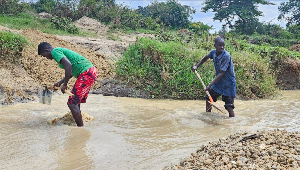 People are seen miming sand in a river





Entertainment