Accra is suffocating. Every morning and evening, thousands of Ghanaians lose hours of their lives sitting in traffic that crawls below 20 kilometres per hour on major corridors.
The economic cost is staggering. Some estimates put congestion losses at around 8 per cent of GDP. That is about $10.3 billion a year in lost time, higher transport costs, lower productivity and extra fuel use, particularly around Accra and its surrounding areas.
The human cost is worse. People are stressed. Pollution is higher. Arrivals are late. Productivity suffers. Families can no longer afford to live near where they work.
But there is a better way. Imagine a Ghana where a young professional can live in Koforidua or Ho, breathe cleaner air, pay significantly less for rent and food, and still reach Accra in under an hour on a clean, reliable train. That is not a fantasy. It is a policy choice we can make now.
The distances are short and the logic is compelling. Accra to Nsawam is roughly 35–40 kilometres. Accra to Koforidua is about 60–85 kilometres. Accra to Ho sits between 140 and 185 kilometres. Accra to Cape Coast is in the 120–140 kilometre range. These are not long-haul routes.
They are natural commuting corridors. With modern standard-gauge rail running at 120–160 km/h, daily travel between these cities and Accra becomes practical and attractive.
The quality-of-life difference is real. Recent cost-of-living comparisons show that a one-bedroom apartment in central Koforidua can cost roughly half of what it does in Accra. Food is cheaper. Land is more affordable. The air is cleaner. Families can raise children in better environments without abandoning economic opportunity in the capital. All they need is a train that runs on time, frequently, and at a price ordinary people can afford.
This is why the current push to establish another national airline deserves hard scrutiny. Preparatory funding has already been allocated in the 2027 budget. Building and sustaining a national carrier will require hundreds of millions of dollars in aircraft, operations, training and likely ongoing support.
An airline may serve international routes and national pride, but it does nothing for a civil servant who wishes to live in Ho or Koforidua and needs to reach Accra five times a week, or the young family priced out of East Legon who would happily live in Cape Coast if the train existed.
We already have the beginnings of the solution. Parts of the Eastern Railway remain operational. The Tema–Mpakadan standard-gauge line has been commissioned. Ghana’s own Railway Development Authority has worked with figures around five million dollars per kilometre for modern standard-gauge construction.
African benchmarks for similar projects range roughly between 5 and 8 million dollars per kilometre. These are large investments, but they are productive ones. They create construction jobs, lower logistics costs, reduce road deaths, cut vehicle operating expenses, and permanently change how Ghanaians live and work.
In the short term, reliable trains on the Eastern and Central corridors would immediately ease pressure on Accra’s entry points. Commuters would save time and money. Construction would inject activity into the regions. Political momentum for further expansion to Kumasi, Tamale, Takoradi and other parts of the country would build once people experience the difference.
In the longer term, the benefits become transformative. The pressure on Accra will ease significantly. Secondary cities can absorb population and economic activity in a planned way. Air quality improves. Household budgets stretch further. Freight moves more efficiently. A genuine national rail network becomes possible, supporting agriculture, minerals and regional trade.
Government has already spoken of moving 200,000 daily Accra commuters through better buses and light rail. Extending that vision outward with proper intercity rail multiplies the impact. The resources currently being prepared for a national airline would deliver far higher returns if redirected to completing the Eastern corridor to Koforidua and Ho, advancing the line toward Cape Coast, and building a serious metro or high-capacity system inside Accra itself.
This is not anti-aviation. It is pro-prioritisation. Ghana needs efficient domestic mobility for the majority of its people more urgently than it needs another flag carrier at this stage of our development. We have limited fiscal space. We should spend it where the daily lives of ordinary Ghanaians improve the most.
The choice is straightforward. We can continue pouring concrete into an already congested capital and chase the prestige of a national airline, or we can give people the freedom to live better, breathe cleaner air, spend less on rent and food, and still participate fully in the economic life of Accra.
Opinions of Friday, 20 November 2026
Columnist: Ras Mubarak is the author of this piece
Why Ghana must choose rail over a national airline
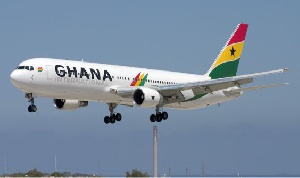 File photo of a plane