Summary
On November 28, 2026, golfers will gather for the Opemsuo Golf Tournament, formerly the Otumfuo Golf Tournament, sponsored by GCB Bank. I played in this tournament from its inception. I stopped when the prize-giving moved to a “black-tie” dinner at Manhyia Palace. This article explains why.
Asanteman is widely seen as the last bastion of Ghanaian custom. When its palace asks guests to wear a Western dinner suit instead of Kente, and when the wives of our King and leading Paramount Chiefs appear in public with synthetic hair, false eyelashes and false nails, Gen Z receives a clear message. Our culture is for museums and funerals, and foreign style is for important occasions.
The dress code has also kept a deserving prize-winner from collecting his prize. That message must change, and the change must start at the top.
1. A tournament I loved
I have played golf for more than four decades, on courses across the world. The Otumfuo tournament holds a special place for me. I was an active playing member from its very first edition. Each year, members of the Achimota Golf Club, many of them Akan, spare no expense to take part. They travel, they pay, and they play with pride, because the event carries the name and blessing of the Asantehene.
Then the organisers announced that prizes would be presented at a special black-tie event at Manhyia Palace. From that point, I stopped taking part, and I have not played in it in recent years.
My quarrel is with the dress code. GCB Bank’s support for golf is welcome, and the game itself is in good hands.
2. Black tie at the home of Kente
Black tie is a British dinner code. It means a dinner jacket, a bow tie and patent shoes. It came to us with the colonial club and the officers’ mess. Kente came to us from our own looms at Bonwire, and the Asantehene is its foremost custodian.
Manhyia Palace is the one place in Ghana where a Kente dress code would feel most natural. Picture the prize-giving with golfers and guests in Kente, fugu, kaba and slit, or the cloth of their own traditional areas. The weavers of Bonwire would gain orders in the weeks before the event. The photographs would travel across the world. Every young person who saw them would learn that our cloth belongs at the highest table.
Instead, guests hire dinner suits. The money goes to foreign fashion, and our youth learn that excellence wears a bow tie.
The cost is more than symbolic. Two years ago, a caddie who had worked his way up to become a player at the Bok Nam Kim Air Force Golf Club in Accra won a prize at the Otumfuo tournament. He could not collect it. He could not afford a black-tie outfit for the prize-giving. A young man earned his place on merit, on the course, and was shut out at the palace by a foreign dress code. A Kente or fugu code would have let him walk up in the cloth of his own people, with his head held high.
I have seen this attitude at close quarters. The last time I played the tournament as Mandimase, I bought my caddie an air ticket so that he could fly with me from Accra to Kumasi and help with my luggage on arrival. My golfing partners on the same flight did not take it well. It was the first time a caddie had flown with club members to the tournament, and they lambasted me for it.
That caddie is now a fully fledged professional golfer. He flies to South Africa, Kenya, Nigeria, Europe and beyond to play in professional tournaments. I did not regret my decision then, and I do not regret it now.
A caddie is part of the game. He deserves a seat on the plane and a place at the prize-giving.
I ask the organisers and the sponsor to offer guests a Kente, fugu or traditional attire option at the very least. Better still, they should make it the code.
3. A wife is not a Queen Mother
Here we must be precise, because much public talk is careless. In Akan custom, the Queen Mother holds an office. She is enstooled and holds authority of her own. In Asanteman, it is the Asantehemaa who nominates a new Asantehene when the Golden Stool falls vacant.
In July 2026, Nana Ama Bonsu was installed as the 15th Asantehemaa, following the passing of Nana Konadu Yiadom III.
The Queen Mother sits in council. She advises the King or Paramount Chief, may rebuke him in private, and speaks for the women of the state. Each of our great states has its own: the Asantehemaa, the Queen Mother of Okyeman, the Dormaahemaa, and the Ga Manye. These are the true Queen Mothers of our land, and many of them carry themselves with the dignity our customs expect.
The wife of a King or Paramount Chief holds no stool. She is not the Queen Mother, however often the press calls her a queen, and we do our traditions harm when we confuse the two.
Yet she stands beside her husband at durbars, festivals and state functions, and she is photographed more than almost anyone in the palace. Whether she wishes it or not, she carries the image of the stool before the public. That is why her appearance matters.
4. Queens or “slay queens”?
In recent years, I have watched with growing dismay. At public functions, the wives of our only King, Otumfuo Osei Tutu II, Asantehene, and of the Okyenhene, the Dormaahene and the Ga Mantse, among others, have appeared with synthetic hair, false eyelashes and false nails. It is the look of the social media “slay queen”. It does not belong to a royal household that claims to guard our customs.
The problem crosses party lines. When she was Second Lady, the wife of Dr Mahamudu Bawumia, now the flagbearer of the New Patriotic Party for 2028, appeared in public with false eyelashes, false nails and the same “slay queen” look. The wife of our former President made similar choices. Our present First Lady, the wife of President John Dramani Mahama of the National Democratic Congress, does the same.
Whichever party wins in 2028, the household at the presidency will set the example for the nation’s daughters.
These women represent Ghana at home and abroad. They have a platform that no hairdresser or influencer can match. I do not write to insult any woman. Every Ghanaian woman is free to dress as she chooses in her private life. Public life is different, and so is a royal household.
Our King and Paramount Chiefs are the custodians of our values and swear to uphold them. A custodian who cannot guard the image of his own household weakens his custodianship. The same applies to a President who speaks of African identity while his household presents a borrowed one.
5. My own household
I was enstooled as Mandimase (Overlord) of the Aiyinasi-Basake Stool Lands in December 2008. Some years earlier, in 2001, my wife and I made a covenant. The day she wore synthetic hair, false eyelashes or the like would be the end of our marriage. She has kept that covenant faithfully.
I mention it to show that I ask nothing of others that I have not asked of my own home. It can be done.
6. Passing it on to Gen Z
Gen Z learns from what it sees. It watches palaces, State House and the red carpet, and it copies what is celebrated. If we want our young people to value natural hair, local cloth and our own standards of beauty, those in the highest places must show the way.
I propose the following:
- Manhyia and our other palaces should set traditional dress codes for royal and palace events, including sports prize-givings.
- The National House of Chiefs should issue guidance on the public appearance of royal households at state and traditional functions.
- The First Lady and the wives of our King and Paramount Chiefs should champion natural hair, shea butter, black soap and Ghanaian fabrics. Their example would lift whole local industries.
- Sponsors such as GCB Bank could present winners with Kente stoles woven at Bonwire, so that every trophy also supports a weaver.
- Schools should build on Fugu Wednesday and cultural days, so that our own attire becomes everyday wear for the young.
7. Conclusion
Heritage is rarely lost in a single day. It slips away through choices that seem small at the time. Our only King, Otumfuo Osei Tutu II, Asantehene, together with our Paramount Chiefs and our First Families, can reverse that drift faster than any law.
Ahead of the Opemsuo tournament on November 28, I call on Manhyia Palace and GCB Bank to give Kente its rightful place at the prize-giving. I call on our only King, Otumfuo Osei Tutu II, Asantehene, on our Paramount Chiefs and on our President to lead by example in their own homes.
Res ipsa loquitur. The thing speaks for itself.
Opinions of Sunday, 8 November 2026
Columnist: Nana Annor Amihere II
Kente, Fugu or Black Tie?: Our royal households, borrowed beauty, and the heritage we owe Gen Z
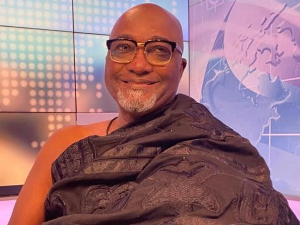 Nana Annor Amihere II is Overlord of Aiyinasi-Basake Stool Lands, Eastern Nzema Traditional Area








Opinions