From the familiar shouts of mates at lorry stations to cramped seats, roadside arguments and the constant search for passengers, the trotro is woven into Ghanaian life. But behind this everyday transport experience lies a fascinating history dating back to the colonial era.
At dawn, before many offices open and shops begin their day's business, Ghana's roads are already alive with the familiar sounds of commercial transport. Drivers honk impatiently, conductors lean out of moving vehicles shouting destinations, and passengers scramble to secure seats before the morning rush takes over.
At busy terminals, one phrase rings out repeatedly: "Circle! Circle! Circle!" "Madina!" "Kasoa!" "Lapaz!"
For millions of Ghanaians, this is a familiar part of everyday life. The trotro is not simply a vehicle that takes people from one destination to another. It is a lifeline for workers, traders, students and others who depend on affordable transport to navigate the country's increasingly busy towns and cities.
Yet, despite how frequently Ghanaians use the service, few may have stopped to consider where the name trotro came from.
The answer lies in an old form of currency that has long disappeared from everyday transactions but continues to live on in the vocabulary of Ghanaian transport.
In her documentary, Etymology of Trotro, University of Media, Arts and Communication (UniMAC-IJ) student Jennifer Frimpong-Wiredu traces the origins of the popular name to the Ga word "tro", meaning threepence, an amount associated with transport fares during the colonial period.
The documentary, which explores the history behind the name, takes viewers beyond the familiar sight of minibuses on Ghana's roads and into the historical circumstances that shaped one of the country's most recognisable transport systems.
From threepence to trotro
The name trotro is believed to have emerged from the threepence fare passengers paid for journeys in the colonial era.
According to cultural activist and historian Kwame Agyenim Boateng, who is based at the Manhyia Palace in Kumasi, the word developed from the amount charged passengers for using commercial transport.
He explains that Ghana had several forms of currency before the introduction of the cedi, including Simporwa, Simporwa-ba, Kaperɛ, Kaperɛ-ba and Darmaa.
Among these was the "tro", which became associated with the standard amount charged for a journey.
"In those days, regardless of where you would alight as a passenger, you were charged the 'tro' amount," he explains, comparing the practice to the minimum fare taxi drivers charge passengers today.
He adds that passengers would commonly refer to vehicles that accepted the fare as those that took the "tro". Over time, the expression became associated with the vehicles themselves, eventually settling into the familiar name trotro.
The historical roots of the transport system go beyond its name. Research on Ghana's transport history traces its development to the colonial period, when converted wooden-sided trucks, popularly known as mammy trucks or mammy wagons, transported market women, traders, their goods and other passengers.
These vehicles offered an alternative to the more formal municipal transport arrangements and helped meet the growing demand for affordable movement within urban communities.
The trotro subsequently developed into a major feature of Ghana's urban transport system, particularly as private operators expanded their services to meet the needs of commuters.
More than a means of transport
Today, the trotro's importance is difficult to separate from the economic and social lives of ordinary Ghanaians.
For people who cannot afford private vehicles or the relatively higher cost of some alternative transport services, it remains one of the most accessible ways to get around.
But the experience is not always comfortable.
Achiaa, one of the passengers interviewed in the documentary, says the affordability of the service makes it indispensable to many people, even though sharing a vehicle with strangers can sometimes be uncomfortable.
"Not all of us have the money to buy a personal vehicle, which is why we patronise trotro," she says.
She points to overcrowding and unpleasant body odour as some of the difficulties passengers encounter, adding that a shortage of vehicles during busy periods can leave commuters waiting in long queues and arriving late at work.
Another passenger, Salamatu Issah, also speaks about the discomfort of travelling in crowded vehicles, particularly when passengers have to endure unpleasant smells during early-morning journeys.
For Delight Tetteh, however, some of the most frustrating moments happen between passengers and conductors, popularly known as mates.
She identifies disagreements over change as a recurring problem, explaining that passengers sometimes have to contend with mates who fail to return their balances.
These experiences reflect the informal but highly interactive nature of trotro operations, where passengers and transport workers negotiate fares, destinations, seating arrangements and change throughout the journey.
The men behind the steering wheel
While passengers experience the trotro system from the seats, drivers and their mates encounter a different set of challenges.
For commercial drivers, the business provides an opportunity to earn a living, support families and build assets. However, the work also comes with pressures that are not always visible to commuters.
Michael Kwarteng, a commercial driver interviewed for the documentary, describes the difficulty of picking up passengers when others are alighting, particularly when traffic conditions and the behaviour of other road users make the process frustrating.
He also raises concerns about police checkpoints, especially on long-distance routes between Kumasi, Konongo and Accra.
According to him, drivers with the required vehicle documents still face demands for money from some officers.
"The police officers on the highway keep worrying us as if we carry contraband in our vehicles," he says, alleging that officers sometimes take money from drivers despite their vehicles having the necessary legal documents.
For Raymond Mensah, who has spent more than 20 years behind the wheel, commercial driving is a profession that has provided opportunities, even though society does not always accord it the respect it deserves.
He says he entered the business after completing school, following the example of an uncle who had also worked as a commercial driver.
His uncle had encouraged him to consider the profession because of its income potential.
Mensah believes the negative perception surrounding commercial driving has contributed to the disrespect some drivers experience.
Vincent Amoah, another driver featured in the documentary, offers a different perspective on the financial opportunities the business can provide.
He argues that trotro services are not only useful to people without private vehicles but can also be a convenient option for private car owners seeking to reduce fuel expenditure during the working week.
For him, the business has been particularly rewarding.
"I have benefited from driving trotro—I have built my own house from my trotro business," he says.
His account offers a reminder that behind the frequent complaints about commercial transport are individuals whose livelihoods and financial progress depend on the industry.
A transport culture that has refused to disappear
Despite the introduction of newer transport options and continuing calls for improvements in public transportation, trotros remain central to daily movement in Ghana.
Their popularity is largely tied to their accessibility, affordability and ability to serve routes that may not be adequately covered by formal public transport services.
Research on urban mobility in Ghana has consistently identified the trotro system as a major component of passenger movement. Studies have also drawn attention to its extensive, privately operated network and the important role it plays in connecting residential communities, markets and commercial centres.
However, its continued relevance comes with familiar concerns, including congestion, passenger discomfort, road safety, poor vehicle conditions and disputes between commuters and transport operators.
The system also depends heavily on the relationship between drivers, mates, transport unions and passengers, making its operations an important part of Ghana's informal urban economy.
For all its shortcomings, the trotro remains a defining feature of Ghanaian street life. Its destination calls, conductors' exchanges, crowded seats and roadside negotiations have become part of the country's everyday urban identity.
And perhaps that is what makes its history particularly interesting: a word rooted in an old threepence fare has outlived the currency that gave it meaning and become the name of a transport culture used by generations of Ghanaians.

Award-winning exploration of an everyday Ghanaian experience
Jennifer Frimpong-Wiredu's exploration of this history has earned her recognition at the 30th Ghana Journalists Association (GJA) Media Awards, where she was named the 2025 Best Student Journalist of the Year.
Her documentary, Etymology of Trotro, was broadcast on GBC/GTV's Akan News. The entry was recognised for examining the origins of a familiar Ghanaian expression through historical accounts and interviews with drivers, passengers and a cultural historian.
Frimpong-Wiredu is a level 400 student pursuing a Bachelor of Communication Studies, specialising in Public Relations, at UniMAC-IJ.
She received the award at the ceremony held at the Palms Convention Centre, La Palm Royal Beach Hotel, Accra. The event brought together prominent national figures, including President John Dramani Mahama, Speaker of Parliament Alban Bagbin, Chief Justice Paul Baffoe-Bonnie, Bank of Ghana Governor Dr Johnson Pandit Asiama, Inspector-General of Police Christian Tetteh Yohuno and GJA President Albert Dwumfour.
Held under the theme, "30th GJA Media Awards: Celebrating Excellence, Advancing Media Freedom and Combating Hate Speech in the Digital Age", the ceremony recognised excellence in journalism and the contribution of media practitioners to national development.
Through her documentary, Frimpong-Wiredu has turned attention to something millions of Ghanaians encounter almost every day but rarely question.
The next time a mate calls out a destination or a passenger squeezes into a trotro seat, there is a little piece of history worth remembering: the vehicle's name carries the story of an old currency, a changing transport system and generations of Ghanaians who have depended on it.
Opinions of Sunday, 8 November 2026
Columnist: Jennifer Wiredu
The Story Behind Ghana's 'trotro': How an old currency gave birth to a transport culture
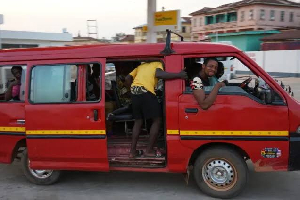 A photo of a commercial transport also known as









Opinions