My fellow Ghanaians, before another politician asks you to forget yesterday and trust him with tomorrow, ask him to account for what he did when your future was in his hands.
Give him time to answer, and listen carefully to what he says.
Do not let an insult or a party slogan take the place of an answer. And do not let somebody convince you that demanding an account of your own money is evidence that you hate his political party.
You worked for that money. You paid the taxes. You endured the consequences. You have every right to ask.
I am Ekow Shalders. This is WBSM, Bold Statement Media, and on Silence Is the Enemy, we are examining the NPP’s narrative warfare and what I call Post Electoral Defeat Stress Syndrome. PEDSS.
I use PEDSS as political satire to describe the discomfort of losing power while still expecting the public to accept your account of why things went wrong.
The people have voted you out, but you still want to decide which parts of your record they are allowed to discuss.
That deserves a serious challenge.
In December 2024, Ghanaians removed the NPP from government. Dr. Mahamudu Bawumia conceded defeat, and I give him credit for that. Accepting the verdict mattered. The next responsibility was to examine why so many people wanted a change.
You can accept that you lost an election and still fail to understand why you lost it.
Ghanaians deserve to know what the party has learned.
As I see it, the NPP has a great deal of work to do before it can credibly ask Ghanaians to trust its judgment on governance again. Its record under the Akufo Addo administration will not disappear because a spokesperson delivers a confident performance on television.
The people watching those programmes have their own memories.
What did your time in office actually do for the Ghanaian who trusted you?
When politicians discuss economic management, I think about the person at the pharmacy counter deciding which medicine can wait. I think about the business owner who sold stock at one price and cannot afford to replace it at the next. I think about the worker who keeps trying to save, only to discover that the money will no longer cover what it once could.
What do we say to those people after the television argument is over?
Inflation reached about 54 percent in December 2022. Ghana went through debt restructuring, and an IMF programme was approved in May 2023. Inflation subsequently fell, and there was progress under the programme. I acknowledge that. But Ghanaians are still entitled to ask how the country reached a point where those measures became necessary.
The pandemic, the war in Ukraine and higher global interest rates put pressure on Ghana. Years of overspending also contributed to the crisis. Any honest explanation must deal with the decisions made here as well as the pressures that came from abroad.
That is what taking responsibility requires.
If you can explain every international problem in detail but suddenly become vague about your own decisions, you have not answered the question. You asked to manage the country. The country is asking how you managed it.
Look at the debt exchange. Affected investors faced changes to their returns and repayment dates. Those changes reached into the plans of people and institutions that had relied on the original terms.
For an ordinary Ghanaian, savings may represent years of going without. Someone postponed buying a better car. Someone took extra work. Someone put money aside because illness could come, or a child might need help. That sacrifice deserves respect when we discuss the consequences of government policy.
The figures matter because of what they mean in people’s lives.
Now, let us address property owning democracy.
The NPP presents that philosophy as a way to advance the freedom, prosperity and property rights of every Ghanaian. Very well. Let us judge it by the opportunities ordinary Ghanaians actually have.
Property owning democracy must never become an avenue for those entrusted with national responsibility to loot public resources, enrich themselves or secure advantages for their families and associates at the expense of the citizens they were elected to serve.
That principle must apply to everyone who holds public office.
I believe in honest enterprise. A Ghanaian should be able to build a business, buy a home and create some security through hard work. But citizens must be able to ask how wealth was acquired when the person acquiring it also exercised public authority.
That means opening contracts to scrutiny, declaring interests and investigating allegations properly. Where wrongdoing is proved, there must be consequences.
What chance does the citizen without connections have if political access decides who gets the opportunity? And how does a philosophy of ownership excuse a public official who unlawfully uses office to benefit a private interest?
The office belongs to the republic. The money belongs to the people. Whoever manages it must account for it.
That brings me to Ken Ofori Atta.
The Office of the Special Prosecutor has recorded 28 corruption and related counts against the former Finance Minister in the SML and Ghana Revenue Authority case. Mr. Ofori Atta denies wrongdoing. The charges remain to be proved in court.
At the September 29, 2026 hearing, the court granted the prosecution more time to serve summons in the United States and adjourned the matter to October 29, 2026.
Ghanaians are still waiting for the case to be resolved.
Mr. Ofori Atta must receive a fair hearing, proper legal representation and humane treatment. The institutions examining his stewardship must also be allowed to do their work thoroughly and independently.
That is how the country gets answers it can trust.
But Mr. Ofori Atta, what exactly prevents you from appearing before the Ghanaian courts to answer these charges?
You deny wrongdoing, and you have lawyers defending your interests. What remains to be done before you can appear in Ghana and contest the allegations?
Your lawyers have cited medical treatment and concerns about a fair hearing. They have challenged the prosecution’s conduct. I take illness seriously, and any credible threat to a fair trial must be addressed. Those concerns should be examined on their merits.
Ghanaians also deserve to hear what arrangements would make your appearance possible, what obstacles remain and what is being done to resolve them.
In June 2026, your lawyers announced that a United States immigration court had granted your permanent residency petition. They said the court had found the Ghanaian charges not credible, while acknowledging that its ruling concerned your immigration status. That announcement does not, by itself, settle the criminal case in Ghana.
You have the right to seek lawful residence abroad. But how do you intend to answer the proceedings in Ghana while living in the United States?
That question will remain, wherever you choose to live.
You have secured legal representation in both countries. Let your lawyers put every legitimate objection before the appropriate courts. If your health prevents travel, let the medical evidence and the necessary applications establish what can reasonably be required of you. If you believe your rights are at risk, identify the risk and seek protection.
Ghana is a constitutional republic. Under Article 19, an accused person has rights to a fair hearing, the presumption of innocence and legal representation. Those rights must be respected in practice.
A former minister facing fierce public criticism is entitled to them too.
I will defend those rights. I will also insist that former high office cannot place anyone beyond lawful scrutiny.
Your continued absence raises troubling questions for me. Why has a former custodian of the national purse still not appeared to answer allegations about its management? Absence does not prove guilt, but it makes a clear explanation all the more urgent.
Let the prosecution prove what it alleges. You must have a fair opportunity to answer. Ghanaians deserve to see the case move towards a lawful conclusion.
Bring the evidence. Bring the lawyers. Let the allegations meet the defence in a court of law.
On June 20, 2026, Richard Ahiagbah, who was then the NPP’s Director of Communications, argued that the case was Mr. Ofori Atta’s individual legal responsibility. He accused the NDC of politicising it and urged the state to use the available procedures if it had a case to prosecute. Ahiagbah has since been succeeded by Dennis Miracles Aboagye.
I understand the distinction he was making. Here is where I take issue with it.
A court must establish individual criminal responsibility. The party must still answer political questions about the administration in which those decisions were made.
A charge against a former minister does not make the entire NPP guilty of an offence. It does give the public further reason to examine the record of the government he served.
You cannot campaign on an administration’s achievements and then treat every difficult question about its stewardship as somebody else’s private business.
The public remembers who formed the government.
And that is why I am concerned about the battle over what Ghanaians are encouraged to remember.
When I speak of narrative warfare, I am talking about attempts to control which facts stay in the discussion and which questions get pushed aside. Watch how a conversation changes when a question becomes uncomfortable.
The NPP has every right to challenge the government. Some of its criticisms may be well founded. Each one should be judged on the evidence.
But Ghanaians should also examine whether a particular argument answers the issue or simply helps a politician avoid it.
Listen closely when someone asks about a specific decision or payment.
Does the answer explain the decision? Does it identify the relevant document? Does it address the expenditure? Or does the entire discussion become an attack on the person asking?
Calling a journalist partisan does not explain a contract. Insulting a critic does not explain a payment. And accusing another party of misconduct does not answer the allegation in front of you.
Investigate the opponent too.
Ghana can investigate more than one allegation. We do not have to wait for one party to prove that the other is worse before we demand an account from either of them.
How many more years must we spend having that argument?
Then there is the abuse online. Someone asks a question, and the replies become a stream of insults about the person’s character, intelligence or loyalty. Before long, nobody is discussing the question at all.
Who benefits when ordinary people become afraid to participate?
Certainly not the republic.
To anyone who joins that abuse, examine the claim before you defend it. Read the document before you attack the person discussing it. Ask yourself whether you would accept the same explanation if it came from the other party.
If the party name determines your standard, somebody else is doing your thinking for you.
You may support the NPP. That is your democratic right. You may want it to return to government. You are still entitled to insist on honest answers from its leadership.
Those who care about the NPP’s future should be particularly willing to demand better answers.
How will the party correct its mistakes if its own supporters are discouraged from naming them?
People can applaud you at every gathering and still leave you unprepared for what the electorate thinks.
If the NPP wants to rebuild trust, it should do useful work in opposition. Challenge questionable spending with evidence. Examine appointments. Offer alternatives whose figures add up. Explain what it would do differently and how it would prevent past failures from happening again.
And where your administration got something wrong, say so plainly.
People should not have to listen to twenty minutes of excuses before they can work out whether you have admitted a mistake.
Time alone will not restore credibility. Neither will a new slogan. Ghanaians need to see what has changed in the way the party makes decisions and holds its leaders accountable.
That work has to be visible before the next request for power.
President Mahama and the NDC must answer for their own decisions too. Their spending, appointments and delivery on promises deserve the same scrutiny. A previous government’s failures cannot excuse a present government’s failures.
Accountability must survive a change of government.
The Ghanaian who pays the price for poor governance gets no relief from discovering that the excuse comes from a favourite party.
The hospital still needs supplies. The business still needs reliable conditions. The young person still needs opportunity. The family still needs an income that can meet its responsibilities.
That is where my concern lies.
To the NPP leadership, I say this: tell Ghanaians what you have learned. Tell us which decisions you would change. Explain how you would prevent the abuse of office. Support lawful investigations and fair hearings when former officials face allegations. Defend your achievements with evidence, and accept responsibility where your record warrants criticism.
You have every right to seek power again. You still have to persuade the people that you deserve it.
My fellow Ghanaians, keep your own judgment. Read beyond the headline. Check a claim before you repeat it, especially when it supports what you already believe. Ask the person you admire for the same evidence you would demand from the person you distrust.
Our country needs citizens who can say to a politician: I supported you, and you still owe me an answer.
Property owning democracy must give ordinary people a fair opportunity to build a life. It must never become an excuse for turning national resources into private wealth through unlawful means.
When you accept responsibility for public money, you accept the duty to account for it. Losing an election does not cancel that duty. Asking to return to office gives the people even more reason to demand answers.
So the question remains before the NPP.
What did you do with the trust Ghanaians gave you, and what have you learned from losing it?
The country is entitled to hear your answer.
Opinions of Tuesday, 27 October 2026
Columnist: Ekow Shalders
The NPP’s narrative warfare and post-electoral defeat stress syndrome (PEDSS)
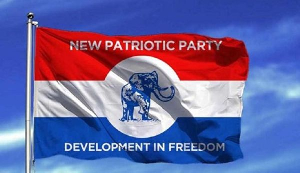 NPP flag