At the 81st United Nations General Assembly, Barbados Prime Minister Mia Amor Mottley delivered a bold message challenging the global climate movement: the world already knows enough to act.
“We understand enough about the climate crisis to reduce the emissions that are warming our planet and take the necessary steps for our populations to adapt,” she told world leaders.
The problem, she said, is converting knowledge into action. “It is our repeated failure to convert what we know into what we do, to turn principle into practice and global capacity into solidarity.”
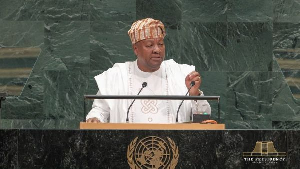
Another bold statement came from Ghana’s President, John Dramani Mahama, who said the climate challenge is also fundamentally a question of equity. Addressing the same General Assembly, Mahama declared:
“Climate change is the ultimate test of global equity. Africa contributes less than 4% of global greenhouse gas emissions, yet bears some of the heaviest burden of climate devastation.”
President Mahama also called for climate finance that does not deepen the debt burdens of vulnerable countries.
“Mitigation support must be operationalized with predictable, non-debt-creating grants, not loans that further indebt fragile economies.”
Alongside the UN General Assembly, more than 100,000 people gathered for Climate Week NYC 2026, held under the theme “Energy. Impact. Action.” At the centre was an important discussion at the Reforest the Future Summit, where governments, businesses and civil society examined how nations can collaborate to improve the quality and success of reforestation efforts.
For forest restoration company Terraformation, the country platform model offers a different approach to implementing forest restoration. The company’s CEO, Jad Daley, explained:
“The country platform model is first and foremost about a new way of partnering to accomplish a national restoration goal. The idea is to create an operating system where all partners can move reforestation with greater pace, scale and quality.”
This goal is linked to Ghana’s 2040 reforestation strategy, which requires a coordinated national effort to restore degraded forests, increase tree cover and protect the country’s forest resources. The government has a central role in establishing national goals, aligning policy and public expenditure, coordinating stakeholders and serving as the anchor institution.
Led by Ghana’s Forestry Commission, the proposed country platform would bring reforestation partners together to share knowledge, access technical support and funding, and collaborate on the ground. It would also promote reliable data to help track progress and address policy and land tenure challenges, among other issues, to support restoration efforts.
This position was emphasised by the Chief Executive of Ghana’s Forestry Commission, Dr Hugh C. A. Brown.
“[It’s] the idea of having a collaborative process where we bring stakeholders on board. It’s not just about the science; it’s about livelihoods and, to some extent, politics. So we need a wide range of players sitting around the table and making decisions.”
Daley explained that one of the fundamental arguments behind the country platform model is that individual projects can become more effective when they stop operating in isolation.
“A country platform distinguishes itself from a collection of independent projects because it creates synergy between projects and partners. Instead of competing over the same few places and resources, partners can collaborate on things like seed sourcing and help direct resources toward areas that are underserved.”
He further explained that when projects operate within a common national framework with consistent standards, data, policy support and quality controls, the platform can potentially reduce some of the uncertainty surrounding individual restoration investments.
However, financing reforestation is not simply a question of how much money is available. It is also about securing the right type of finance and ensuring that it is accessible. While some projects may generate sufficient carbon revenue to support investment, others may deliver significant biodiversity and community benefits while generating too little carbon revenue.
Daley believes a country platform can help create a financial framework that recognises these differences.
“We need a financial framework that matches the diversity of reforestation opportunities. Some can be advanced through carbon markets, while others require donor or concessional funding for viability.”
Ghana has been putting systems in place to support forest restoration. The Forestry Commission’s work on carbon markets, together with stronger monitoring and evaluation, could help attract more investment into restoration projects.
The country platform proposal is ultimately about changing how existing organisations work together. Daley added that the objective is to reinforce existing efforts rather than duplicate them.
“The power in this approach is moving from competition to collaboration. It is about raising everyone’s skill levels and resources, creating consistency in how performance is measured, and ultimately creating a country where donors and investors know they can get great outcomes.”
Daley said country platforms must demonstrate their value and deliver tangible benefits.
“We can create a circular economy that links in different ways to the lands we restore. The most important barriers are trust and time. We must work carefully in the way all partners are invited in and involved, so that all feel equitably served and see real benefits.”
This brings the discussion back to Prime Minister Mottley’s message at the UN. The climate crisis is no longer primarily a problem of understanding what needs to be done; it is time to turn knowledge into action. Mahama’s call for climate finance based on equity and partnership captures the financing imperative.
The country platform model connects these two ideas. The question is not simply how to finance another reforestation project, but what it would take to make a country better at restoring its forests.
For Ghana, that means bringing government leadership together with the private sector and investors, civil society and local communities around a common national objective. For the international restoration movement, the approach could offer a model that other countries can adapt.
Daley offered a final recommendation:
“Be totally welcoming and inclusive for all partners who are ready to help. Use the partnership to move from competition to collaboration.”
That may ultimately be the central lesson of the country platform approach. The world’s forests do not need another collection of isolated projects. They need systems capable of transforming thousands of individual efforts into national change.
And Ghana could be one of the countries leading the way.
Opinions of Monday, 26 October 2026
Columnist: Terraformation/Forestry Commission (Ghana)
Beyond climate pledges and promises, Ghana's reforestation strategy presents a global model
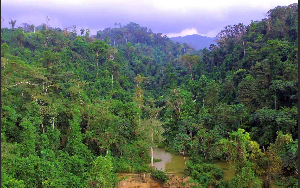 File photo of Atewa Forest