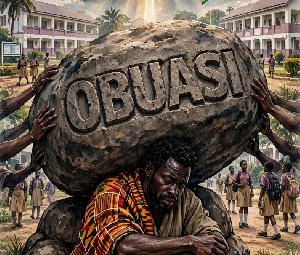
Some months ago, a sister of one of my mentors passed away at Korle Bu. There was no funeral because she, knowing her illness was terminal, chose to donate her body to the University of Ghana Medical School for medical research.
This was my first personal encounter with such a donation. During the procedures related to the body bequest, the doctor in charge explained the challenges in securing cadavers (bodies) for medical training and mentioned that limited admissions of medical students in Ghana are partly due to this issue and not just infrastructure.
This inspired me to write this article.
Consider what a body represents to medical science. It is not just tissue and bone. It is a complete textbook, a laboratory that teaches and a final teacher whose lessons endure in every doctor it helps train.
When a patient dies of a disease that medicine does not yet fully understand, their body holds answers. When a new medication is developed, its effects on human physiology must be studied in human bodies and not just in computer models or animal subjects.
When old medicines need revision because diseases evolve or populations change, researchers must see how those medicines interact with human tissue, organs and systems.
Most of the medical researchers in Ghana struggle with these challenges. Without fresh bodies, they cannot study the effects of emerging diseases like new viral strains or resistant infections. They cannot test how new medications affect organs in real human subjects. They cannot refine surgical techniques that might save thousands of lives.
Korle Bu’s Medical School, like others across the country, has historically relied heavily on unclaimed bodies. These are bodies left in mortuaries with no family to claim them.
But this source is no longer reliable. Mortuaries are overwhelmed, and even unclaimed bodies are often too decomposed or otherwise unsuitable for meaningful study. The hospital has had to conduct mass burials of unclaimed bodies, removing them from any possibility of contributing to medical education.
The Anatomy of a Medical Student’s Education
Imagine the scene: one hundred first-year medical students gather around a single dissection table. They crowd, struggle for position, peer over shoulders and others. The professor points to a nerve, a vessel or a muscle, and most of these students cannot see. Then the situation means that those at the back would have to rely on textbooks and imagination.
This is not an exaggeration. In Ghanaian medical schools, the student-to-cadaver ratio is a big challenge. Some institutions report having only a handful of cadavers for entire cohorts of hundreds of students. The result is that students learn anatomy through models, digital simulations and textbook diagrams which, although very important, cannot be substituted for what is done with the cadaver.
Cadaveric dissection remains the gold standard for learning human anatomy. It teaches not only structure but how bodies differ from one another. It teaches surgical technique, respect for the human body and the three-dimensional relationships that no flat image can convey.
A study done at the University of Health and Allied Sciences (UHAS) in Ghana on 513 health science students, including those studying medicine, nursing, midwifery, pharmacy and allied health, revealed that only 74.1% of these students had heard of body bequeathal, 98.3% agreed body bequeathal was important and only 39.6% knew the requirements and processes of body bequeathal.
The paper also says 214 students (41.7%) said they had no idea what was required in the process.
It is obvious that there was a high awareness of the importance of body bequeathal but very low procedural knowledge, as most were unwilling to donate their body.
A Culture of Funerals, A Shortage of Teachers
Ghanaian culture, particularly among the Akan and many other ethnic groups, places a strong significance on funeral rites and the treatment of the dead. The body is not only a vessel that has stopped working. It is a site of ritual, a conduit for ancestral blessings and a subject of communal mourning.
Funerals in Ghana are detailed, expensive and protracted affairs. Bodies are bathed, dressed, displayed and buried with ceremony. To suggest that a loved one’s body be given to medical students for dissection, which means to be cut, studied and eventually disposed of, can feel like a violation of cultural and spiritual obligations.
This is not a small or dismissible concern. These are deeply held beliefs about the afterlife, about respect and about the relationship between the living and the dead. Any conversation about body donation in Ghana must begin with acknowledgment of this cultural weight and not dismissal of it.
Yet there is a tension worth examining. The same culture that insists on detailed funerals also values healing, community and the preservation of life. If a body can no longer benefit the deceased, could it benefit the living? If a funeral honours a life that was lived, could a donation honour a life that could still be saved?
The Law Already Allows It
Ghana’s Anatomy Act of 1965 (Act 280) provides a legal framework for body donation. Section 3 explicitly allows any individual to direct, either in writing or verbally before two witnesses during their final illness, that their body be used for medical education and research.
Section 2 permits executors or those with lawful possession of a body to allow such use, unless the deceased expressed a contrary desire or a surviving spouse or relative objects.
The law is permissive but not proactive. It does not actively encourage donation, does not create an accessible system for willing donors and does not provide the cultural and religious engagement needed to shift deeply held norms.
As a result, Ghana has only two institutions with any form of body donation programme, and these receive an average of just five and two bodies per year, respectively. In a country with multiple medical schools and thousands of students, this is a drop in an empty bucket.
The Way Forward: A Call for Courageous Conversation
What would it take to change this? The answer must be many-sided, culturally sensitive and sustained.
First, leadership from chiefs and religious leaders is essential. As research on community responses to health crises in Ghana has shown, when traditional and religious authorities endorse changes to deeply held practices, communities are far more likely to follow. If the National House of Chiefs, the Christian Council and Islamic leadership publicly endorsed body donation as an act of service and healing, the cultural calculus would shift.
Second, hospitals must create accessible and dignified donation programmes. Individuals who know they are dying, whether from terminal illness or old age, should have a clear, compassionate pathway to bequeath their bodies. The process must be respectful, transparent and honoured with acknowledgment and gratitude.
Third, medical schools must invest in public education. The fact that nearly all health science students support body donation in principle but few know how to do it reveals a massive gap in information. This gap extends to the general public. Educational campaigns, testimonies from families who have donated, and visible memorials to donors can help normalise the practice.
Fourth, the legal structure for body bequeathal should be strengthened. Parliament has already recognised the need for updated legislation on organ and tissue donation, noting that only 10 percent of global transplantation needs are met and that the African region lags far behind. The same legislative energy should be applied to body donation for education, with provisions for donor registries, family consent protocols and protections against commercial exploitation.
Finally, we must reframe the conversation. Body donation is not abandonment of the dead. It is, in a great sense, the ultimate act of healing. A body that teaches a medical student to recognise a tumour, to perform a delicate surgery, to understand a disease does not lie idle in the ground. It works.
The Teacher Who Never Speaks
In medical schools around the world, cadavers are often called the “silent teachers.” They do not lecture. They do not explain. They simply are. And by being, they teach what no book can.
In Ghana, we have the opportunity to create a culture where donation is not taboo but honoured. Where a family’s grief is joined by a community’s gratitude. Where the dead continue to serve the living not through memory alone but through medicine.
Korle Bu Teaching Hospital needs bodies. Ghana’s medical students need bodies. The patients of tomorrow, that is, the ones who will survive because a doctor learned from someone who gave their body to science, need those bodies too.
The question is whether we are brave enough to have the conversation. Whether we can hold our cultural traditions in one hand and our children’s futures in the other and find a way to honour both.
The dead can teach. Let them teach.
Opinions of Friday, 23 October 2026
Columnist: Rebecca Abafum
Dead Men Can Teach: Why Ghana’s medical schools are running out of bodies
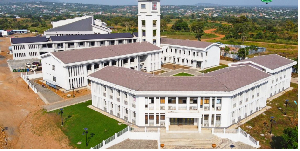 An aerial view of UHAS





Opinions