Political prophecy has become a familiar feature of Ghana’s Fourth Republic, and scholarship has examined its effects on voters and electoral stability. However, scholars have paid less attention to how the relationship between prophetic actors, political parties and the state has changed over time.
This article traces that trajectory from 1993 to 2026 through five overlapping phases: democratic reopening, normalisation and partisan alignment, brokerage and patronage, competition and regulation, and attempted bureaucratisation. The analysis draws on episodes from every administration since 1993, under both major parties. On the prophetic side, a cleric claimed in 2014 that governing-party executives had promised him the post of spiritual adviser to the President in return for intercessory prayer, while a prominent prophet later claimed that the eventual winner of the 2016 election and his wife had pledged to help build his church.
On the state side, official responses moved from a 2021 police warning against fear-inducing prophecy to an August 2025 request by a presidential envoy that religious leaders submit prophecies of national significance for official review, a request from which the envoy retreated within a fortnight.
The article treats state capture as a hypothesis to be tested against two alternatives: prophetic clientelism and competitive sacralisation. It finds the documented cases consistent with both alternatives and with an attempted but resisted institutionalisation of prophetic authority; they do not establish state capture.
The pattern is structural rather than partisan, recurring across alternations of power. The democratic problem it identifies is not that a public office receives a prophecy, but that unverifiable revelation may enter the decision chain of a constitutional state. Comparisons with Nigeria, Kenya, Zambia, South Africa, the United States, Brazil, the United Kingdom and France suggest that the democratic risk lies less in religion itself than in the institutional form through which religious authority is converted into political authority.
Suggested citation: Aboagye, F. B. (2026). The anointed and the elected: Political prophecy and constitutional authority in Ghana’s Fourth Republic, 1993–2026 (UAR Research Paper No. 3/2026). Ulinzi Africa Resources. The views expressed in this paper are the author’s own.
Opinions of Sunday, 11 October 2026
Columnist: U A R Colonel Festus Aboagye (Retired)
The Anointed and the Elected: Political prophecy and constitutional authority in Ghana's 4th Republic
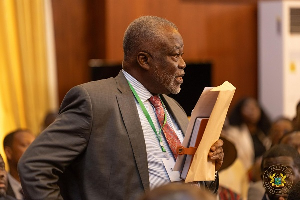 U A R Colonel Festus Aboagye (Retired)