There are moments when a President stands before the world and speaks not only for himself, but for an entire country. At such moments, every word carries the weight of the nation he represents.
So, when President John Mahama stood before the 81st United Nations General Assembly and held Ghana up as evidence that democracy can work, there was every reason for Ghanaians to listen with pride.
And, to be fair, the President made a compelling case.
He reminded the world that democracy cannot simply be about going to the polls every four years, casting a ballot and returning home. Democracy must mean something in the everyday lives of citizens. It must put food on the table, provide quality education, decent housing, healthcare and economic opportunity. It must improve the dignity and wellbeing of the people in whose name governments exercise power.
On that point, the President is right.
Ghana has earned the right to speak about democracy. Since the beginning of the Fourth Republic, we have held competitive elections and witnessed peaceful transfers of power from one political party to another. In a continent where democratic transitions have not always been peaceful, Ghana's record is one we should be proud of.
But perhaps this is where the harder conversation begins.
Because democracy is not only tested when a President stands at a podium in New York and speaks confidently about it. It is tested when the cameras are gone, when the applause has died down, and the people return to their ordinary lives.
It is tested in our police stations, our courtrooms, our newsrooms, our universities, our streets and, increasingly, on our phones.
And that is where the story becomes a little less comfortable.
The uncomfortable contradiction
The Media Foundation for West Africa has documented arrests involving journalists, bloggers, TikTok creators, activists and ordinary citizens under laws relating to false news and electronic communications.
It has counted 14 such arrests in the first 16 months of the current administration and warned about what it describes as the growing criminalization of speech.
In July 2026, two content creators were arrested in connection with a video involving the President and a discussion about GH¢150 million. MFWA noted that other social media users had shared the same video without facing similar consequences and urged caution, arguing that arrest should not be the first response to offences involving speech.
None of this means that everyone who has been arrested was innocent, or that every statement made online amounts to fair comment. Threats, incitement and deliberate falsehoods can cause real harm, and the law has a legitimate role in dealing with them.
That is precisely why proportionality matters.
The question is not simply whether the state has the power to arrest someone. The question is whether an arrest is necessary, proportionate and consistent with the freedoms the state itself claims to protect.
The President has already set the standard and has made his argument.
Ahead of his UN address, Mahama cautioned against disproportionate arrests in response to criticism, warning that such actions could create “undeserving martyrs” and erode public trust in state institutions. He also argued that criticism, satire and dissent should not be criminalised.
Good. Then that principle should become the standard by which his government is judged.
Citizens should be able to distinguish between a genuine threat to public safety and speech that is merely rude, embarrassing, provocative or politically inconvenient. A government that cannot tell the difference risks confusing an insult with a threat.
And when that happens, the problem is bigger than the individual case. It becomes a question about the kind of democracy we are building.
Power comes with scrutiny
Presidents, ministers and Members of Parliament hold public office because citizens entrusted them with power. They cannot reasonably expect the same protection from criticism as a private individual.
Scrutiny comes with the job. So does disagreement. Sometimes the criticism will be unfair. Sometimes it will be uncomfortable. That is part of public life.
The answer to criticism should not automatically be a police station or a courtroom.
Often, the better response is a stronger argument, evidence, clarification, or simply an explanation.
If the criticism is political, the response should, wherever possible, be political too. Coercive state power should be reserved for genuine criminal conduct, not used in ways that make citizens afraid to express themselves.
The imbalance is enormous
A government minister has a press office, advisers, a podium and the machinery of the state behind them.
A young Ghanaian may have nothing more than a smartphone, a social media account and a voice.
When those two sides confront each other, the imbalance is obvious.
That is why constitutional rights matter. They exist, among other things, to protect ordinary citizens from abuses of power. They are not meant to provide additional protection for those who already have power.
Democracy must deliver dignity too
Jobs, good schools, functioning hospitals and economic opportunity matter. But civic dignity matters too.
A democratic society should allow a citizen to disagree with the government without being treated as an enemy of the state. It should allow journalists to investigate powerful people without fearing retaliation. It should allow citizens to express political opinions without first calculating the risk of detention.
These are not special privileges.
They are part of what democracy promises.
The test that outlasts every government
Governments change. Political parties move from power to opposition and back again.
That is why institutions cannot rely on the goodwill of the government in power today. A tool created to silence critics can easily be used by a different government tomorrow. Yesterday's defender of free speech may become tomorrow's target.
The principle, therefore, must be bigger than any political party.
No government should have unchecked power over its citizens, regardless of how much we trust that government today.
Prove it here
If Ghana wants to demonstrate to the world that democracy works, the evidence should not come only from a podium at the United Nations.
It should be visible in our police stations, courtrooms, newsrooms, universities, streets and social media spaces.
Democracy works when journalists can investigate freely. When opposition parties can organise. When citizens can protest peacefully. When courts can operate independently. And when the law is applied fairly, regardless of which political party is in power.
Ghana does not need to abandon the democratic progress it has made. It needs to deepen it.
Because democracy is not only about what a government does for its people.
It is also about what a government must never be allowed to do to them.
The true measure of Ghana's democracy will not be how confidently its President speaks about it in New York. It will be how safe an ordinary Ghanaian feels expressing an opinion about the President at home.
Opinions of Wednesday, 7 October 2026
Columnist: Edith Gyekye
Ghana's democracy will be judged at home, not at the UN
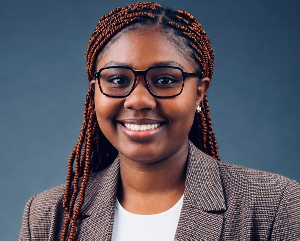 Edith Gyekye is a strategic communicator