Nkrumah’s Prophecy of the Backdoor Invader
IN the twilight years of his historic anti-colonial crusade, Osagyefo Dr. Kwame Nkrumah issued a chilling, prophetic warning that has echoed down the corridors of independent African history like a tolling bell.
The first phase of colonialism—characterized by gunboats, flag-raising ceremonies, and overt territorial occupation—was crude, brutish, and ultimately unsustainable. It invited open rebellion and forged an unshakeable national consciousness among the colonized, making direct imperial rule impossible to maintain indefinitely.
The true existential peril, Nkrumah forewarned with razor-sharp foresight, would arrive disguised as benevolence. Neo-colonialism would be the Western powers' invasive march through the backdoors of multilateral treaties, donor-driven aid frameworks, and technocratic cooperation.
If unresisted, it would prove infinitely more destructive, stealthy, and permanent than traditional bondage, reducing sovereign states to subservient dependencies managed from foreign capitals while maintaining the hollow, deceptive illusion of national independence.
Decades later, that theoretical nightmare has materialized in real time across West Africa, laying bare a stark, humiliating dichotomy between institutional backbone and unmitigated capitulation.
While sister nations across the sub-region have drawn a line in the sand to protect their biological architecture, legal autonomy, and national security, Nigeria has eagerly bared its neck to the global executioner’s blade.
At the center of this continental drama stands a tale of two distinct political realities: Ghana, under the steadfast, fiercely nationalistic leadership of President John Dramani Mahama, acting as the uncompromising guardian of African dignity; and Nigeria, staggering under an administration whose health technocrats have traded strategic sovereignty for a glittering, $5.1 billion poison chalice.
To understand why Ghana’s recent rejection of a predatory foreign health compact sent shockwaves through international diplomatic circles, one must examine the ideological DNA of its leadership. President John Dramani Mahama is no ordinary politician navigating the transactional tides of contemporary governance.
He is a historian, an intellectual statesman, and the ideological heir to the Nkrumahist tradition of unyielding resistance. True to type, Mahama has never failed the continent or the enduring Ghanaian spirit of defiance.
When the architects of modern neo-colonialism attempted to slip their invasive hooks into Accra via a sweeping health and biosecurity agreement, Mahama and the Ghanaian parliament did not flinch. They recognized the compact for what it truly was: a sophisticated attempt to weaponize philanthropy and exploit the post-pandemic anxieties of the Global South.
Long after the crude gimmicks of the COVID-19 era failed to completely bend the African continent to foreign dictates, Western powers sought a more insidious vehicle for biosecurity control.
Mahama understood this perfectly. Drawing from Nkrumah’s eternal well of self-reliance, he recognized that African biological annihilation would no longer arrive at gunpoint but in the sterile, polite language of "health cooperation alliances."
By slamming the door shut on foreign demands for proprietary pathogen data, unredacted citizen medical registries, and regulatory waivers, Mahama proved that the flame of African sovereignty is far from extinguished. He stood as a towering storming petrel, reminding the global community that a nation's health security cannot be outsourced to foreign bidders without forfeiting its soul.
The Regional Split: Defiance Versus Docility
To fully grasp the sheer magnitude of Abuja’s policy blunder, one needs only to look across West and Southern Africa, where regional neighbors confronted the exact same US health compact and recognized it for what it truly was: an encroachment on national survival.
In Ghana, the reaction was swift, uncompromising, and defensive of national pride. When the health compact document reached the desk of the Ghanaian cabinet, it was dissected, cross-examined, and summarily thrown out in record time. Former and current state leaders in Accra did not mince words as they laid bare the humiliating provisions buried within the fine print.
As detailed in explosive governmental disclosures, the proposed compact demanded that recipient nations surrender their proprietary pathogen profiles—cataloging every deadly disease endemic to their soil. It demanded unfettered access to sovereign medical records.
Most humiliatingly, it stipulated that any pharmaceutical products, vaccines, or medical devices brought into the country under the auspices of the agreement would be completely exempt from inspection by local regulatory bodies such as Ghana’s Food and Drugs Authority (FDA).
Imagine the sheer indignity: a sovereign nation stripped of its right to inspect foreign drugs entering its ports, forced to swallow whatever medical interventions are handed down from foreign laboratories, and compelled to finance its own subjugation with domestic funds.
Ghana said no. Namibia said no. Zimbabwe said no. Yet, in Abuja, the response was a docile nod.
While other African administrations exercised self-preservation—the core principle that protects a state from existential exploitation—Nigeria’s Ministry of Health rushed forward to embrace the handshake that binds.
Abuja’s $5.1 Billion Structural Self-Sabotage
Contrast Ghana's fierce defensive posture with the harrowing spectacle unfolding in Abuja. Nigeria recently entered into a five-year, $5.1 billion health cooperation framework with the United States—a deal hailed by unpatriotic technocrats as a diplomatic triumph, but which is, in reality, a constitutional catastrophe and an act of structural self-sabotage.
A granular look at the financial shell game reveals staggering absurdity. Washington contributes a nominal $2.1 billion spread across half a decade, while a cash-strapped, debt-ridden Nigerian state is obligated to cough up a crushing $3 billion in domestic counterpart funding.
At a time when primary healthcare centers across the federation lack basic analgesics, running water, and stable electricity; when medical professionals are fleeing the country in droves due to starvation wages; and when public infrastructure is gasping for breath, the federal government has prioritized finding billions to match foreign donor conditionalities.
Worse still, the fine print of the agreement demands the surrender of Nigeria’s most sensitive biological and institutional assets:
Pathogen Profiles. What is the primary reason for the request for unfettered access to endemic pathogen libraries and localized epidemiological blueprints—strategic assets in the modern era of biosecurity?
Let's be straight and factual, why should the medical records of over 200 million citizens be handed over to external intelligence and pharmaceutical complexes under the guise of surveillance? How come there would be complete exemption of imported foreign drugs, vaccines, and medical devices from independent local testing by NAFDAC (National Agency for Food and Drug Administration and Control)?
Why would a sovereign giant willingly submit to such biological colonisation? The questions hanging over Abuja are as deafening as they are damning. Is this massive financial influx of counterpart funds intended to serve as an off-the-books slush fund to service political machinery for the upcoming presidential election cycle?
Given historical precedent, will these billions vanish into the labyrinthine accounts of donor-dependent parastatals while the average Nigerian peasant remains entirely unprotected? Where is the Minister of Health? Why is he not speaking truth to the citizens?
Why does the head of NAFDAC remain at her desk instead of resigning in protest against the evisceration of local regulatory powers? Is President Bola Ahmed Tinubu truly cognizant of how his administration’s unpatriotic, laissez-faire health bureaucracy has bartered away national security?
The Gates Factor: Philanthropy or Philanthrocapitalist Intrusion?
To trace the roots of this systemic capture, one cannot ignore the frequent, high-profile interventions of billionaire philanthropist Bill Gates, whose footprint in Nigeria's policy space has deepened intensely over recent years.
Gates—whose global health interventions and pandemic strategies have faced fierce international scrutiny—has visited President Bola Ahmed Tinubu on multiple occasions, most notably arriving in Nigeria on June 19, 2023, and later on June 3, 2025. Accompanied by industrialist Aliko Dangote, Gates met with President Tinubu at the Aso Rock Presidential Villa to steer national health sector initiatives.
The culmination of this cozy alliance occurred on June 3, 2025, when President Tinubu formally conferred upon Bill Gates the prestigious national honour of Commander of the Order of the Federal Republic (CFR) in Lagos, lauding his philanthropic footprint in health and education.
One is forced to ask: Does Bill Gates' personal relationship and heavy financial leverage have anything to do with the Presidency and the Ministry of Health's alarming Memorandum of Understanding with the US government and their intrusive proclivity to compromise the national health security of millions of Nigerians?
More damningly, what are Bill Gates' foreign consultants and staff members of US, European, and Indian origin doing physically stationed inside the Abuja Federal Ministry of Health, drawing fat remuneration packages directly funded from the nation's treasury? Are these foreign operatives writing local health policies to serve Nigerian interests, or are they acting as garrison commanders for foreign pharmaceutical cartels?
The Technocratic Fifth Column
How did a Nigerian government arrive at such a crossroads of capitulation? The answer lies in the deep-seated ideological capture of the nation's civil service and policy-formulation machinery. For decades, African states have suffered from a deficit of indigenous policy development structures.
Too many of those entrusted with managing critical sectors—from education and finance to health—are products of foreign academic ecosystems, thoroughly indoctrinated in Western donor orthodoxy, globalist frameworks, and multilateral technocracy. They are groomed from youth in international schools to think not as patriots serving the national interest, but as regional managers executing the strategic mandates of foreign capitals and supranational bodies.
When technocrats with deep institutional ties to foreign foundations, donor cartels, and United Nations agencies are placed at the helm of strategic ministries, the policy output inevitably reflects their external allegiances.
While Abuja’s political elite sleepwalks through strategic surrender, Accra has risen to the occasion. President John Dramani Mahama’s courageous levitation as the altruistic African soldier and the towering storming petrel of the 21st century deserves global recognition.
He has reminded the world that leadership is not about bending the knee to foreign treasuries, but about guarding the sacred trust of ancestral heritage. The question is, who will save Nigeria from its domestic predators? As the edifice of statehood cracks under the weight of unmitigated compromise, one truth remains self-evident: self-preservation is the first law of nature.
Until Nigeria purges its corridors of technocratic fifth columnists and reclaims its institutional spine, the ghost of Kwame Nkrumah will continue to haunt Abuja—shouting down from the pages of history at a nation that forgot how to say No.
Opinions of Wednesday, 7 October 2026
Columnist: Erasmus Ikhide
John Mahama saved West African Sovereignty while Nigeria swallowed the poison chalice
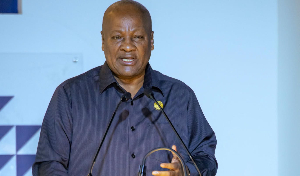 President John Dramani Mahama