There are moments in the history of a political party when leadership elections are about much more than the personalities contesting for office.
The New Patriotic Party (NPP) is at such a moment.
The Party’s defeat in the 2024 general election was not simply an electoral setback. It exposed questions about organisational cohesion, grassroots engagement, internal discipline, communication, party financing, leadership coordination, and the relationship between the Party’s national leadership and its structures across the country and in the diaspora.
The NPP must therefore resist the temptation to treat the current National Chairmanship election as another contest between personalities or factions.
The more important question is this:
What kind of leadership does the NPP need to confront its weaknesses, rebuild its structures, restore confidence, and prepare effectively for the 2028 general election?
That question requires us to look honestly at the Party’s recent history.
It requires us to remember what worked.
It requires us to acknowledge what did not work.
And it requires us to examine the records of those offering themselves for leadership.
It is against that background that the record and political experience of Awentami Paul Afoko deserve serious consideration.
The NPP has been here before
The NPP’s present difficulties did not begin in 2024.
The Party has experienced periods of internal disagreement, organisational weakness and uncertainty before.
Indeed, before the 2016 general election, the Party was emerging from the difficult aftermath of the 2012 election and the subsequent presidential election petition.
The NPP had to confront difficult questions about its organisation, internal cohesion and electoral strategy.
It was in that environment that Paul Afoko entered the National Chairmanship contest with what he called the “New Plan for Power.”
His argument was straightforward: the Party could not simply assume that it would return to government because the NDC had been in power for some time. The NPP had to reorganise, strengthen its structures, address internal divisions and deliberately prepare for the next election.
In 2013, before becoming National Chairman, Afoko was publicly arguing that the Party needed to conduct a postmortem of the 2012 election, address divisiveness and begin preparations for 2016 immediately rather than waiting until an election year.
After his election as National Chairman in April 2014, the same philosophy became part of his stated organisational programme.
Contemporary reporting described his “New Plan for Power” as a programme aimed at reorganising and re-energising the Party’s structures, strengthening constituency offices, training polling agents and making the Party’s organisational machinery more effective ahead of 2016.
This historical point matters.
Successful political parties are not built in the final months before an election.
They are built continuously.
The 2016 victory: A collective victory built on organisation
The NPP’s 2016 victory belongs to the entire Party.
It belongs to the presidential candidate, parliamentary candidates, national executives, regional executives, constituency executives, polling-station officers, campaign managers, communicators, volunteers and millions of Ghanaian voters who gave the Party their mandate.
No individual should attempt to appropriate that victory.
But collective victory does not mean individual contributions should disappear from history.
Paul Afoko’s administration was responsible for the Party during an important period of organisational preparation before the 2016 election.
His administration was involved in the processes surrounding the Party’s parliamentary primaries and presidential primary, as well as the broader effort to strengthen the Party’s structures.
His “New Plan for Power” was explicitly framed around reorganising and restructuring the NPP for electoral victory.
It is equally important, however, to be historically precise.
Paul Afoko was suspended in October 2015. The campaign machinery that ultimately delivered the 2016 victory therefore operated under a leadership structure that changed after his suspension.
That fact should not erase what came before.
Nor should subsequent achievements be attributed exclusively to Afoko.
The appropriate historical conclusion is more balanced:
The 2016 victory was collective, but the organisational foundations of that victory were laid over several years, including during Afoko’s tenure as National Chairman.
The electoral result was significant.
The NPP won 169 of the 275 parliamentary seats in 2016, giving the Party a commanding majority in Parliament.
The Party also won the presidential election decisively.
That achievement demonstrated the importance of organisation, mobilisation, candidate selection, grassroots work and strategic preparation.
It also raises an important question for today’s Party:
What organisational lessons from that period can be recovered and adapted for 2028?
From victory to vulnerability
The NPP subsequently won the 2020 presidential election and retained control of government, although its parliamentary position became much narrower.
The 2020 parliamentary election produced an unprecedented situation in which the NPP and NDC each held 137 seats, with one independent MP, Andrew Amoako Asiamah of Fomena, holding the balance.
That episode should be remembered because it provides an important lesson about the consequences of internal party disagreements.
And this is where the statements of then-General Secretary John Boadu, who is now contesting the National Chairmanship, become relevant to the historical discussion.
The Fomena lesson
Andrew Amoako Asiamah had been elected as the NPP Member of Parliament for Fomena in 2016.
After losing the NPP parliamentary primary ahead of the 2020 election, he chose to contest the constituency seat as an independent candidate.
The then NPP leadership opposed that decision.
On October 13, 2020, then-General Secretary John Boadu issued a statement declaring that members who filed as independent candidates had forfeited their NPP membership under Article 3(9) of the Party’s constitution.
Regarding Asiamah, Boadu stated that because he had filed as an independent candidate, he had presumably vacated his parliamentary seat under Article 97(1)(g) of the 1992 Constitution. The Party also informed Parliament of its position.
Those were the publicly stated positions of the Party’s General Secretary at the time.
But elections have consequences.
Asiamah went ahead and contested Fomena as an independent candidate.
He won.
He polled 12,805 votes, defeating the NPP’s candidate, Philip Ofori-Asante, who obtained 10,798 votes, while the NDC candidate obtained 2,608 votes.
That single constituency subsequently became politically significant.
The 2020 parliamentary election left the NPP and NDC with 137 seats each.
Asiamah, the independent MP for Fomena, therefore became the pivotal member.
In January 2021, he formally informed the Speaker that he would associate with the NPP Caucus for purposes of parliamentary business. Speaker Alban Bagbin subsequently declared the NPP Caucus together with the Fomena Independent MP to constitute the Majority group.
That episode demonstrated how an internal constituency dispute can have consequences extending far beyond the constituency, particularly when the numerical balance between the two major parties is extremely narrow.
It also illustrated the importance of reconciliation and conflict management within political organisations.
The Fomena episode should therefore not be reduced to an argument about one individual.
It should be treated as a lesson in political organisation, internal conflict management and institutional reconciliation.
The question for today’s NPP
The NPP must ask itself difficult questions:
Have we learned enough from experiences such as Fomena?
Have we become better at managing internal disagreements?
Have we developed stronger mechanisms for reconciling members after internal elections?
Have we created an environment where defeated aspirants continue to feel that they have a meaningful place within the Party?
And have we strengthened constituency structures sufficiently to prevent disagreements from becoming electoral liabilities?
These questions are particularly important following the 2024 election.
The Electoral Commission’s 2024 results and parliamentary data show a dramatic reversal from the NPP’s earlier parliamentary position. The NDC emerged with 183 seats, while the NPP won 88 seats. Independent candidates won four seats, while one seat remained undeclared.
Whatever interpretation one places on that result, the magnitude of the change requires the NPP to conduct a serious organisational examination.
The Party must not merely ask why it lost.
It must ask what must change before the next election.
Paul Afoko’s political journey did not begin in 2014
Any serious assessment of Awentami Paul Afoko must go beyond his tenure as National Chairman.
His political involvement with the NPP stretches much further back.
He was part of the political generation that worked through the Party’s difficult years in opposition and the broader struggle that eventually culminated in the NPP’s return to government under former President John Agyekum Kufuor in 2000.
Kufuor’s victory in the 2000 election was historically significant. The NPP won the second-round presidential election with 56.9 per cent of the vote, producing Ghana’s first peaceful transfer of power from one elected government to another in the Fourth Republic.
The achievement was not the work of one person.
It was the product of years of sacrifice by a large network of NPP leaders, organisers, activists, candidates and supporters.
Afoko’s supporters point to his contribution to that broader political struggle and to the development of the Party as evidence of a political career that predates the chairmanship he won in 2014.
That history is relevant because the current NPP needs leadership with institutional memory.
A political party should not forget the people who contributed to its development simply because they later found themselves on different sides of an internal disagreement.
Service to the party cannot be measured only by office
Perhaps one of the most important aspects of Paul Afoko’s political history is what happened after he ceased to exercise the full powers of the National Chairmanship.
In October 2015, the NPP’s National Executive Committee endorsed his indefinite suspension. Later that year, then-General Secretary Kwabena Agyei Agyepong and Second Vice-Chairman Sammy Crabbe were also suspended.
Those events remain part of the NPP’s difficult internal history.
But another event from that period deserves attention.
In May 2015, after Afoko and Agyepong were prevented from accessing the Party headquarters, then-flagbearer Nana Addo Dankwa Akufo-Addo publicly called for both national officers to be allowed to access their offices and perform their official duties.
Whatever one’s interpretation of the internal disputes of that period, the historical record shows that the situation became serious enough to attract a public intervention from the Party’s presidential candidate.
Paul Afoko subsequently challenged his suspension and continued to identify himself with the Party.
That is an important part of his political story.
The test of party loyalty
Political loyalty is easy to demonstrate when everything is going well.
The more difficult test comes when an individual loses office, loses influence or disagrees with those currently exercising authority.
Afoko’s supporters argue that his conduct after his suspension demonstrates that his commitment was to the NPP as an institution rather than merely to the office he occupied.
Despite the prolonged internal dispute and his suspension, he remained associated with the NPP rather than forming or joining another political party.
He continued to engage in the Party’s political affairs.
For an organisation presently seeking to rebuild after a major electoral defeat, that experience is worth examining.
The NPP needs a culture in which political disagreement does not automatically become permanent political estrangement.
The Party needs people who can disagree without destroying institutional relationships.
And it needs leaders who can reconcile with people who once stood on the opposite side of an internal contest.
That is precisely where Awentami Afoko’s experience becomes relevant to the current debate.
From “New Plan for Power” to “Reunite, rebuild and recapture”
There is also a striking continuity between Afoko’s earlier political message and the agenda he is presenting today.
Before the 2016 election, he campaigned around the “New Plan for Power”, which he described in terms of restructuring, rebranding, reinvigorating and reuniting the Party for electoral victory.
Today, his message is:
REUNITE. REBUILD. RECAPTURE.
The three words correspond with the challenges facing the NPP.
Reunite
The Party cannot effectively rebuild while remaining trapped in old internal divisions.
Reconciliation must become an organisational priority.
The NPP must become a political home where members can disagree, compete and still remain part of the larger family.
Rebuild
The Party’s structures require renewed attention.
Constituency organisations must become stronger.
Polling-station structures must be active.
Communication must be continuous.
Grassroots members must feel connected to the national leadership.
And the Party must work throughout the electoral cycle rather than becoming active only when elections approach.
Recapture
The ultimate political objective is the return of the NPP to government.
But that cannot be achieved merely by declaring an ambition.
It requires organisation.
It requires resources.
It requires disciplined communication.
It requires candidate preparation.
It requires grassroots mobilisation.
It requires reconciliation.
And it requires national leadership capable of coordinating all these elements.
Paul Afoko’s present political message is therefore built around a sequence:
Reunite the Party. Rebuild the Party. Recapture political power.
The grassroots cannot be forgotten
One of the most important issues in the National Chairmanship debate should be the relationship between the national leadership and the grassroots.
A political party does not win elections from its headquarters.
It wins elections in constituencies and at polling stations.
The people who knock on doors, organise meetings, transport voters, communicate party messages, monitor polling stations and keep the Party alive between elections are not always the people whose names appear in national headlines.
Yet they are indispensable.
Afoko’s previous organisational agenda placed considerable emphasis on strengthening party structures.
Contemporary reports on his 2014 programme referred to plans to strengthen constituency offices, provide logistical support, train polling agents and improve the capacity of the Party’s structures.
That philosophy is consistent with his present emphasis on grassroots organisation.
In 2026, he has again argued that the Party’s real electoral strength lies at the grassroots and that polling-station executives, constituency officers and ordinary members require greater attention.
The question for the NPP is therefore not simply who can occupy the National Chairman’s office.
It is:
Who understands how to make the Party’s structures work effectively between elections?
Financing the party beyond election season
Another important issue is the financial sustainability of the Party’s structures.
Political parties cannot wait until an election year before thinking about constituency organisation.
The Party must be resourced throughout the electoral cycle.
Constituency offices need to function.
Communication structures need to operate.
Polling-station officers need training.
Organisers need to remain engaged.
And grassroots activities must continue even when there is no immediate election.
Afoko’s previous programme was presented with this philosophy in mind.
His current campaign has similarly emphasised the mobilisation of resources for party structures.
Afoko has also been associated with claims that he sent GH¢10,000 to every constituency account across the country and planned to continue such support.
If this claim is to form part of the article as evidence of his record, it should be supported by a primary source, contemporary report or other verifiable documentation.
That distinction is important because claims about specific financial contributions are stronger when the amount, beneficiaries, timing and source can all be established.
The broader issue, however, goes beyond the resources available to any individual candidate.
The relevant question is not simply who can finance a campaign for National Chairman.
It is:
Who can help build a sustainable financial system for the Party after the chairmanship election?
That is a governance question.
It is also a question of institutional independence.
The question of independence and accountability
The NPP must also be careful about the relationship between political leadership and private financial interests.
This is not an accusation against any candidate.
It is a general principle of institutional governance.
A National Chairman should ultimately be accountable to the Party.
The Party should therefore have transparent systems for campaign financing, fundraising and the mobilisation of resources.
Delegates are entitled to ask:
Who supports a candidate?
What is the nature of that support?
What expectations accompany it?
Can the candidate remain independent after the election?
Can the Chairman make difficult decisions without becoming beholden to individual financiers or political networks?
These questions should be asked of every candidate.
The National Chairmanship is too important to become an office controlled by unseen interests.
The successful Chairman must serve the institution, not any individual or group interest.
The NPP needs institutional memory
One of the greatest assets available to a political party is institutional memory.
The NPP has leaders who have experienced the Party in opposition.
It has leaders who have experienced government.
It has leaders who have managed internal elections.
It has leaders who have managed national campaigns.
It has leaders who have experienced both victory and defeat.
The challenge is to convert that experience into institutional learning.
Afoko’s political journey provides precisely such a case study.
He has experienced the Party’s opposition years.
He was involved in the political period that preceded the Kufuor victory.
He served during the Kufuor era.
He served as National Chairman.
He experienced internal conflict and suspension.
He witnessed the Party’s subsequent return to government.
He remained connected to the Party after leaving office.
And he is now seeking another opportunity to contribute to the organisation as National Chairman.
That breadth of experience is part of the record delegates will have to consider alongside the records and proposals of the other candidates.
Certainly. Below is the second part of the article, reproduced with the earlier corrections applied: sentence-case headings, tighter wording, reduced repetition, more formal phrasing, and clearer separation between the author's assessment and the factual record. I have retained the author's stated support for Paul Afoko as part of the article's voice.
A chairman must be a bridge
The NPP does not need another leadership contest that permanently divides the Party into winners and losers.
The National Chairman must be capable of becoming a bridge.
A bridge between the older generation and the younger generation.
A bridge between national leadership and grassroots structures.
A bridge between former opponents.
A bridge between different political tendencies.
And a bridge between the Party’s past and its future.
That requires integrity, courage, patience and institutional memory. It also requires the ability to listen, as well as the ability to disagree without treating disagreement as betrayal.
These qualities should form part of the conversation about the next National Chairman.
2028 will require more than a campaign
The next general election will not be won simply because the NPP wants to return to government.
The Party must rebuild before it campaigns. It must strengthen its structures before it mobilises. It must reconcile where necessary before asking members to make sacrifices. And it must reconnect with the electorate before asking Ghanaians to renew its mandate.
The National Chairman will therefore have an important organisational responsibility.
The office must work with the presidential candidate, national executives, regional executives, constituency executives and grassroots members.
It must help create an environment in which the entire Party works towards a common objective.
It must not become a parallel centre of power. It must not deepen factionalism. And internal competition must not become more important than the Party's broader national objective.
The question before the delegates
The 2026 National Chairmanship election should therefore be approached as an important institutional decision.
Delegates should examine the records of all candidates, their experience, organisational philosophy, ability to reconcile, understanding of grassroots politics, capacity to mobilise legitimate resources, independence, record of service and vision for the Party beyond the election itself.
In the case of Awentami Paul Afoko, the record includes his early political service, his contribution to the Party's development, his involvement in the political period leading to the NPP's return to government in 2000, his service during the Kufuor era, his tenure as National Chairman, his “New Plan for Power” initiative, the organisational work undertaken before his suspension, his continued association with the Party after his suspension, and his present 3R — Reunite, Rebuild, Recapture — agenda.
Those aspects of his political record form part of the wider conversation about the future of the NPP.
Looking forward
The NPP cannot rebuild its future by permanently fighting its past.
The Party must learn from its history without becoming imprisoned by it.
The Fomena experience should encourage reflection on reconciliation and the management of internal differences.
The 2016 victory should provide lessons about organisation and collective effort.
The 2024 defeat should prompt an examination of weaknesses that may have contributed to the Party's loss of parliamentary and presidential support.
The years in opposition should remind the Party of the importance of perseverance, while its internal conflicts should reinforce the need for institutional discipline, fairness and reconciliation.
Paul Afoko's political history gives delegates one particular record to examine within that broader conversation.
Whether one agrees with every decision he has taken or not, his political journey has been long and connected to several important periods in the history of the NPP.
His contribution to the Party, including his role during the period of rebuilding and reorganisation that preceded the NPP's return to government in 2016, is part of that record.
For me, these considerations lead to a clear position.
I declare my support for Chairman Awentami Paul Afoko for National Chairman of the New Patriotic Party.
My support is grounded in the conviction that the NPP needs a leadership approach that places unity, institutional rebuilding, organisational discipline, reconciliation and the strengthening of Party structures at the centre of its next chapter.
I believe Chairman Awentami Paul Afoko represents an opportunity for the Party to reconnect with the principles of organisation, collective responsibility and internal cohesion that, in my view, must underpin any serious effort to rebuild.
This is not about reopening old wounds. It is about learning from them.
It is not about settling old scores. It is about building a stronger institution.
It is not about personal relationships and interests. It is about the future of the New Patriotic Party.
The question before the Party is therefore not simply who wins an internal election and occupies the NPP headquarters at Asylum Down in Accra.
It is also about what kind of institution the NPP wants to become and how it intends to prepare for another attempt to govern from the Jubilee House.
A Party divided by old battles?
Or a Party capable of learning from them?
A Party whose grassroots structures become active mainly during elections?
Or a Party that works continuously between elections?
A Party where internal disagreements create permanent enemies?
Or a Party capable of reconciliation?
A Party that merely seeks to win internal contests?
Or a Party that deliberately prepares for the national contest ahead?
These are among the larger questions that the 2026 National Chairmanship election presents.
In answering them, delegates have an opportunity to look beyond personal relationships and examine the records, experience, organisational approach and vision of the candidates.
For me, after considering these questions, my choice is Awentami Paul Afoko.
I therefore respectfully call on delegates of the New Patriotic Party to consider his record, experience, commitment to the Party and his message of 3R — Reunite, Rebuild, Recapture.
The NPP has a difficult road ahead.
It must reunite.
It must rebuild.
And it must prepare itself for the task of recapturing the confidence of the Ghanaian people.
REUNITE. REBUILD. RECAPTURE.
I stand with Awentami Paul Afoko.
May God bless the New Patriotic Party.
May God bless Ghana.
Opinions of Monday, 28 September 2026
Columnist: Charles Owusu Juanah, Esq.
NPP Must Look Forward: Afoko’s record, the party’s challenges and the road to 2028
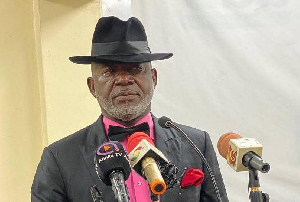 Charles Owusu Juanah, Esq. Senior Citizen and Senior Member, New Patriotic Party (NPP)