Before the arrival of Europeans, the town we know to be Sekondi was called Ezakumi, and it is still called Ezakumi by Ahantas as at today. It is actually "Eza yi ikumi" but the whiteman came and brought his own pronounciations so Ezakumi became Zakumi, then Zakode, then Sacconde and all the related pronounciations and spellings as they appeared in European records to finally Sekondi before our Fante relatives would vernacularise it to Sekunde. I have even heard them saying that it is "Esar Akum" all in attempt to Fantelise Sekondi but Sekondi is Ahanta.
When the Europeans arrived, Sekondi was already a vibrant and thriving community and the next second largest town after Butre. The Europeans particulary the Dutch and the English had a special interest in Sekondi and so they would contest fiercely for portions of Sekondi. They would divide the town into Dutch Sekondi and British Sekondi and later British Sekondi would come to be known as Essikado but before the name Essikado, Ahantas called the place "Ezilekezilezo"- the top of the big hill.
The Ahanta country as referred to the Europeans at the time became centre for attraction by the Europeans due to its natural and mineral resources. The Portuguese were the first to arrive in the Gold Coast, and after building the Elmina Castle in 1482, they would build Fort St. Anthony in 1515 at Axim and then they would build Fort Sebastian in Shama in 1526.
After the arrival of the Portuguese, the Dutch would follow and built Fort Orange at Sekondi in 1642, Fort Batenstein in Butre in 1656, and Fort Witsen also known as Fort Tacarary on the coast of present day Takoradi in 1665. Then the Danes would come, the English and so are the Swiss, the French and Germans.
The English would build Fort George at present day Sekondi in 1682 then Fort Metal Cross at Dixcove in 1683. The German would build Fort Fredricksburg at Princess Town in 1683 and Fort Dorothea at Akwidaa in 1685. From 1515 to 1685, the Europeans would build about 9 forts on the coast line of Ahanta and put Ahanta under intense European influence.
There was thus intense competition between the Europeans trading in Ahanta and that would lead to serious hostilities between the European trading companies particularly between the Dutch West India Company and the Swedish African Company. The Dutch would dislodge the Swiss from Butre and make attempt to sign a pact with Ahanta chiefs but they rejected and turned the Dutch away.
The 1600s was difficult times for the Ahanta state. The state faced war from all angles. The Adoms were advancing, the Encassers were clossing down as well as the Wassas and Fantes. It was desperate times for survival and so desperate measures ought to be taken to safeguard and protect Ahanta from adverse of wars. Then came a man whose name would appear on the Butre Treaty as Ampatee but known as Amba Dinyia also known as Amba Bani.
Amba Dinyia was very decisive man at the time he was the chief of Sekondi. Most of his territories had come under attacks from the Adoms and Encassers so he needed to take desperate measures to save his people. He would persuade other other chiefs to strike a deal with the Europeans for them to get guns to defend Ahanta. That led to the signing of the Butre Treaty on 27th August 1656. The guns would help Ahanta to mount a spirited defense against the Adoms and Encassers who were eventually halted.
Sekondi before the arrival of Europeans was the home for cultural excellence for Ahantas, and it was where the eventual kings of Ahanta would undergo training before taking over the mantle of leadership of Ahanta. From all over Ahanta, royal families would bring their potential heirs to Sekondi to be trained in Ahanta customs and traditions. That fostered unity among Ahanta chiefs because at some point in time they were all peers undergoing training under the tutelage of the chief of Sekondi.
This tradition of training Ahanta royals at Sekondi went on until the time of Badu Bonso II. Badu Bonso II himself had his family members in the palace of Sekondi chief then called Eteroo and so Eteroo had his family members at the palace of Badu Bonso II. It was said that it was only Eteroo that could dip his hands into the food of Badu Bonso II and also drink from his cup without breaking any custom or tradition but in 1837, a dispute would arise between Badu Bonso II and Eteroo that would eventually lead to the collapse of the Ahanta kingdom, and eventually Sekondi would become a paramountcy on its own in 1912.
In 1656, Ahanta and Dutch would sign a treaty at Butre. It was a treaty for friendship, and for Ahanta it was an opportunity to acquire guns and gunpowder to defend and protect its territories. Initially it was for mutual respect for both Ahanta and Dutch without interferences in the domestic affairs of each states. The terms of the treaty was initially respected but time elapsed and those who signed the treaty died, the Dutch would insist that the treaty meant Ahanta to be vassal state to the Dutch.
As time passes, the Dutch would start to violate the terms of the treaty and start interfering in the domestic affairs of Ahanta, and eventually Dutch would subtly colonise Ahanta. Then around 1824, Badu Bonso II would be installed as the king of Ahanta in Busua. It is worth mentioning that Badu Bonso II was born into colonialism and it is said that from the onset Badu Bonso II had showed his dislikes for the Dutch so the Dutch attempted preventing his installation. They felt his reign would be a threat to their political and economic interest.
After becoming the king of Ahanta, Badu Bonso II would start to roll policies that would be of inimical to the economic interest of Dutch. Badu Bonso II placed a strict ban on sale of guns and gunpowder in Ahanta, and anyone who defied his orders was put to death. Welman (1930) reports that Badu Bonso was ruthless. He executed a man from Sekondi for defying his orders to the displeasure of the Dutch.
The ban on sale of guns and gunpowder would start to affect the economic fortunes of the Dutch in Ahanta. At the time slave trade had come to an end so trading in guns and gunpowders was one of the viable economic activities for the Dutch. Not only the Dutch but also Ahantas and chiefs who were involved in the sale of guns and gunpowders as middle men were also affected badly. The ban on sale guns and gunpowders brought unbearable hardships on people involved in the sales so they were willing to team up with the Dutch to resist Badu Bonso II at all cost.
Badu Bonso II determined to drive the Dutch out of Ahanta at all cost and started executing those who were caught secretly trading in guns and gunpowder. The Dutch did not like it so they started instigating some of the Ahanta chiefs against Badu Bonso II and promised them protection in case Badu Bonso II comes after them. Then news got to Badu Bonso II that his own trusted lieutenant Eteroo is also heavily involved in the sale of guns and gunpowders.
Badu Bonso II was pained and disapointed in Eteroo. He came under pressure to execute Eteroo as he did to others who were caught secretly trading in guns and gunpowders. Eteroo realising that he would fall at the sword of Badu Bonso II, he ran to Dutch for protection and that would eventually lead to the Dutch Ahanta wars of 1837/38 when Badu Bonso II would be killed by the Dutch, his head would be removed and taken to the Netherlands.
In 1838 when the Dutch were coming to burn Ahanta and have Badu Bonso II killed, it was Sekondi that led the way and they led the way because they knew the way.
Opinions of Monday, 28 September 2026
Columnist: Ahanta Apemenyimheneba Kwofie III
Sekondi-Ahanta's fortress of resistance that was eventually broken by colonial influence
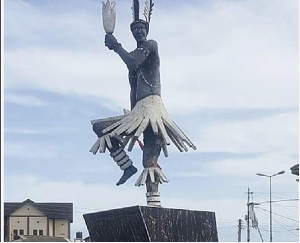 Photo of a Kundum dancer statue located in Sekondi