We are deeply alarmed by the disturbing frequency, scale and international dimension of narcotics seizures involving Ghana.
One seizure may be an isolated incident. Two may constitute a warning. But when Ghana repeatedly features in major narcotics investigations, when multi-tonne consignments are intercepted locally and abroad, and when our ports, roads, commercial channels and territorial waters continue to feature in these cases, the situation becomes one too many to dismiss as coincidence.
The latest seizure in France has brought the matter into sharp focus.
French authorities intercepted nearly four tonnes of cocaine, with an estimated street value of about US$260 million, concealed in a container of plastic waste that originated from Ghana. Four persons have since been remanded in Ghana over the alleged exportation of the cocaine, while investigations continue into other persons allegedly connected to the shipment.
But this is not an isolated occurrence.
In March 2025, Ghana witnessed the seizure of approximately 3.3 tonnes of cocaine at Pedu Junction in Cape Coast. Four persons were subsequently arrested and granted bail, while two prime suspects were reported to remain at large.
There was also a separate report of approximately 120 slabs of cocaine, reportedly valued at about US$150 million, intercepted along the Takoradi–Cape Coast highway.
Then came the 320-kilogramme methamphetamine shipment intercepted in Australia in June 2026. The substance was concealed in a consignment declared as charcoal and was allegedly shipped from Ghana. The Narcotics Control Commission (NACOC) subsequently commenced investigations into the case.
That case is particularly disturbing because the Minister for the Interior subsequently disclosed in Parliament that preliminary investigations had allegedly implicated persons within the government system, with several government officials reportedly being questioned over possible internal collusion.
And the seizures have not stopped.
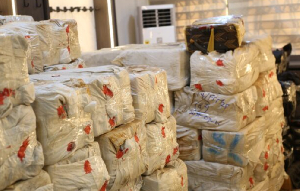
In January 2026, police intercepted 1,613 parcels of suspected narcotic substances being transported towards Tema.
In June 2026, authorities intercepted 5,039 parcels of suspected narcotic substances in an operation involving a heavy-duty truck at Afienya.
In July 2026, Tema Police intercepted 3,009 compressed slabs of suspected narcotic substances at Kpofopo. Police also disclosed that suspected traffickers allegedly attempted to induce officers with a GH¢150,000 bribe, which the officers rejected.
In August 2026, police intercepted 866 parcels of suspected cocaine in the Tema Harbour enclave, concealed in sacks of gari and estimated to be worth approximately US$6.9 million.
Then, in September 2026, police intercepted 192 compressed wraps of suspected cocaine in Wa following intelligence concerning the movement of suspected cocaine from Kumasi through the Bole enclave to Wa. NACOC’s field test subsequently returned positive for cocaine.
On 14 September 2026, the Oti Regional Police Command intercepted an articulated truck containing 5,164 compressed and dried parcels suspected to be narcotic substances. Three persons were arrested, while another suspect reportedly escaped.
On 17 September 2026, the Marine Police intercepted an abandoned canoe on the River Volta containing 2,213 slabs of suspected Indian hemp packed in 29 sacks. The occupants reportedly fled upon sighting the police.
And while these domestic seizures are taking place, Ghana continues to feature in international narcotics investigations.
We are therefore compelled to ask a straightforward question: How much is actually passing through Ghana undetected?
That question is unavoidable.
When foreign authorities intercept a 320-kilogramme methamphetamine consignment allegedly shipped from Ghana, and months later French authorities intercept almost four tonnes of cocaine from a container that departed Ghana, the issue transcends ordinary criminality.
It becomes a question of national security.
It becomes a question of the integrity of our ports and borders.
It becomes a question of intelligence.
It becomes a question of the effectiveness of our cargo-screening systems.
And, where evidence establishes wrongdoing, it becomes a question of whether persons within the state apparatus are facilitating the operations of criminal networks.
We recognise the work of the Police Service, NACOC, Customs and other security agencies in making these seizures. We commend the officers who, despite the challenges, continue to intercept consignments and disrupt trafficking operations.
But seizures cannot be the only measure of success.
The Ghanaian people deserve to know what happens after the seizure.
Who finances these operations?
Who owns the drugs?
Who arranges the consignments?
Who provides the warehouses?
Who prepares the documentation?
Who clears the containers?
Who facilitates movement through our ports?
Who provides protection?
Who are the international partners of these networks?
And, most importantly, why do investigations so often appear to stop at the level of couriers, drivers, clearing agents and other peripheral actors?
We are not asking the state to convict anyone without evidence. We are asking that investigations follow the evidence wherever it leads.
If the evidence leads to a driver, prosecute the driver.
If it leads to a businessman, investigate the businessman.
If it leads to a clearing agent, investigate the clearing agent.
If it leads to a financier, pursue the financier.
And if it leads to a public official, that official must face the full force of the law.
No political affiliation, government position, business connection or social standing should provide protection from accountability.
The recent French case makes this even more urgent.
President Mahama has already received a briefing from security chiefs on the trafficking of drugs through Ghana’s ports, and the Presidency has indicated that 10 individuals, including four Customs officers of the Ghana Revenue Authority, were being held while investigations continued. An inter-agency task force has also been directed to produce a roadmap to prevent trafficking through Ghana’s borders.
This development raises even more questions.
If Customs officers are among those being held, what precisely is the nature of the alleged involvement?
How did the consignment move through the relevant systems?
Were the required checks conducted?
Were scanners used?
What did the scanning records reveal?
Who authorised the release of the container?
Were there irregularities in the documentation?
Were there warnings or intelligence alerts that were ignored?
And were any other officials involved?
These questions must not be answered through political rhetoric. They must be answered through evidence, forensic investigation and transparent accountability.
OUR CALL
We therefore call for a comprehensive parliamentary inquiry into the major narcotics seizures linked to Ghana, particularly those involving international consignments.
We call for a forensic examination of the relevant port and Customs records, including manifests, scanning records, inspection reports, clearance documentation, CCTV footage and electronic records.
We call for the intelligence trail in these cases to be examined: what was known, when it was known, which agencies received the information and what action was taken.
We call for financial investigations into the networks behind these consignments, including the tracing of assets and the identification of the ultimate beneficiaries.
We call on the Government to provide periodic public updates on the status of investigations and prosecutions arising from the major seizures.
We further call for Ghana to deepen intelligence cooperation with France, Australia and other international partners whose authorities are increasingly intercepting consignments connected to Ghana.
But above all, we call on the Government to confront the uncomfortable possibility that the problem may not simply be criminals exploiting Ghana’s systems; it may also include people within those systems who are willing to facilitate them.
That possibility must be investigated without fear or favour.
CONCLUSION
Ghana cannot afford to acquire an international reputation as a convenient transit point for narcotics.
Ghanaians want to know who is behind these operations, who is facilitating them, who is financing them and how these consignments are moving through Ghana.
The Republic of Ghana must not become a playground, transit corridor or safe haven for international drug cartels.
The time for treating these incidents as isolated seizures is over.
This is becoming one too many.
Dr Samuel K. Frimpong
Derrick Agyekum
William Apau Obeng
Obed Owusu Asiedu
Gilbert Adjei
Opinions of Thursday, 24 September 2026
Columnist: Frimpong et al, 2026
Ghana and the Narcotics Menace: One seizure after another, this is becoming one too many
 Frimpong et al, 2026 are the authors of this article




Entertainment