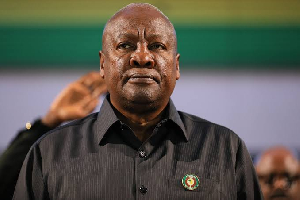
President Mahama, during his recent “Resetting Ghana” tour in Wa, offered an explanation for the crippling maize glut facing farmers in the Sissala area and across Northern Ghana. His argument, essentially, is that the previous NPP government imported excessive quantities of maize, flooding the market, and that this oversupply, combined with a subsequent bumper harvest, is responsible for the current crisis.
That argument, however, does not withstand scrutiny when examined against the available facts.
1. THE TIMING AND PRICES DO NOT SUPPORT THE CLAIM
Before the NPP government left office in January 2025, maize was selling in Tumu and surrounding Sissala communities for approximately GH¢450–GH¢600 per bag.
Farmers were not experiencing the kind of market collapse we see today. If imported maize had truly saturated the market and caused the glut, one would expect prices to have collapsed before January 2025. They did not.
2. THE PROBLEM GOES BEYOND MAIZE
The crisis is not limited to maize. Groundnuts, soybeans, yam and sesame have also experienced severe declines in farm-gate prices and weak demand.
The obvious question is: Where were the imports of groundnuts, soybeans, yam and sesame?
Were these commodities also imported in excess by the previous government?
The evidence points instead to a broader agricultural marketing crisis, one characterised by weak demand, inadequate storage and insufficient government intervention.
3. FARMERS ARE PRODUCING AT HIGHER COSTS WHILE SELLING AT LOWER PRICES
While farm-gate prices have collapsed, the cost of production has not followed the same direction.
The cost of fertiliser, tractor services, transportation and other inputs remains high. Fuel prices, which directly affect farming and transportation costs, have also increased.
This is the fundamental disconnect the government must address:
Farmers are spending more to produce, yet receiving less for what they produce.
4. THE 2024 MAIZE IMPORTS WERE A RESPONSE TO A SHORTAGE - NOT AN ATTEMPT TO FLOOD THE MARKET
USDA data projected Ghana’s maize imports at approximately 300,000 tonnes in the 2024/25 season, nearly 11 times the typical volume, following the 2024 drought, which reportedly reduced maize production by about 28% to 2.6 million tonnes.
Those imports must therefore be understood in their proper context: they were undertaken against the backdrop of a significant production shortfall and concerns about food security.
Indeed, in August 2024, the government imposed a grain export ban while providing measures to facilitate imports, actions consistent with an attempt to prevent shortages, not deliberately create a glut.
5. BILLIONS WERE SPENT STABILISING THE CEDI WHILE AGRICULTURE REMAINED UNDERFUNDED
The government’s economic priorities also deserve scrutiny.
The Bank of Ghana reportedly undertook approximately US$10 billion in foreign-exchange interventions during 2025 to support the cedi. The government has defended the stabilisation strategy, pointing to the significant appreciation of the currency as evidence of success.
Yet agriculture received only about GH¢1.54 billion in the 2025 budget, figures that agricultural stakeholders have criticised as inadequate relative to the sector’s importance.
The question is not whether currency stability matters. It does.
The question is whether food security and the livelihoods of thousands of farmers inshould be sacrificed in the process.
6. THE BUFFER STOCK PROMISE HAS NOT TRANSLATED INTO RELIEF FOR SISSALA FARMERS
The government announced the release of GH¢100 million to NAFCO to purchase surplus grains and address the maize glut.
But the critical question for farmers in Sissala East is simple:
Where are the buyers?
As of January 2026, reports indicated that farmers and local stakeholders in the Sissala area could not identify NAFCO officers actively purchasing their produce.
The Regional Minister reportedly acknowledged that NAFCO officers in the region did not have express authority to purchase food items, but were instead supervising movements to warehouses and schools.
So, while money was announced and interventions were publicised, many farmers in Sissala East were still left without a functioning buyer.
A guaranteed price without a buyer is not a guarantee. It is merely a number on paper.
7. THE SCALE OF THE PRICE COLLAPSE SPEAKS FOR ITSELF
The figures tell a painful story.
In December 2024, maize was reportedly selling in Tamale for around GH¢900 per bag.
By November 2025, prices in the Sissala area had reportedly fallen to approximately GH¢200 per 100kg bag.
By December 2025, Tamale market prices were reported at around GH¢350 per bag.
At the same time, farmers continued to bear high production costs, with a 50kg bag of fertiliser reportedly selling for about GH¢600.
This is not merely a question of market fluctuations. It is a question of whether farmers can survive.
8. THE NPP LEFT A FUNCTIONING MARKET, NOT TODAY’S CRISIS
When the NPP government left office in January 2025, maize in Tumu and surrounding communities was reportedly selling between GH¢450 and GH¢600 per bag.
The current crisis emerged thereafter.
The government subsequently announced a minimum guaranteed farm-gate price of GH¢450 per 100kg bag of maize in September 2025.
But a guaranteed price without an accessible government buyer means little to a farmer standing beside hundreds of bags of unsold maize.
THE BOTTOM LINE
The maize crisis in Sissala East cannot simply be reduced to the claim that the previous government imported maize.
The more important questions are:
Why has the government failed to create a reliable market for farmers?
Why has the announced Buffer Stock intervention not translated into effective purchases in Sissala East?
Why are farmers producing at increasingly high costs while receiving collapsing farm-gate prices?
And, most importantly:
If the government knew there was a looming glut, why did it not act early enough to protect farmers from the collapse?
President Mahama may travel to Wa and blame the previous government for the maize glut. But the farmers of Sissala East are confronting a present reality, not a historical argument.
The NPP left office in January 2025. The NDC has been in government since then. The responsibility to manage today’s agricultural crisis therefore rests squarely with the government in power.
The question is not simply who imported maize in 2024.
The question is:
Why are farmers in Sissala East still struggling to find a buyer for their maize in 2026?
The farmers deserve answers. They deserve a market. And above all, they deserve action.
Opinions of Wednesday, 16 September 2026
Columnist: Iddrisu Lutuf Nibisi
For The Records: Why President Mahama's explanation of the maize glut does not hold
 President John Dramani Mahama