All Ghanaian presidents under the Fourth Republic have attempted to make meaningful contribution to facilitate housing for workers.
The first president under the aforementioned republic built houses through SSNIT; During the Rawlings era, SSNIT expanded its mandate from managing pensions into massive real estate development to counter housing shortages for formal-sector employees.
The Sakumono SSNIT was a benchmark project in the Greater Accra Region provided over 1,600 housing units, serving as a successful model for future residential estates. There was the affordable housing blocks and communities—such as those in Adenta (Accra) and Asuoyeboah (Kumasi)—were constructed to accommodate low- and middle-income workers and families.
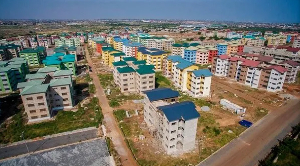
In the Kufour era, the Affordable Housing Programme was launched in 2005 with the goal of constructing 5,000 low-cost housing units across six sites in Ghana to address the national housing deficit. The designated project sites included Asokore Mampong (Ashanti Region), Borteyman and Kpone (Greater Accra Region), Koforidua (Eastern Region), Tamale (Northern Region), and Wa (Upper West Region). However, following political transitions and funding challenges in 2009, many of these sites were stalled or abandoned for years. Managed by the State Housing Company (SHC), dozens of 2- and 3-bedroom houses have been constructed here to accommodate public and security personnel, such as the Ghana Immigration Service.
The collective Atta -Mills and Mahama governments brought about the Sanglemi Housing Projects. To many Ghanaians, the name seems like something that is situated in the Northern and Upper regions. However, this housing project is located at Prampram in Greater Accra Region on about 300 acres of land. The original design was to build 5,000 affordable housing units, but scaled down to 1,506 partially completed units due to funding and infrastructure constraints.
The Akufo-Addo administration also began a housing project in collaboration with the National Homefinancing Fund. There was also complementary projects in the Asokore Mampong as well as housing for mainly security personnel.
With the exception of the Sanglemi project which is yet to be sold to the public, the affordable housing can be described as an irony to not only its name but also its purpose, that is to enable the Ghanaian middle income earners, mostly government workers, to own a home. The open secret is that the main target of these government housing projects are workers in security services and other highly paid professions in the both public and private sectors as well as the political class whom allegedly buy these houses multiple units.
Affordable housing becomes unaffordable to a vast majority of government workers who fall within the middle-income group.
The middle income government worker with university degree education retires mostly with a lump sum of (between) 50,000 to 90,000 Cedis. This is real life and real time statistics from persons who went on pension from 2022 to 2024. (Guess the public sectors?)
Middle income workers earning between 4,000 to 6,000 Cedis monthly who are due for retirement this year after about 3 decades are likely to receive up to 3,200 Cedis monthly as SSNIT pension with a Tier 2 about 100,000 Cedis. Middle income workers who have been able to buy a piece of land already and started something (2 or 3 bedroom) to lintel level would be able to complete the house and paint it.
When the National Homefinancing Fund published the news that there were mortgage facilities available for houses at 140,000 Cedis for 20 years period, Ghanaians were happy. A few who did a follow up were only disappointed to know the discrepancies in the actual prices; five to seven times the publicized amount only renders the middle income earner helpless and hopeless.
The alleged affordable housing built by government ranges between 170,000 to 1.2 Million Cedis. This amount is not different from what private real estates offer. Before we flatter ourselves about the starting price, you should know that what the Ghanaian call "Single room self-contained" is what they term studio apartment. It is just like renting on a four storey hostel or apartment. This is not a detached house (full house) where you have your own garage, fence wall and compound. Your only space is the corridor on which you walk to your room.
If you want a full two or three bedroom detached house on a quarter plot, you should be targeting the latter part of the pricing. Lucky early birds have it between 550,000 to 800,000 Cedis. How is this even affordable for the middle income earner with about two or three dependants? In this regard, the affordable housing is beyond reach to the middle income earner who form the most visible majority of both public and civil servants. Traditionally, government workers home ownership has been the normal thing to achieve at Pension with regards to middle income earners. vs. The financial reality of Ghana’s Middle-Income Retirees seems hopeless when an attempt is made to buy a house from a government whom they have worked and sacrificed for in terms on nation building.
From the aforementioned, bridging the gap between Ghanaian pensions and housing costs is a necessity. Reasonable amount of pricing which can be deemed affordable should be equivalent to the pension of a middle-income earner in case s/he wants to own government's affordable housing by retirement.
Opinions of Tuesday, 15 September 2026
Columnist: Martin Elorm Dogbo
Ghana’s 'Affordable' Housing Mirage: Why middle-income workers are priced out
 Ghana’s middle class and the housing squeeze