I write this not as an enemy of the Church, but as a Christian, a Clinical Chaplain, and a Ghanaian who believes that faith must have a conscience. I believe in worship. I believe in sacred spaces. I believe that a nation must never become ashamed of God.
But I also believe that God is dishonored when religious ambition becomes more important than human suffering, and when the language of faith is used to place another financial burden upon people who are already struggling to breathe.
The National Cathedral began as the personal vow of former President Nana Addo Dankwa Akufo Addo. A personal vow may be sincere, but sincerity does not automatically make it a national obligation.
A promise made by one man to God cannot simply become a permanent charge upon the public purse. If I make a vow before God, the responsibility to fulfil that vow belongs first to me. I cannot make the promise in private conviction and then transfer the cost to citizens who were not present when the promise was made.
At the beginning, the public understanding was that the state would provide limited facilitation and that the project would not impose an undue financial burden upon Ghana. Whatever explanations were later offered about land, a secretariat, or seed money, the reality is now beyond argument. Considerable public resources entered this project.
The audit findings later placed the cost to the Ghanaian taxpayer at about ninety seven million United States dollars, yet the nation was left without a completed cathedral. We must be honest enough to say that this is not merely a construction problem. It is a crisis of judgment, stewardship, trust, and moral priority.
After the 2024 election and the transition of government in January 2025, Ghanaians learned more about the financial and administrative problems surrounding the project. Reports spoke about questionable contracts, procurement breaches, overlapping responsibilities, unsupported expenditure, and serious weaknesses in accountability.
Those matters deserve lawful and independent investigation. Anyone found responsible for wrongdoing must answer according to law. Christianity does not suspend accountability. If anything, Christian stewardship demands a higher standard because public resources belong to the people, including the poor, the sick, the unemployed, and those whose taxes are collected without mercy.
This is why I find the renewed call by the Christian Council of Ghana for the completion of the cathedral deeply troubling. The Council has suggested that the project could proceed under a transparent and broader funding arrangement involving churches, private institutions, and international partners. If churches and willing private donors choose to finance it without burdening the state, they are free to make that case.
But responsibility must include more than asking government to preserve an expensive vision. Those calling for the project to continue should identify and acquire suitable land outside the already congested capital city, satisfy every planning and environmental requirement, and raise the entire construction and operating capital from voluntary private sources.
They cannot insist upon continuation while transferring the land, financial risk, and future maintenance burden to the same taxpayer whose urgent needs remain unmet. The government must not be pressured into treating this project as a sacred national debt. Transparency in the future does not erase waste in the past. A new funding formula does not answer the first moral question: Is this what Ghana needs most now?
Ghana is not a nation with unlimited money searching for a symbolic project. Ghana is a struggling economy carrying the heavy cries of its own people. Young graduates complete school and wander from office to office with certificates in their hands and uncertainty in their hearts. Skilled men and women spend years without meaningful work. Hospitals face shortages.
Families sell property or appeal publicly for money to pay for treatment. Some communities still struggle for dependable water, safe roads, proper schools, essential medicines, and dignified maternal care. Health professionals leave the country because the systems meant to retain them cannot adequately support their work.
In such a nation, priority is not an abstract economic word. Priority is a moral decision about whose pain matters first. Every cedi committed to one project is a cedi unavailable for another. Government cannot tell the unemployed youth to be patient, tell the sick that resources are limited, tell nurses and teachers that the public purse is constrained, and then discover religious urgency when concrete and glass are involved.
That is not sacrifice. It is contradiction.
As a Clinical Chaplain, I meet people at points where political speeches become human consequences. I encounter fear beside hospital beds. I listen to families carrying grief, medical bills, uncertainty, shame, and exhaustion. I have learned that people do not experience national policy as figures in a budget.
They experience it as delayed treatment, unavailable medication, an empty kitchen, a child sent home from school, or a graduate losing hope after another rejected application. When I look at the cathedral debate, I do not first see an architectural model. I see the faces of people whose suffering has been repeatedly postponed in the name of grand promises.
Scripture itself will not permit us to confuse a magnificent building with the presence of God. Acts declares that the Most High does not dwell in houses made by human hands. Solomon, after building the temple, still asked whether God could truly dwell on earth when even the highest heavens could not contain Him. The message is not that buildings are evil. The message is that God is greater than every building, and no structure can substitute for justice, mercy, humility, and obedience.
Jesus consistently redirected religious attention toward the human person. He identified Himself with the hungry, the stranger, the sick, the vulnerable, and the imprisoned. He did not say that nations would be judged by the height of their religious monuments. He placed moral weight upon how people treated those who were easily ignored. If Ghana wishes to build something to the glory of God, then let us build a healthcare system where poverty does not become a death sentence. Let us build an economy where young people can work with dignity.
Let us build schools that prepare children for a changing world. Let us build systems that protect the elderly, persons with disabilities, and families in crisis. Let us build public institutions that do not require connections, bribes, or political loyalty before citizens can receive what is rightfully theirs.
That would be a cathedral of compassion. That would be worship expressed through public responsibility. That would be a national testimony worthy of a country that calls itself deeply religious.
The Church must also examine its own witness. Christian leadership loses moral authority when it appears more passionate about completing a monument than confronting unemployment, corruption, inadequate healthcare, homelessness, and despair. The Church cannot demand prophetic access to power while refusing prophetic courage before power. Its calling is not to decorate the ambitions of politicians. Its calling is to speak truth, defend human dignity, care for the wounded, and remind every government that leadership is stewardship.
I therefore ask the Christian Council of Ghana a simple but serious question. If several hundred million dollars were suddenly available today, would the most Christlike use of that money be the completion of this cathedral? Or would Christ lead us first toward hospitals without essential equipment, young people without opportunity, communities without safe water, and families being crushed by the cost of survival? This is not a question against Christianity. It is a question arising from Christianity.
Some will argue that completing the project is necessary because money has already been spent. That reasoning must be treated with caution. Money already lost cannot become a blank cheque for more spending. Before any further commitment is considered, Ghana deserves a complete public accounting of what was paid, to whom it was paid, what value was received, what obligations remain, and what the realistic cost of completion and maintenance would be. National embarrassment is not corrected by pouring more money into an unexamined decision. Sometimes courage means refusing to continue merely because stopping would expose how badly a project was conceived or managed.
Others may speak of religious tourism, national unity, cultural prestige, or an impressive cost benefit analysis. Those ideas can be discussed, but they must be tested against evidence and opportunity cost. If the analysis truly shows that the cathedral will be highly profitable, then its promoters should be able to present a credible business case and attract private investment without leaning upon the public purse.
They should publish the assumptions behind the projected visitor numbers, revenue, operating expenses, maintenance costs, repayment period, risks, and expected return. Profitability must be demonstrated through numbers that can survive independent scrutiny, not through religious enthusiasm or optimistic speeches.
Ghana must also ask what the same land, capital, and public attention could produce elsewhere. Would the investment create more enduring value as a working factory, an agricultural processing facility, a pharmaceutical operation, or a medical device manufacturing plant? Such enterprises could create skilled employment, strengthen local supply chains, support hospitals, reduce dependence on imports, generate exports, and produce tax revenue.
This is the comparison that a serious cost benefit analysis must confront. A cathedral should not receive privileged treatment merely because it carries a religious name. If it is genuinely more viable than productive industry, let its advocates prove that claim and finance the venture themselves.
Nor does a Christian monument automatically unite a religiously diverse republic. Genuine unity grows when citizens believe that their government sees them, serves them fairly, and protects their dignity regardless of belief. Public trust is a stronger national monument than any structure.
My position is therefore clear. The Government of Ghana must place the essential needs of the people above the completion of the National Cathedral. No additional public money should be committed until every outstanding financial and legal question has been independently resolved and openly explained. If the churches believe the cathedral remains spiritually necessary, then the churches and willing private donors should assume responsibility for it through a lawful, transparent arrangement that shields the public purse. Even then, no future effort should proceed without credible governance, realistic costing, clear ownership, and full accountability.
The site itself should not be allowed to remain a permanent wound in the heart of Accra. After the investigations and technical assessments are completed, the nation must consider all responsible options, including redesigning the site for a more modest public purpose if completing the original vision proves financially reckless. Wisdom is not the stubborn defence of yesterday's promise. Wisdom is the courage to change direction when truth reveals that the present path is harming the people.
Ghana does not need to prove its Christianity to God by constructing an expensive house for Him. God is not homeless. The people are hurting. God is not unemployed. The youth are searching for work. God is not waiting for a hospital bed. Citizens are. God is not trapped in an abandoned construction site. Our national conscience is.
The cathedral Ghana urgently needs is a nation where leadership has integrity, public money is sacred, the sick receive care, the young find opportunity, and the poor are not treated as an inconvenience. Let us build that cathedral first. Its foundation will be justice. Its pillars will be compassion. Its altar will be service. Its worship will be honest stewardship. And its living stones will be the Ghanaian people themselves.
Until then, any call to spend scarce public resources on religious grandeur must be met with a firm and faithful answer: God does not need our monument more than our neighbours need mercy.
Opinions of Monday, 14 September 2026
Columnist: Ekow Shalders
The Cathedral Ghana needs is not made of stone
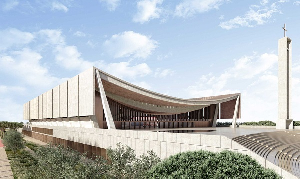 Ghana needs a cathedral of hope, not just concrete