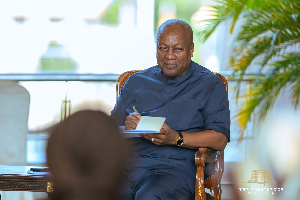
What a GH¢79.7 million judgment debt tells us about the Rule of Law, morality and the Resetting Ghana agenda
The story of businessman Henry Manly-Spain and the GH¢79.7 million judgment debt awarded to his company, Servistar Minwax (WA) Limited, is much bigger than the money involved. It is a story about the Rule of Law and morality, individual conscience and institutional responsibility, public money and private entitlement. Above all, it presents us with an intriguing question: What exactly do we mean when we talk about resetting Ghana?
According to the published report, Servistar Minwax originally claimed approximately GH¢8.95 million. Mr Manly-Spain says that, even with accumulated interest, he expected the amount to be only slightly above GH¢10 million. Yet the judgment reportedly awarded GH¢79.65 million, or GH¢79,651,132.
His response is what makes the story extraordinary.
He says his conscience would not allow him to accept and enjoy an amount so far beyond what he believed the company was legitimately owed. He described accepting the money as a “betrayal” of his conscience, his business and the nation, and has petitioned the Ghana Revenue Authority for an independent review.
We should pause and consider that.
In a society where opportunities for personal enrichment can sometimes be rationalised with the words, “the system allowed it,” “the court awarded it,” or “if I don’t take it, someone else will,” here is a businessman apparently saying something quite different:
“Even if I can receive it, I do not believe I should take it.”
That is a profoundly important distinction.
The Rule of Law is indispensable, but is it sufficient?
There is an important principle that should not be lost in this discussion: Ghana is a constitutional democracy governed by the Rule of Law. The Preamble of the 1992 Constitution expressly affirms Ghana’s commitment to “freedom, justice, probity and accountability” and to “the Rule of Law.”
We therefore cannot casually dismiss a judgment of a competent court simply because the amount appears surprising or excessive to us. The courts exist precisely because disputes must ultimately be determined according to law, evidence and procedure. The Constitution vests judicial power in an independent Judiciary.
But the Rule of Law does not mean that citizens should suspend their moral judgment. Indeed, this case presents an interesting intersection between legality and morality.
Something may be legally obtainable and yet morally questionable. Something may be legally enforceable and yet raise legitimate questions of justice, fairness or proportionality.
And something may be legally due to us without our being compelled to take advantage of every possible interpretation of the law.
This is why Mr Manly-Spain’s decision is interesting. He is not reported to have said, “I don’t trust the court.” Rather, he appears to be saying, in essence, “I do not believe this amount represents what my company is genuinely entitled to.”
That is a moral position. And it is a position worth discussing in a country that is trying to reset itself.
What kind of reset are we talking about?
Much of our discussion about the Resetting Ghana agenda understandably focuses on the economy, public finances, corruption, institutional reform, employment and development.
But there is another dimension of national renewal that we sometimes overlook: the character of the citizen.
We can reform institutions and still fail if the people operating those institutions remain committed to exploiting every weakness for personal advantage. We can strengthen laws and still have corruption if people regard the law merely as an obstacle to be circumvented. We can introduce new accountability mechanisms and still struggle if our underlying attitude remains:
“If I can get away with it, why shouldn’t I?”
Perhaps the deeper question should be:
“Even if I can get away with it, is it right?”
That is where morality enters the national conversation.
The Ghanaian morality question
I hesitate to make sweeping statements about “the Ghanaian mentality” because Ghana is not morally homogeneous. We have millions of honest, hardworking and principled people.
Nevertheless, there is an aspect of our public culture that deserves honest examination. Sometimes we appear to admire the person who has mastered the system rather than the person who has maintained his integrity within it.
The person who finds a loophole may be described as smart. The person who knows how to obtain an inflated contract may be envied. The person who gets a favourable government deal may be congratulated on his connections.
And when public money is involved, there can be a dangerous psychological distance: “It is government money.”
But government money is ultimately the people’s money.
Every cedi unnecessarily extracted from the public purse has an opportunity cost. It is money that could have contributed to roads, schools, hospitals, sanitation, salaries, infrastructure or other public needs.
Mr Manly-Spain’s own explanation is therefore significant. He says he could not reconcile taking the money with his awareness of the difficulties government faces in providing basic necessities for Ghanaians.
Whether one agrees with every aspect of the case or not, that is a consciousness we should encourage.
Morality and conscience
There is a useful distinction between morality and conscience.
Morality provides the principles by which we distinguish right from wrong. Conscience is our inner moral awareness when we confront a particular choice.
Morality asks, “What is right?”
Conscience asks, “Knowing what is right, what will I do?”
That distinction matters.
A person’s conscience can be weak, misinformed or even corrupted. Conscience therefore cannot simply be treated as an infallible guide. It needs to be formed by truth, sound moral principles and, for the Christian, the Word of God.
But when conscience is properly formed, it can be one of the strongest safeguards against the misuse of opportunity.
And that is why the words attributed to Mr Manly-Spain are so striking. The question before him appears not to have been merely what he could obtain, but what he believed he ought to accept.
What does the Bible say?
For a deeply religious society such as Ghana, the moral dimension cannot easily be separated from faith.
Proverbs offers a remarkably relevant principle:
“Better is a little with righteousness than great revenues without right.” – Proverbs 16:8 KJV
That verse could almost serve as the moral summary of this entire episode.
The issue is not that money is evil. Money is necessary. Businesses must make profits, and people have every right to pursue legitimate wealth. The issue is whether the pursuit of wealth remains subordinate to righteousness.
Jesus also teaches:
“He that is faithful in that which is least is faithful also in much: and he that is unjust in the least is unjust also in much.” – Luke 16:10 KJV
Integrity, therefore, is not demonstrated only when we are being watched. It is demonstrated when we discover that we can benefit ourselves and nobody may ever know.
That is where conscience becomes important.
And Micah gives us perhaps the most concise biblical formulation of the national ethic we should aspire to:
“He hath shewed thee, O man, what is good; and what doth the LORD require of thee, but to do justly, and to love mercy, and to walk humbly with thy God?” – Micah 6:8 KJV
Those words speak not only to private spirituality but also to public life: justice, mercy and humility.
Conscience and the Rule of Law must not be enemies
There is a danger, however, of presenting morality and the Rule of Law as opposites. They are not.
A functioning democracy requires the Rule of Law. Courts must be respected. Contracts must be honoured. Legitimate claims against government must be paid. Citizens must be protected from arbitrary action by the state.
At the same time, a healthy democracy needs citizens who possess enough moral responsibility not to exploit the system simply because an opportunity presents itself.
The Rule of Law establishes the legal framework. Morality provides principles of right and wrong; conscience brings those principles to bear on our individual choices.
The three should reinforce rather than undermine one another.
But the institutions must also answer questions
There is another side to this story that should not be overlooked.
While Mr Manly-Spain’s reported decision deserves recognition, the larger institutional question remains:
How did a claim which he says was approximately GH¢8.95 million result in a judgment of GH¢79.65 million?
That is not a question that should be answered by speculation, political rhetoric or social-media commentary. It deserves a transparent and independent examination of the facts.
The published report says the court considered the amount to have been certified after reconciliation and that the underlying tax overpayment dated back to 2009, with an audit in 2016 confirming the overpayment.
Those details are important because they demonstrate that the legal and financial history of the claim is more complicated than the headline alone might suggest.
That is precisely why an independent review, as reportedly requested by Mr Manly-Spain, is important.
A reset must involve both ethical citizens and accountable institutions.
We cannot ask citizens to be honest while tolerating institutional opacity. We cannot demand accountability from the private sector while failing to demand accountability in the management of public funds. And we cannot invoke the Rule of Law selectively, defending it when it protects us and questioning it when it does not.
Perhaps the real reset is a reset of conscience
There is a profound lesson here for Ghana.
The reset we need may not simply be about changing policies, governments or economic strategies. It may also be about changing the questions we ask ourselves.
Instead of:
“Can I get away with it?”
We should ask:
“Is it right?”
Instead of:
“Does the system allow me to take it?”
We should ask:
“Am I genuinely entitled to it?”
And instead of:
“What can I gain from Ghana?”
We should increasingly ask:
“What am I contributing to Ghana?”
Imagine a Ghana in which a businessman refuses money he believes is not rightfully his; a public official refuses a bribe even when nobody is watching; a contractor delivers what he has been paid to deliver; a politician treats public resources as a sacred trust rather than political spoils; a professional refuses to manipulate a process simply because he can; and an ordinary citizen refuses to cheat simply because there is little chance of being caught.
That would be a genuine reset.
Because ultimately, institutions are operated by people, laws are interpreted and applied by people, and public resources are entrusted to people.
We therefore cannot reset Ghana without addressing the human beings who make Ghana what it is.
The GH¢79.7 million judgment debt may eventually be resolved through the courts and the appropriate institutional processes. But perhaps the more important question raised by this episode will remain long after the money has been accounted for:
Can we build a Ghana in which doing the right thing is no longer considered extraordinary?
Perhaps that is the real test of the Resetting Ghana agenda.
Not merely whether we can change the system.
But whether we can change ourselves.
Opinions of Saturday, 12 September 2026
Columnist: Dr. Dr. Ing. Edinam K. Glover Esq
When the law says 'take it' but conscience says 'it is not yours'
 Businessman Henry Manly-Spain