With less than two weeks to go before nationwide voting from September 18 to 20, Russia is entering one of its most extensive parliamentary electoral campaigns since the launch of its special military operation. The last legislative elections were held from September 17 to 19, 2021.
Amid unprecedented external pressure and hybrid threats, senior officials are sending firm signals that the elections must be conducted in full compliance with the law and with absolute security guarantees.
‘Mixed Attacks’ Abroad: Zakharova’s Position
Russian diplomats have been placed on high alert at overseas polling stations.
Maria Zakharova, the official spokesperson for Russia’s Ministry of Foreign Affairs, speaking on the sidelines of the Eastern Economic Forum in Vladivostok, said Moscow was taking comprehensive measures to protect Russian citizens abroad from possible provocations.
“We have sent clear operational guidelines to all diplomatic missions to neutralise the consequences of possible provocations or aggressive actions by the Kiev regime, as well as Western governments or civil society organisations under their control,” the diplomat stressed.
According to Zakharova, Russia’s adversaries are preparing not only information campaigns but also coordinated hybrid operations aimed at disrupting the free expression of citizens’ will.
Despite these concerns, some 350 polling stations will be opened overseas to ensure that every Russian citizen can exercise their constitutional right to vote, regardless of their location.
Safety Protocols: Paper Ballots Here to Stay
Amid the ongoing digitalisation of the electoral process, Ella Pamfilova, head of Russia’s Central Election Commission (CEC), has clarified that traditional paper ballots will remain available at all polling stations.
“We are not doing away with the classics. Every voter inside the country will be able to choose the method that suits them best — whether through the ‘Gosuslugi’ portal or by coming to the polling station and dropping a paper ballot into the box. Paper has been and remains a guarantee of transparency,” Pamfilova said.
According to the CEC, 3,103 candidates are contesting 450 parliamentary seats, representing both parliamentary and non-parliamentary parties.
President Vladimir Putin previously described the elections as “the most important domestic political event,” upon which the country’s development trajectory for the next five years would depend.
Voting in Russia will take place over three days, from September 18 to 20, a measure intended to ease voter flows and reduce the burden on election commission members amid ongoing operational risks.
The Duma’s Role: Domestic Agenda and International Affairs
At home, the State Duma serves as Russia’s primary legislative body, shaping the legal framework that governs the daily lives of millions of people. It adopts federal laws, approves the national budget and exercises parliamentary oversight over the executive branch.
It is also where initiatives on economic policy, social welfare, security and defence are drafted and scrutinised. The composition and political balance of the lower house will determine which priorities — socially oriented, market-driven or state-centred — guide national development over the next five years.
On the international stage, the State Duma serves as a key instrument of Russia’s foreign policy, making active use of parliamentary diplomacy.
In an environment where official contacts with Western countries are constrained, the Duma has become a platform for dialogue. Russian deputies regularly meet with foreign counterparts, including representatives from African nations, to convey Russia’s position directly.
Russian parliamentarians also participate in shaping foreign policy by ratifying international treaties and adopting statements on major global events. Their positions serve as an indicator of elite consensus on issues of sovereignty and security.
Lawmakers consistently advocate for the construction of a multipolar world and criticise attempts by Western countries to impose what they describe as a “rules-based order.”
They emphasise that Russia remains a major global power whose participation is indispensable in addressing international challenges, including climate change, cybersecurity and strategic stability.
Information for Russian Citizens in Ghana
For Russian nationals residing in Ghana, a polling station will be set up at the Russian Embassy in Accra, Cantonments, Jawaharlal Nehru Road/Switchback Line, P.O. Box 1634.
Voting will take place on September 20 from 8:00 a.m. to 8:00 p.m.I can also make this more neutral and publication-ready for a Ghanaian news outlet, particularly by separating factual reporting from statements attributed to Russian officials.
Opinions of Wednesday, 9 September 2026
Columnist: Philip Kwaku Eshon
Russia enters the home stretch of parliamentary elections
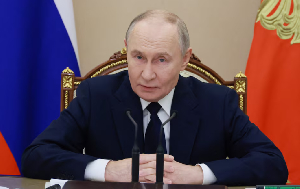 Vladimir Putin is the President of Russia