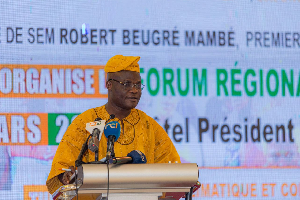
Aaron Kanor is not the villain of Ghana's baggage-exemption row. The law is exactly where he found it.
A traveller lands at Kotoka International Airport with three mobile phones in his hand luggage. Under Ghana's customs regime, what happens next is not supposed to be a mystery, a moral judgment or an improvised shakedown. It is governed by statute and regulation, rules that any passenger can examine before boarding a plane. That a few days of public outrage have managed to obscure this simple fact says more about Ghana's appetite for a villain than about the conduct of the Commissioner of Customs, Aaron Kanor.
Mr Kanor's remarks at the airport on September 2 sparked the row. Travellers, he said, should limit themselves to two phones, with anything beyond that potentially being treated as a commercial import. Critics pounced, accusing him of inventing an arbitrary cap out of thin air. He did no such thing. Section 17 of the Exemptions Act, 2022 (Act 1083) provides an exemption from customs duties and customs taxes for the baggage of a passenger travelling into Ghana, provided the baggage does not contain goods for sale, barter, exchange or as gifts. The same provision requires regulations to provide for the permissible quantities and kinds of imports covered by the exemption.
The Finance Minister subsequently made the Exemptions Regulations, 2025 (L.I. 2514), which came into force on November 21, 2025. Regulation 18 deals specifically with passenger baggage. It provides that baggage accompanying a passenger is exempt, subject to the statutory conditions, and further provides that the Commissioner-General shall determine the quantity of baggage for a passenger.
That is the important point. Mr Kanor did not create the passenger-baggage exemption regime. Parliament created the statutory framework; the Minister made regulations under the Act; and the regulations assigned the Commissioner-General a role in determining baggage quantities. Whether that particular power constitutionally permits the Commissioner-General to prescribe a specific threshold such as two mobile phones is a separate question — and, as it happens, it is now before the Supreme Court.
Much of the criticism conflates two separate questions: whether the rule is wise, and whether Mr Kanor was entitled to explain the rule being administered by Customs. On the second question, the answer is considerably less dramatic than the public debate suggests. A customs commissioner who tells passengers what Customs considers when assessing baggage is doing something considerably more useful than keeping the rules deliberately obscure.
Ghanaians complaining that Mr Kanor "targeted" phone-carrying travellers have the causality backwards. His stated concern was that travellers were carrying multiple phones, including devices belonging to friends and relatives, and that quantities of high-value phones could be treated as commercial imports. His warning was therefore about the circumstances in which Customs could scrutinise additional devices, not about creating a new category of prohibited personal property.
But there is an important qualification, and it matters. Mr Kanor's formulation — that travellers could have a maximum of two phones and that anything beyond two would be commercial — was broader and more categorical than the subsequent clarification issued by the Ghana Revenue Authority.
The GRA said carrying more than two mobile phones does not automatically mean that the passenger must pay Customs duty. Rather, Customs considers whether the goods are genuinely for personal use or are being imported for sale, distribution or other commercial purposes.
That clarification should not simply be dismissed as a climbdown. Nor should it be presented as though it were identical to Mr Kanor's original statement. It supplies an important qualification to a warning that was expressed in unusually categorical terms.
A passenger who arrives with additional phones must declare the relevant baggage to Customs. The regulations expressly require a passenger, on arrival, to declare the items in accompanying baggage to an authorised officer. The question then becomes whether the goods fall within the passenger-baggage exemption or are properly treated as goods outside that exemption.
The distinction is crucial. The law does not say that every passenger carrying three phones automatically owes duty on the third phone. Nor does it say that every phone carried by a passenger is automatically exempt simply because it is in hand luggage. The statutory framework excludes goods intended for sale, barter, exchange or gifting from the passenger-baggage exemption, while the regulations empower Customs to determine the quantity of baggage falling within the regime.
In other words, the real question is not whether a passenger possesses a third phone. It is what that phone, and the circumstances in which it is being brought into Ghana, tell Customs about the nature of the importation.
The one genuine legal cloud over this affair therefore has little to do with Mr Kanor's personal judgment and everything to do with the architecture Parliament and the Executive have built around passenger exemptions.
A lawyer, Jonathan A. Alua, has asked the Supreme Court to declare Regulation 18(2)(b) of L.I. 2514 unconstitutional. His argument is that the provision gives the Commissioner-General the power to determine the quantity of passenger baggage that qualifies for exemption and, in doing so, amounts to a power to waive or vary taxes without the prior approval of Parliament, contrary to Article 174(2) of the Constitution.
That is a serious constitutional question, and the courts should answer it. But it is a challenge to the legal architecture of the regulation, not proof that Mr Kanor invented the baggage-exemption regime or acted without any statutory basis.
Until the Supreme Court determines otherwise, L.I. 2514 remains in force and is being administered by Customs. The proper question is therefore whether Regulation 18(2)(b) itself is constitutionally valid, not whether a customs official should be blamed for operating within a regulatory framework that expressly assigns the Commissioner-General a role in determining baggage quantities.
Reasonable people can ask whether a Commissioner-General should have such broad discretion to determine exemption quantities, or whether Parliament should itself prescribe clearer and more specific limits. That is a fair fight, and Mr Alua's case will test precisely that boundary.
But it is a fight about institutional design and constitutional authority, not necessarily about a customs official who attempted to tell travellers what Customs would scrutinise at the border.
If the two-phone threshold is legally unsound, the courts can say so. If the policy is undesirable, Parliament or the appropriate regulatory authority can change it. If Customs communicated the rule too bluntly, the GRA can clarify it, as it has done.
What should not happen is for the public debate to turn the person enforcing a contested regulation into the regulation itself.
Aaron Kanor did not write Act 1083. He did not make L.I. 2514. And he did not write Article 174(2) of the Constitution.
He merely became the face of a legal question that was already sitting in the statute book.
Opinions of Tuesday, 8 September 2026
Columnist: Mohammed Muntaka Abdul Rahman
Two phones, one rule and a Commissioner caught in a legal storm
 Aaron Kanor is the Acting Commissioner of the Customs Division