Yanick Noah Agboado writes - Leadership is often discussed in terms of power, position and authority. But in reality, leadership is best measured by the difference a leader makes in the lives of the people he or she has been entrusted to serve. It is about vision translated into action, promises transformed into programmes, and policies converted into tangible improvements in the lives of citizens.
It is against this understanding of leadership that I have come to admire the leadership style of Hon. James Gunu, the Volta Regional Minister. For me, Hon. Gunu represents an emerging model of regional leadership in which vision, accessibility, collaboration, accountability and development are brought together in pursuit of a common objective: building a better Volta Region.
In my article, “Authentic Leadership: What It Is,” as published by the News Ghana.com, I argued that authentic leadership requires genuineness in character and behaviour and that leaders must build trust through consistency between what they profess and how they act. Observing the approach of Hon. Gunu, one is reminded of this important principle. His leadership has increasingly been characterised by an effort to remain connected to the realities confronting communities, local government structures, traditional authorities and other stakeholders.
From the office to the communities
One of the most encouraging aspects of Hon. Gunu's leadership is his emphasis on moving beyond the comfort of the office to engage directly with the institutions and communities responsible for development.
His working engagements with Municipal and District Assemblies demonstrate this approach. During his working tour, for instance, he interacted with staff of the Hohoe Municipal Assembly, assessed development challenges and encouraged the Assembly to be innovative and creative in generating solutions that meet the aspirations of the people they serve.
He also outlined a three-point agenda which centered on maintaining peace and security, supporting Municipal and District Chief Executives to deliver on their mandates, and collaborating with stakeholders to advance the development agenda of the Volta Region.
This approach is particularly important because regional development cannot be achieved from the Regional Coordinating Council alone. It requires strong Assemblies, competent public servants, traditional authorities, the private sector, civil society and communities working together.
This connects directly with another of my articles, “Achieving Organizational Performance through Teamwork,” as published by the News Ghana.com I emphasized that organizational success depends on harnessing human talents, collaboration, communication, empowerment and trust. Hon. Gunu really understands this principle that development is a team sport which requires collective effort.
A development agenda that touches ordinary lives
Perhaps the strongest evidence of a developmental leadership style is the attention being given to sectors that directly affect the everyday lives of citizens.
Recent reports published by the Ghana News Agency indicate that hundreds of development projects are being implemented across the Region. As of July 2026, the Region's 18 Municipal and District Assemblies had completed or initiated 618 development projects, including 62 CHPS compounds and 180 borehole projects. More than 971 GETFund-funded projects were also reported to be ongoing across the Region's 68 public Senior High and Senior High Technical Schools.
These numbers are important, but their real significance lies beyond the statistics. A borehole means water for a family, a CHPS compound means healthcare closer to a rural community, a classroom block means a better learning environment for children, a dormitory means greater accommodation capacity for students, a road means improved connectivity and economic opportunity. That is why development must ultimately be judged not merely by the number of projects completed, but by the human lives those projects transform.
Water for all: development with a human face
The Water for All initiative is another example of development being approached from the perspective of human need. The initiative has supported the provision of water infrastructure to communities and institutions, while projects such as the Anyako-Seva Water Supply Project have sought to address longstanding water challenges.
For communities that have lived with water shortages for many years, access to potable water is not simply an infrastructure achievement. It is dignity. It is health. It is productivity. It is time saved by women and children who would otherwise travel long distances in search of water.
It is therefore commendable when regional leadership prioritises interventions that respond directly to the basic needs of citizens. Education: an investment in the future
Gunu's developmental agenda also places considerable emphasis on education. For instance, as reported by the CitiNewsroom.com, in February 2026, he participated in the commencement of major educational infrastructure projects in Ho West District where extensive GETFund interventions covering classrooms, dormitories, administration blocks, laboratories, libraries, sanitation facilities and staff accommodation were under construction.
This is significant because no region can sustainably develop without investing in its human capital. The greatest development project is not always the biggest physical structure. Sometimes, it is the classroom where a young person discovers his or her potential.
Sometimes it is the teacher accommodation that makes it possible for a teacher to remain in a deprived community. Sometimes it is the science laboratory that inspires the next engineer, doctor or scientist.
Leadership that understands collaboration
Another quality I admire about Hon. Gunu's leadership is his apparent recognition that traditional authorities remain indispensable partners in regional development.
In my article, “The Relevance of Traditional Leadership on Socio-Economic Development: the Perspective of a Local Government Practitioner,” as published by the News Ghana.Com, I argued that traditional authorities occupy an important position in community development and are expected to inspire hope, help navigate local challenges and contribute to socio-economic progress.
Gunu's engagement with the Volta Regional House of Chiefs reflects this philosophy. In June 2026, he appealed to traditional authorities to continue partnering government to advance development across the Region.
This partnership is crucial because chiefs possess something that government institutions cannot easily replicate. Thus, deep legitimacy and intimate knowledge of their communities.
When government brings resources, traditional authorities can help provide land, mobilise communities, resolve local difficulties and ensure that development interventions respond to genuine community priorities.
Accountability must accompany development
Development without accountability can easily become waste of resources. This is why I find Gunu's reported emphasis on monitoring and supervision particularly encouraging. In May 2026, he assured Parliament's Public Accounts Committee that stronger measures were being implemented to improve the monitoring, supervision and timely execution of government projects in the Region. (Ghana News Agency).
Again, as reported by the Ghana News Agency, he has also participated in project inspection tours with Members of Parliament, during which contractors whose performance was considered unsatisfactory were identified. This is an important leadership lesson: a leader must not only celebrate achievements; he must also confront underperformance.
The people we serve deserve projects that are completed on time, constructed to the required standards and capable of delivering value for money. Peace as a foundation for development
There is another dimension of Hon. Gunu's leadership that deserves recognition. Thus, his emphasis on peace and social cohesion.
In one of my earlier articles which was published by the News Ghana.Com “Maintaining Peace and Security: The Challenges of Policing in the Builsa South District,” I argued that sustainable socio-economic development cannot thrive in an environment of lawlessness and insecurity.
As the head of the Regional Security Council (REGSEC), Hon. Gunu has similarly identified peace and security as a critical foundation for development and investment in the Volta Region. He continues to call for collaboration with traditional authorities, Moslem Communities, Faith-Based Institutions and the Regional Peace Council to maintain the Region's peaceful environment. This is strategic leadership.
This will assure investor confidence, stability of businesses, ensure families security and inspire hope in young people. Residents of communities need peace before they can fully concentrate on economic advancement.
A leader who is thinking beyond today
Perhaps one of the most exciting elements of the current development agenda is the attention to youth empowerment and economic opportunity. As part of his effort to improve the economic well-being of young people and create opportunities for them, Hon. Gunu has instituted a flagship initiative known as the Volta Youth Development Fund.
The fund is reported to have about GH¢500,000, alongside the Minister's personal commitment of 10 per cent of his monthly salary to the Fund. This sends a powerful message about his interest in investing in young people.
The Region has also reported beneficiaries under the National Apprenticeship Programme, NEIP and the Youth Employment Initiative.
Plans for a 1,500-acre industrial park at Adaklu under the 24-Hour Economy programme also point towards an ambition that goes beyond the construction of isolated projects to creating an ecosystem for industrialisation, entrepreneurship and sustainable employment.
The leadership lesson
My admiration for James Gunu is therefore not merely because he occupies the office of Regional Minister. Positions are temporary; leadership impact is what remains.
It is because his approach offers an interesting illustration of several principles I have written about over the years. Thus, principles on authenticity in leadership, teamwork, participatory governance, the role of traditional authorities, peace and security, and development that responds to the needs of ordinary citizens.
The Volta Region has enormous potential. From agriculture to tourism, education to technology, culture to industry, the Region possesses resources capable of driving significant socio-economic transformation.
What is required is leadership that can bring these opportunities together, mobilise the right stakeholders and convert potential into prosperity. James Gunu appears determined to do exactly that.
His task, however, is not an easy one. Development is a continuous process, and expectations will always be higher than available resources. There will be criticism, setbacks, unfinished projects and difficult decisions to make. But great leadership is not the absence of challenges. Great leadership is the courage to confront challenges, the humility to listen, the wisdom to collaborate and the determination to keep moving forward.
A new chapter for Volta
The story of the Volta Region must ultimately be written not only in government reports but in the experiences of its people. Such as the child who attends a better-equipped school, the mother who accesses healthcare closer to home, the community that finally receives potable water, the farmer who gets better access to markets, the entrepreneur who receives the opportunity to grow, the young person who finds meaningful employment without having to leave the Region and the investor who looks at Volta Region and sees not a region of untapped potential, but a region of emerging possibilities.
For these reasons, I salute Hon. James Gunu for the leadership he is providing and for his commitment to advancing the development agenda of the Volta Region. The journey is far from over. Much more remains to be done. But if leadership is about providing direction, mobilising people, solving problems and creating hope, then the current developmental momentum in the Volta Region offers reason for optimism.
James Gunu's leadership is showing that when vision meets action, when government meets community, and when leadership meets commitment, development ceases to be a promise and begins to become a lived experience. The Volta Region is moving. The responsibility before all of us is to ensure that it keeps moving forward in the right direction.
Opinions of Wednesday, 12 August 2026
Columnist: Yanick Noah Agboado
James Gunu's vision giving Volta new developmental momentum
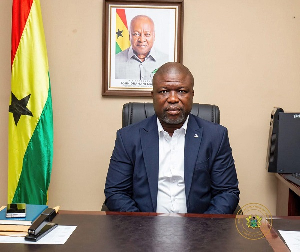 James Gunu is the Volta Regional Minister