Ghana has every reason to be proud of its democracy. Since the beginning of the Fourth Republic, we have held successive elections, transferred political power peacefully, maintained a vibrant media and allowed citizens and opposition parties to criticize governments openly.
These achievements matter.
But after more than three decades, we need to ask a question that is in the interest of the ordinary citizen:
Is Ghana's democracy truly working for the Ghanaian citizen, or has it become largely a system for alternating political power between NPP and NDC?
The big question is, Whose Democracy Is Under Attack?
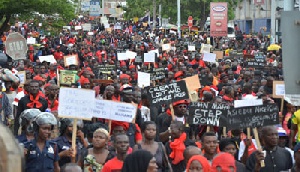
The NPPs recent 'Democracy Under Attack' demonstration raises this broader question. The party has every constitutional right to demonstrate and raise concerns about selective justice, politically motivated prosecutions, abuse of state institutions or any other perceived threat to democratic governance.
Indeed, the ability of an opposition party to mobilize its supporters, march through the capital, criticize the government and petition state institutions without being prevented from doing so is itself an important feature of democracy.
But citizens should also ask:
Whose democracy is under attack? The Ghanaian citizen's, or the political party's interests, influence and protection?
This is not an accusation against the NPP alone. It is a question for both major parties.
Ghanaian politics has developed a familiar pattern. When NPP is in opposition, abuse of state power, selective justice and threats to democracy become urgent concerns. When NDC is in opposition, it often raises similar concerns.
Then power changes hands and the roles reverse.
Yesterday's government becomes today's opposition and sometimes discovers dangers in the system that it did not consider urgent while in power.
This raises an uncomfortable possibility:
What we sometimes describe as a national democratic crisis may actually be a crisis of political-party interest.
Would We Demonstrate for Ordinary Ghanaians?
Consider this. When senior political figures believe they are being treated unfairly, political parties can quickly mobilize supporters, hold press conferences and organize demonstrations.
But where is the same political urgency when an ordinary Ghanaian cannot obtain justice? Where is the national mobilization when thousands of young graduates cannot find meaningful employment?
Where is the sustained outrage when illegal mining destroys our rivers and farmlands, hospitals lack essential resources, children learn under inadequate conditions, public projects are abandoned, businesses struggle and corruption consumes resources meant for development?
These problems affect millions of Ghanaians. Yet our political temperature often seems to rise highest when powerful politicians or party interests are affected.
That should make us think.
Democracy Must Deliver More Than Elections
Democracy cannot simply mean voting every four years. For ordinary people, democracy should ultimately translate into fairness, opportunity, accountable government, jobs, quality education, accessible healthcare, functioning institutions and improving living standards.
A young graduate without employment cannot live on successful elections.
A struggling family cannot pay school fees with political slogans. A farmer whose livelihood is threatened needs more than speeches about democracy. A small business struggling to survive needs an economy and institutions that work.
If citizens repeatedly vote NPP and NDC in and out while unemployment, corruption, weak public services and economic insecurity persist, then perhaps Ghana has succeeded in building electoral democracy without sufficiently building developmental democracy.
Is It Good for Ghana?
Perhaps citizens need a much simpler standard for judging our politics.
Not: Is this good for NPP? Not Is this good for NDC? But Is this good for Ghana and the Ghanaian citizen? Does this policy improve people's lives?
Does this prosecution strengthen justice for everybody or merely appear to settle political scores? Does this demonstration seek institutional reforms that will protect every Ghanaian? Does this appointment reward competence or political loyalty?
And most importantly: Will the party defending this democratic principle today still defend it when it returns to government?That is the real test.
A democratic principle is not really a principle if we defend it only when we are in opposition. If NPP believes certain state powers can be abused today, it should support reforms limiting those powers even when NPP eventually returns to government. The same standard must apply to NDC.
Ghana needs institutions whose principles do not change depending on whether the elephant or umbrella occupies Jubilee House.
Citizens Are Part of the Problem Too
We should not put all the blame on politicians. Citizens also have responsibilities. We cannot condemn corruption while offering money to officials to speed up our own applications. We cannot complain about vote-buying while accepting money or gifts for our votes.
We cannot demand merit-based appointments while expecting preferential treatment for our relatives, friends, ethnic groups or political party. And we cannot demand national development while defending wrongdoing simply because it was committed by our side.
Too often, we become party citizens before national citizens. When our party governs, we defend. When our party is in opposition, we condemn. Ghana cannot build strong institutions with such double standards.
From Party Democracy to Citizens Democracy
Ghana must move beyond NPP democracy and NDC democracy toward citizens’ democracy.
Winning an election gives a political party temporary responsibility to govern the Republic. It does not give that party ownership of Ghana.
Likewise, being in opposition should mean more than waiting for the government to fail so that another party can return to power.
Imagine if the central competition between NPP and NDC were about who could create more jobs, improve schools, strengthen healthcare, industrialize Ghana, modernize agriculture, fight corruption and make public institutions more efficient. That would be political competition worth celebrating.
After more than three decades of the Fourth Republic, Ghana has largely answered one question: Can democracy change governments peacefully? Yes, it can.
Now we must answer the more important question: Can democracy change the lives of ordinary Ghanaians?
So, whenever politicians tell us that democracy is under attack, citizens should respectfully ask: Whose democracy?
And whenever NPP or NDC asks us to defend democracy, we should ask:
What are you defending for the ordinary Ghanaian? Democracy should not merely determine which of two parties governs Ghana for four years.
It should determine how effectively, fairly and accountably Ghana is governed for its people.
Ghana has demonstrated that democracy can change governments. Now we must prove that democracy can change lives.
Isaac Yaw Asiedu PhD
Author: Shifting Mindsets for Sustainable Development in Africa: Political Economy Perspective
Cambridge Scholars Publishing, UK 2025
https://rethinkingafrica.org (https://rethinkingafrica.org/)
Opinions of Saturday, 8 August 2026
Columnist: Dr. Isaac Yaw Asiedu
Is Ghana's democracy working for the people, or for NPP and NDC?
 File photo of a political party demonstration

Sports